Question 10
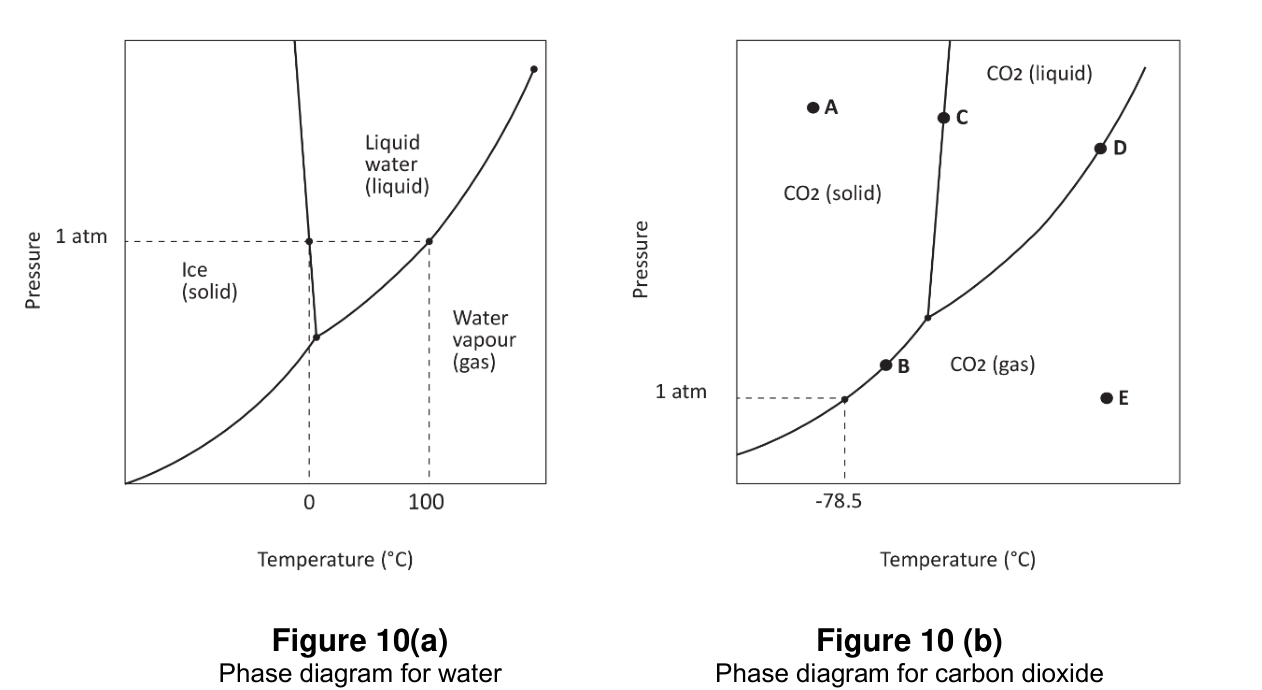
Under normal atmospheric pressure (i.e. 1 atm), water melts at 0°C and boils at 100°C. Unlike water, CO₂ (carbon dioxide) in its solid state does not melt under normal atmospheric pressure. It changes straight to its gaseous state at −78.5°C. The phase diagrams, Figures 10(a) and 10(b), show the states of water and carbon dioxide at various temperatures and pressures.
(a) Name the process in which ice changes directly into water vapour.
(b) What happens to the particles in the CO₂ when it changes from solid to gas?
(c) Which of the following points (A, B, C, D or E) in Figure 10(b) represents the condition that would allow CO₂ to change from solid to liquid state?
(d) Draw a line on the graph in the Answer Booklet to show how the temperature of CO₂ changes over time as it is heated at a constant rate from −90°C to 30°C at 1 atm. Label the states clearly.
(a) Name the process in which ice changes directly into water vapour.
(b) What happens to the particles in the CO₂ when it changes from solid to gas?
(c) Which of the following points (A, B, C, D or E) in Figure 10(b) represents the condition that would allow CO₂ to change from solid to liquid state?
(d) Draw a line on the graph in the Answer Booklet to show how the temperature of CO₂ changes over time as it is heated at a constant rate from −90°C to 30°C at 1 atm. Label the states clearly.