Question 2
Experiment 2
Play with Springiness Oscillations
Introduction:
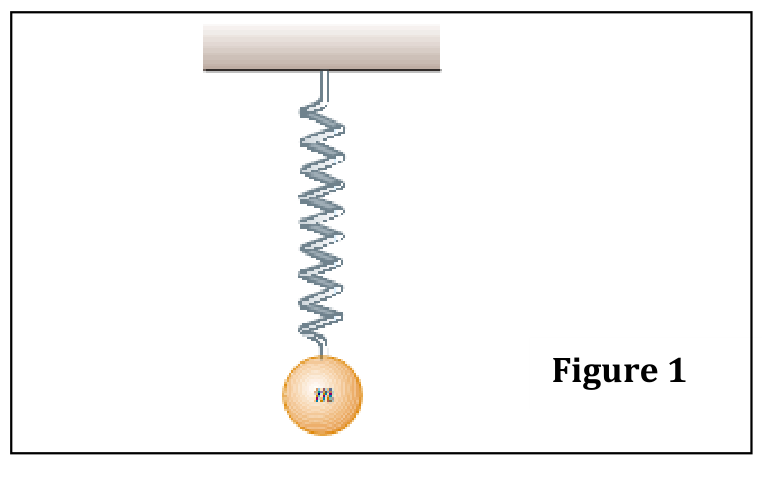
There are so many matters that could be able to do oscillatory motion. Oscillation is base of wave motion. Every wave motion must be had oscillatory motion. However, not every oscillatory motion to be a wave motion. A spring able to do oscillatory motion. The motion could be made in either horizontally or vertically motion. In this experiment you are going to observing the vertically oscillatory motion of spring to avoid friction forces from floor. We neglect all air resistance. A ball is connected to a light spring suspended vertically, as shown in Figure 1. When displaced downward from its equilibrium position and released, the ball oscillates up and down. The frequency of oscillation will be affected by mass of ball and how the degree of spring stiffness. Mathematically, it can be formulated as:
$$f=\frac{1}{2\pi}\sqrt{\frac{k}{m}}\quad\text{or}\quad T^2=4\pi^2\frac{m}{k}\qquad(1)$$
where f is the frequency of oscillation, T is the period of oscillation (T= 1/f ), k is the spring constant and m is a mass of load. The value of k is a measure of the stiffness of the spring. Stiff springs have large k values, and soft springs have small k values. The stiffness of the spring is also associated with number of turns. The physics experiment test is divided into two parts. In this experiment, you will use the springs provided to observe the oscillatory motion to measure some oscillation parameters which are to determine the unknown mass of a material and to determine the spring constant, k.
Materials and Provided Apparatus:
1\. Springs (with N = 30, 40, 50, and 80 turns)
2\. Retort Stand and clamp
3\. Stopwatch
4\. A hunger of load
5\. Masses (3 pieces of plastic mass each 2 g)
6\. A 30 cm ruler
Part 1: To determine mass of matter In this part, you use 4 different springs and only mass of hunger, without the other mass of plastics. Period of spring oscillations are varied by using the number of spring coils.
Set-Up:
Procedure:
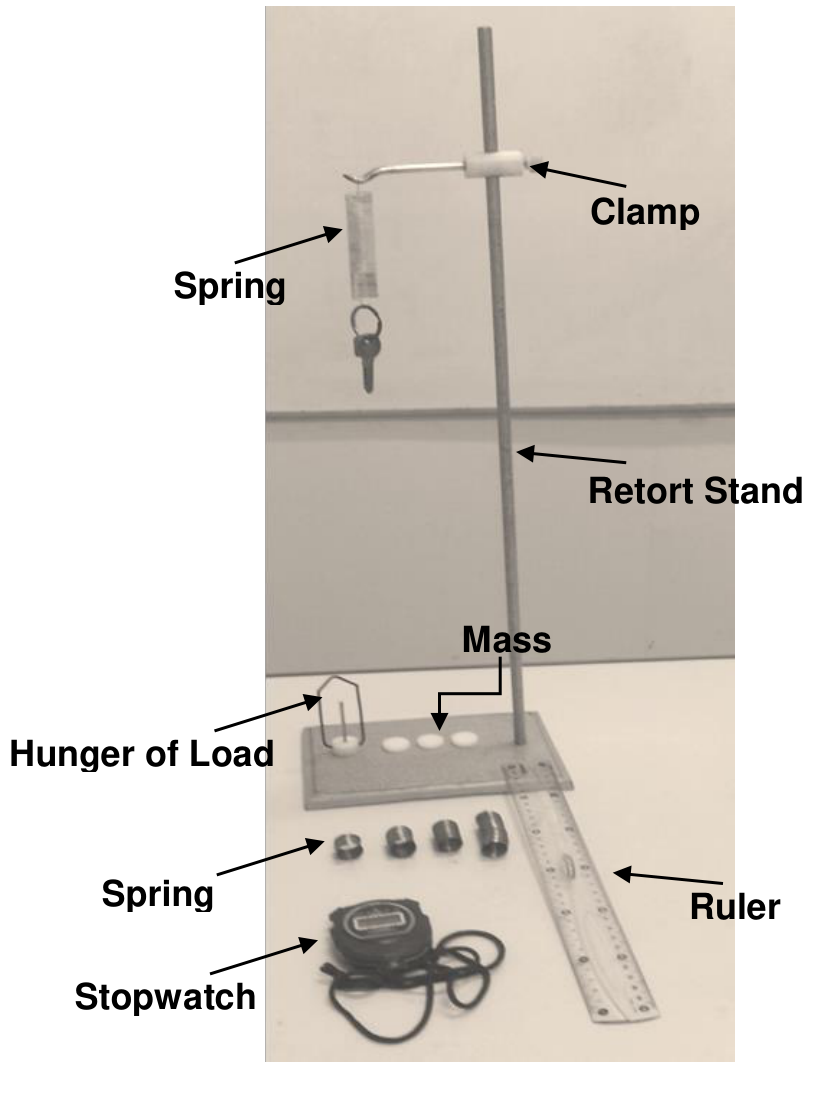
1\. Suspend a spring vertically on the retort stand and clamp as shown in Figure 2.
2\. Hung an unknown mass of hunger, M, at the end of spring.
3\. Initiate the motion of mass by pulling the hunger from equilibrium and releasing it from rest. Observe oscillatory motion that happened.
4\. Measure the duration for 20 oscillations by using stopwatch. Calculate the period of oscillation.
5\. Repeat the step 1 until step 4 for the other spring.
6\. Plot your 4 data in provided millimeter block paper to make a curve of square period of oscillation, $T^2$, versus number of spring coils, N.
7\. Make a straight line.
Questions:
1\. If we get the value N is equal to 100/k, $N=100/k$, from equation (1) and your curve, calculate the mass of unknown hunger! (6 points)
2\. According to your experiment, what is the correlation between the stiffness springs and the number of coils? (2 points)
3\. In the system of the ball, the spring, and the Earth, what forms of energy are there during the motion? (2 points)
Part 2: To determine the spring constant, k The instrument set up is similar to the Part 1.
Procedure:
1\. In this part, use only spring of N = 80 turns.
2\. Use your result of mass of hunger in Experiment 1 to determine the constant of spring of 80 turns.
3\. Do not use Hoke’s Law to determine the constant of spring!
4\. Suspend a spring of 80 turns vertically on the retort stand and clamp as shown in Figure 2.
8\. Hung the calculated mass of hunger, M, at the end of spring.
9\. Initiate the motion of mass by pulling the hunger from equilibrium condition and releasing it from rest. Observe oscillatory motion that happened.
10\. Measure the duration for 20 oscillations by using stopwatch. Calculate the period of oscillation.
11\. Add the mass of load by putting a piece of plastic of 2 g into the hunger. The mass of load now is m.
12\. Repeat the step 9 until step 11 for the other two remain pieces of plastic.
13\. Plot your data in provided millimeter block paper to make a curve of square period of oscillation, $T^2$, versus mass of load, m.
14\. Make a straight line.
Questions:
4\. According to equation (1) and from your linear curve, calculate the spring constant of 80 coils! (6 points)
5\. In the system of the ball, and the spring, what forms of energy are there during the motion? (2 points)
6\. According to your experiment, what is the correlation between the stiffness springs and the mass of load? (2 points)
Play with Springiness Oscillations
Introduction:
There are so many matters that could be able to do oscillatory motion. Oscillation is base of wave motion. Every wave motion must be had oscillatory motion. However, not every oscillatory motion to be a wave motion. A spring able to do oscillatory motion. The motion could be made in either horizontally or vertically motion. In this experiment you are going to observing the vertically oscillatory motion of spring to avoid friction forces from floor. We neglect all air resistance. A ball is connected to a light spring suspended vertically, as shown in Figure 1. When displaced downward from its equilibrium position and released, the ball oscillates up and down. The frequency of oscillation will be affected by mass of ball and how the degree of spring stiffness. Mathematically, it can be formulated as:
$$f=\frac{1}{2\pi}\sqrt{\frac{k}{m}}\quad\text{or}\quad T^2=4\pi^2\frac{m}{k}\qquad(1)$$
where f is the frequency of oscillation, T is the period of oscillation (T= 1/f ), k is the spring constant and m is a mass of load. The value of k is a measure of the stiffness of the spring. Stiff springs have large k values, and soft springs have small k values. The stiffness of the spring is also associated with number of turns. The physics experiment test is divided into two parts. In this experiment, you will use the springs provided to observe the oscillatory motion to measure some oscillation parameters which are to determine the unknown mass of a material and to determine the spring constant, k.
Materials and Provided Apparatus:
1\. Springs (with N = 30, 40, 50, and 80 turns)
2\. Retort Stand and clamp
3\. Stopwatch
4\. A hunger of load
5\. Masses (3 pieces of plastic mass each 2 g)
6\. A 30 cm ruler
Part 1: To determine mass of matter In this part, you use 4 different springs and only mass of hunger, without the other mass of plastics. Period of spring oscillations are varied by using the number of spring coils.
Set-Up:
Procedure:
1\. Suspend a spring vertically on the retort stand and clamp as shown in Figure 2.
2\. Hung an unknown mass of hunger, M, at the end of spring.
3\. Initiate the motion of mass by pulling the hunger from equilibrium and releasing it from rest. Observe oscillatory motion that happened.
4\. Measure the duration for 20 oscillations by using stopwatch. Calculate the period of oscillation.
5\. Repeat the step 1 until step 4 for the other spring.
6\. Plot your 4 data in provided millimeter block paper to make a curve of square period of oscillation, $T^2$, versus number of spring coils, N.
7\. Make a straight line.
Questions:
1\. If we get the value N is equal to 100/k, $N=100/k$, from equation (1) and your curve, calculate the mass of unknown hunger! (6 points)
2\. According to your experiment, what is the correlation between the stiffness springs and the number of coils? (2 points)
3\. In the system of the ball, the spring, and the Earth, what forms of energy are there during the motion? (2 points)
Part 2: To determine the spring constant, k The instrument set up is similar to the Part 1.
Procedure:
1\. In this part, use only spring of N = 80 turns.
2\. Use your result of mass of hunger in Experiment 1 to determine the constant of spring of 80 turns.
3\. Do not use Hoke’s Law to determine the constant of spring!
4\. Suspend a spring of 80 turns vertically on the retort stand and clamp as shown in Figure 2.
8\. Hung the calculated mass of hunger, M, at the end of spring.
9\. Initiate the motion of mass by pulling the hunger from equilibrium condition and releasing it from rest. Observe oscillatory motion that happened.
10\. Measure the duration for 20 oscillations by using stopwatch. Calculate the period of oscillation.
11\. Add the mass of load by putting a piece of plastic of 2 g into the hunger. The mass of load now is m.
12\. Repeat the step 9 until step 11 for the other two remain pieces of plastic.
13\. Plot your data in provided millimeter block paper to make a curve of square period of oscillation, $T^2$, versus mass of load, m.
14\. Make a straight line.
Questions:
4\. According to equation (1) and from your linear curve, calculate the spring constant of 80 coils! (6 points)
5\. In the system of the ball, and the spring, what forms of energy are there during the motion? (2 points)
6\. According to your experiment, what is the correlation between the stiffness springs and the mass of load? (2 points)