Question 1
**The Secret of Color Separation**
**Original introduction.** Colors can be separated by chromatography. Scientists use chromatography to separate molecules of different masses. In coloring materials, molecules with different masses may have different colors.
Plants have various separable pigments that generate the colors of their leaves and flowers. They may have carotene (orange), xanthophyll (yellow), chlorophyll (green) and anthocyanin (red) pigments. The pigments can be separated by chromatography. This method needs suitable paper as a separation medium and a liquid to dissolve the pigments. An everyday example is food coloring.
A quantitative indication of how far a compound travels in a particular solvent is called the retention factor $R_f$:
$$R_f=\frac{D_1}{D_2}.$$
$D_1$ is the distance the color travels, measured from the point where it was placed to the center of its band. $D_2$ is the total distance traveled by the solvent, measured from the same starting line.
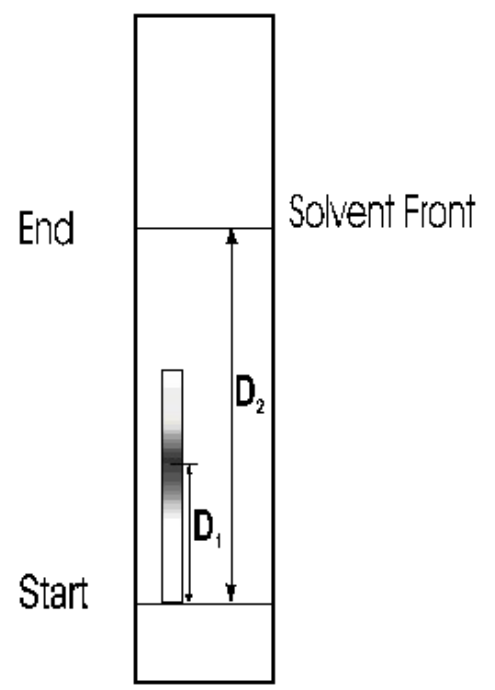
Diagram labels: Start, End, Solvent Front; $D_1$, $D_2$.
You are asked to design experiments to determine the components of marker ink, food coloring and leaves, and calculate their $R_f$ values. The following materials may be needed:
| Material | Quantity |
| --- | --- |
| 70% alcohol | 1 bottle |
| Water | 1 bottle |
| Plastic boxes | 2 |
| Paper clips | 10 pieces |
| Experiment guideline | 1 plastic bag (scrap paper and green marker) |
| Different types of paper | 4 types: rough filter paper; smooth filter paper; scrap paper; copy/HVS paper |
| Spinach leaves | Green and red |
| Food coloring | 3 colors: yellow, green and red |
| Ruler | 1 |
| Watch | 1 |
| Medium plastic bags | 10 |
| Labels | 1 packet |
| Palette (source: “pallet”) | 1 |
| Towel | 1 |
| Water bucket | 1 |
| Toothpicks | 1 packet |
| Coins | 2 |
| Pipettes | 3 |
| Supporting aluminum bars | 2 |
**Experiment 1**
1. Open the experiment guideline.
2. Make a dot with a marker on one piece of scrap paper, 2 cm from the bottom.
3. Prepare a plastic box and fill it with water.
4. Hang the paper with approximately its bottom 1 cm immersed in water. After about 5 minutes, take out the paper, observe it and record your observations.
**Editorial safety note for all experiments:** Work under a teacher’s supervision. Keep 70% alcohol away from flames, sparks and heat; use small supervised quantities with ventilation. Do not taste the materials, avoid eye contact, wash hands, and follow the teacher’s disposal instructions. The leaf species and alcohol type are not specified in the source. Do not substitute an unknown chemical.
**Original introduction.** Colors can be separated by chromatography. Scientists use chromatography to separate molecules of different masses. In coloring materials, molecules with different masses may have different colors.
Plants have various separable pigments that generate the colors of their leaves and flowers. They may have carotene (orange), xanthophyll (yellow), chlorophyll (green) and anthocyanin (red) pigments. The pigments can be separated by chromatography. This method needs suitable paper as a separation medium and a liquid to dissolve the pigments. An everyday example is food coloring.
A quantitative indication of how far a compound travels in a particular solvent is called the retention factor $R_f$:
$$R_f=\frac{D_1}{D_2}.$$
$D_1$ is the distance the color travels, measured from the point where it was placed to the center of its band. $D_2$ is the total distance traveled by the solvent, measured from the same starting line.
Diagram labels: Start, End, Solvent Front; $D_1$, $D_2$.
You are asked to design experiments to determine the components of marker ink, food coloring and leaves, and calculate their $R_f$ values. The following materials may be needed:
| Material | Quantity |
| --- | --- |
| 70% alcohol | 1 bottle |
| Water | 1 bottle |
| Plastic boxes | 2 |
| Paper clips | 10 pieces |
| Experiment guideline | 1 plastic bag (scrap paper and green marker) |
| Different types of paper | 4 types: rough filter paper; smooth filter paper; scrap paper; copy/HVS paper |
| Spinach leaves | Green and red |
| Food coloring | 3 colors: yellow, green and red |
| Ruler | 1 |
| Watch | 1 |
| Medium plastic bags | 10 |
| Labels | 1 packet |
| Palette (source: “pallet”) | 1 |
| Towel | 1 |
| Water bucket | 1 |
| Toothpicks | 1 packet |
| Coins | 2 |
| Pipettes | 3 |
| Supporting aluminum bars | 2 |
**Experiment 1**
1. Open the experiment guideline.
2. Make a dot with a marker on one piece of scrap paper, 2 cm from the bottom.
3. Prepare a plastic box and fill it with water.
4. Hang the paper with approximately its bottom 1 cm immersed in water. After about 5 minutes, take out the paper, observe it and record your observations.
**Editorial safety note for all experiments:** Work under a teacher’s supervision. Keep 70% alcohol away from flames, sparks and heat; use small supervised quantities with ventilation. Do not taste the materials, avoid eye contact, wash hands, and follow the teacher’s disposal instructions. The leaf species and alcohol type are not specified in the source. Do not substitute an unknown chemical.