Question 3
Experiment 3 — Refractive Index of Fluids (30 points)
Basic concept — Snell's law: The quantitative law of refraction, called Snell's law, was first worked out in 1621 by W. Snell, a Dutch astronomer and mathematician. The law can be expressed as
$$n_1\frac{B}{R_1}=n_2\frac{D}{R_2}.$$
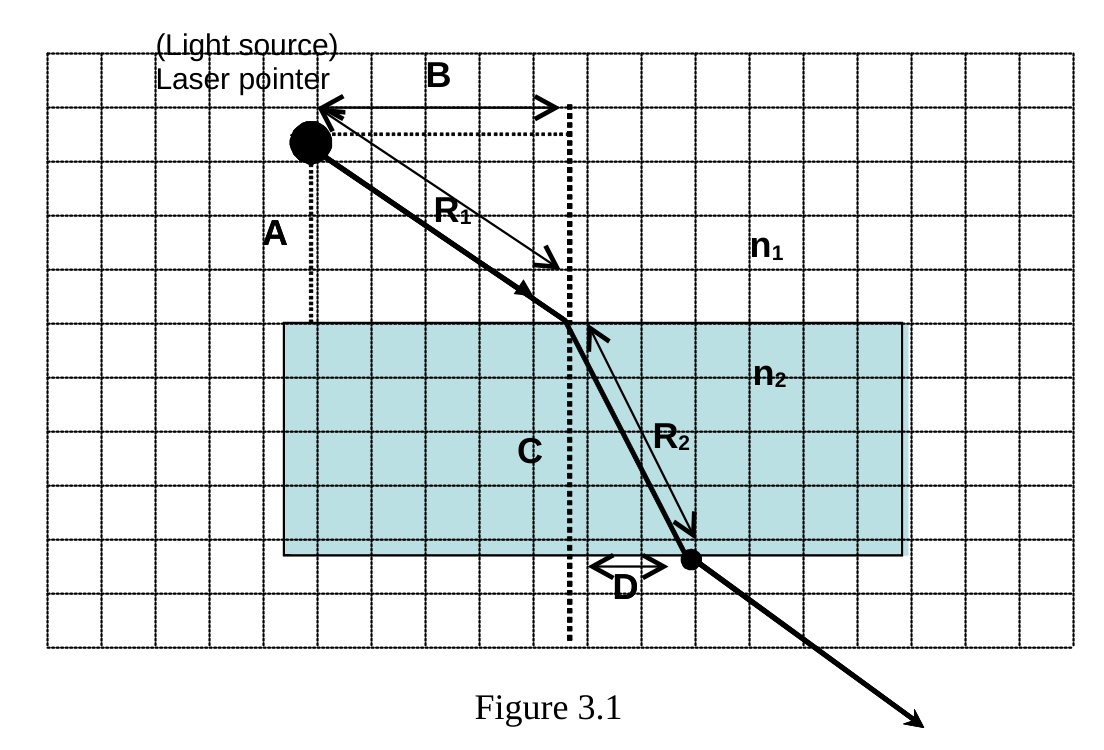
Here $n_1$ and $n_2$ are the indices of refraction of the incident and refracting media, respectively, while $R_1$ and $R_2$ are the paths of the incident and refracted light, respectively. $B$ and $D$ can be seen in Figure 3.1. The source also writes $n=BR_2/(DR_1)$.
Purpose: To determine refractive indices of fluids. The refractive index affects the speed of light in a material.
Materials: Fluids — water, Telon Oil, Yellow Palm Oil.
Devices: Laser pointer; ruler; plastic box; sheets of paper; graph paper.
Procedure:
**1.** Place the plastic box on the graph paper (see Figure 3.1).
**2.** Fill the plastic box with water.
**3.** Fix the position of the pointer and then direct the laser into the fluid in the plastic box. Measure $B$ and $R_1$, then measure $D$ and $R_2$. Write down the measurements in the table below.
**4.** Once finished, empty the plastic box, then clean it using wet tissue.
**5.** Repeat steps 1, 2, 3 for the other fluids.
**6.** Calculate the relative refractive indices using the equation shown in the table.
| No. | Type of fluid | $B$ (mm) | $R_1$ (mm) | $D$ (mm) | $R_2$ (mm) | Relative index $n_2/n_1=BR_2/(DR_1)$ |
| --- | --- | --- | --- | --- | --- | --- |
| 1 | Water | … | … | … | … | … |
| 2 | Telon Oil | … | … | … | … | … |
| 3 | Yellow Palm Oil | … | … | … | … | … |
Answer the following questions:
**1.** The refractive index of air is $n_1$, which equals 1. From your results, is there any refractive index less than the refractive index of air?
**2.** Based on your experiment, which fluid has the highest refractive index?
Basic concept — Snell's law: The quantitative law of refraction, called Snell's law, was first worked out in 1621 by W. Snell, a Dutch astronomer and mathematician. The law can be expressed as
$$n_1\frac{B}{R_1}=n_2\frac{D}{R_2}.$$
Here $n_1$ and $n_2$ are the indices of refraction of the incident and refracting media, respectively, while $R_1$ and $R_2$ are the paths of the incident and refracted light, respectively. $B$ and $D$ can be seen in Figure 3.1. The source also writes $n=BR_2/(DR_1)$.
Purpose: To determine refractive indices of fluids. The refractive index affects the speed of light in a material.
Materials: Fluids — water, Telon Oil, Yellow Palm Oil.
Devices: Laser pointer; ruler; plastic box; sheets of paper; graph paper.
Procedure:
**1.** Place the plastic box on the graph paper (see Figure 3.1).
**2.** Fill the plastic box with water.
**3.** Fix the position of the pointer and then direct the laser into the fluid in the plastic box. Measure $B$ and $R_1$, then measure $D$ and $R_2$. Write down the measurements in the table below.
**4.** Once finished, empty the plastic box, then clean it using wet tissue.
**5.** Repeat steps 1, 2, 3 for the other fluids.
**6.** Calculate the relative refractive indices using the equation shown in the table.
| No. | Type of fluid | $B$ (mm) | $R_1$ (mm) | $D$ (mm) | $R_2$ (mm) | Relative index $n_2/n_1=BR_2/(DR_1)$ |
| --- | --- | --- | --- | --- | --- | --- |
| 1 | Water | … | … | … | … | … |
| 2 | Telon Oil | … | … | … | … | … |
| 3 | Yellow Palm Oil | … | … | … | … | … |
Answer the following questions:
**1.** The refractive index of air is $n_1$, which equals 1. From your results, is there any refractive index less than the refractive index of air?
**2.** Based on your experiment, which fluid has the highest refractive index?