Question 3
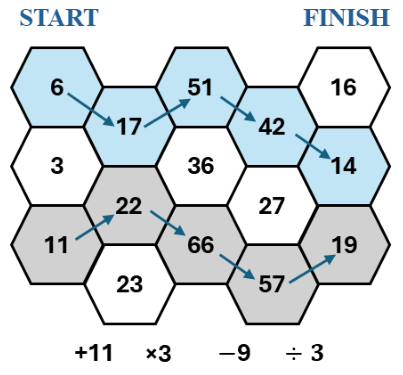
In every honeycomb grid begin in the leftmost START column and end in the rightmost FINISH column.
A. A path is correct when each operation gives the adjacent number in the next column. In the example there are two correct paths: $6\to17\to51\to42\to14$ (blue) and $11\to22\to66\to57\to19$ (gray).
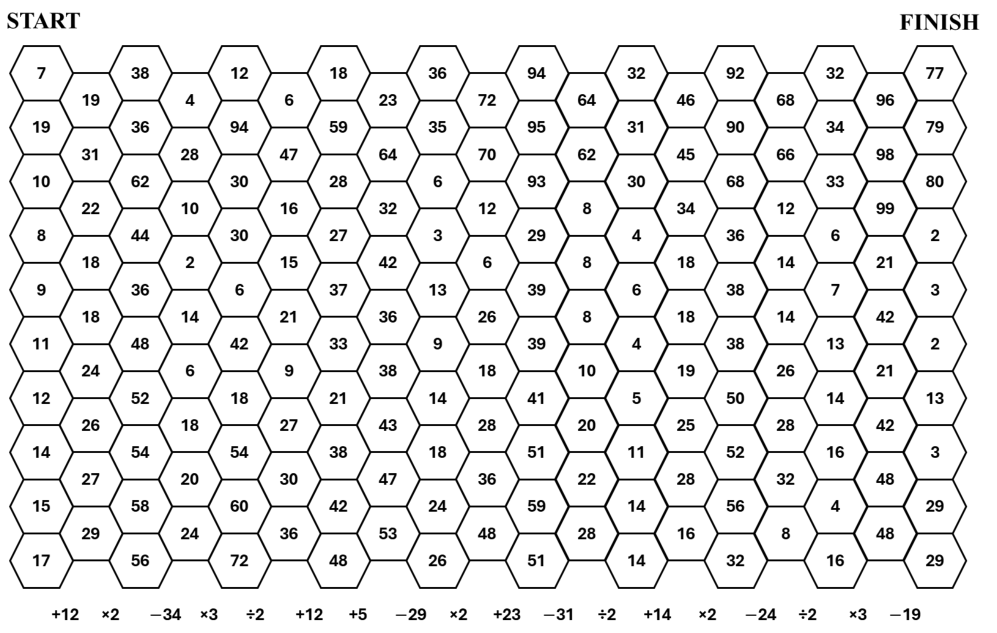
Find and shade all correct paths in the following grid using a colored pencil.
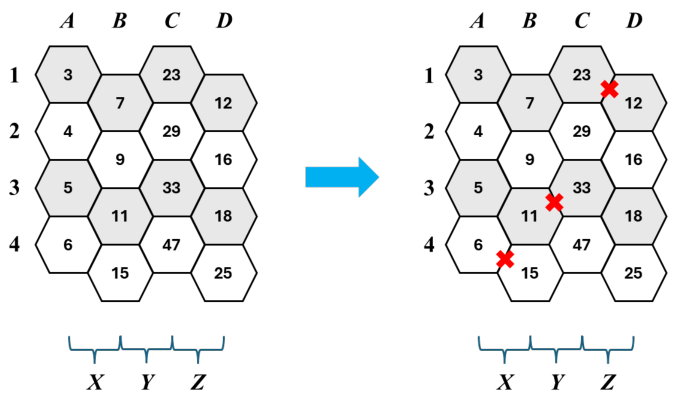
B. A variant uses variables for operations. In the $4\times4$ example, rows are 1–4, columns A–D, and operations X,Y,Z. X maps column A to B; Y maps B to C; Z maps C to D. Each operation has exactly three correct calculations and one incorrect calculation. Put × on the incorrect segments. Writing a,b,c,d for the four numbers in a row, possible rules are: $b=2a+1$, correct in rows 1,2,3 and wrong in row 4; $c=3b+2$, correct in rows 1,2,4 and wrong in row 3; $d=(c+3)\div2$, correct in rows 2,3,4 and wrong in row 1.
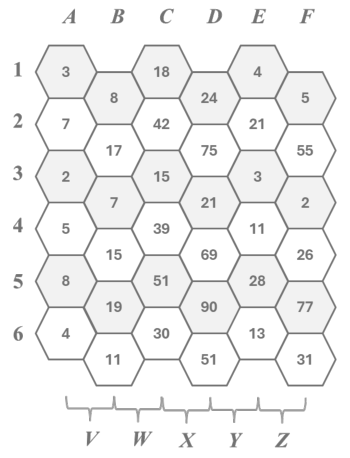
Now, in this $6\times6$ grid, each operation has exactly four correct calculations and two incorrect calculations. Put × on every incorrect segment.
A. A path is correct when each operation gives the adjacent number in the next column. In the example there are two correct paths: $6\to17\to51\to42\to14$ (blue) and $11\to22\to66\to57\to19$ (gray).
Find and shade all correct paths in the following grid using a colored pencil.
B. A variant uses variables for operations. In the $4\times4$ example, rows are 1–4, columns A–D, and operations X,Y,Z. X maps column A to B; Y maps B to C; Z maps C to D. Each operation has exactly three correct calculations and one incorrect calculation. Put × on the incorrect segments. Writing a,b,c,d for the four numbers in a row, possible rules are: $b=2a+1$, correct in rows 1,2,3 and wrong in row 4; $c=3b+2$, correct in rows 1,2,4 and wrong in row 3; $d=(c+3)\div2$, correct in rows 2,3,4 and wrong in row 1.
Now, in this $6\times6$ grid, each operation has exactly four correct calculations and two incorrect calculations. Put × on every incorrect segment.