Question 11
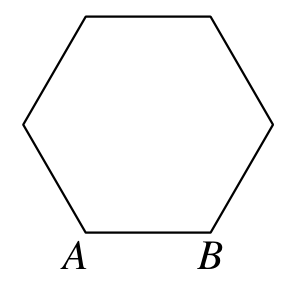
In the diagram below, Andy used a metal rod to form a regular hexagon whose side $AB$ is $16$ cm long. He then divides the hexagon into two equal parts, using one part to construct a square and the other to construct an isosceles triangle with a base of $18$ cm. What is the sum of the areas, in square centimetres, of the newly created square and triangle?