Question 9
In a video game, you start the game with 10 gold coins, 10 wooden coins, 10 stone coins, 0 silver coins and 0 diamond coins.
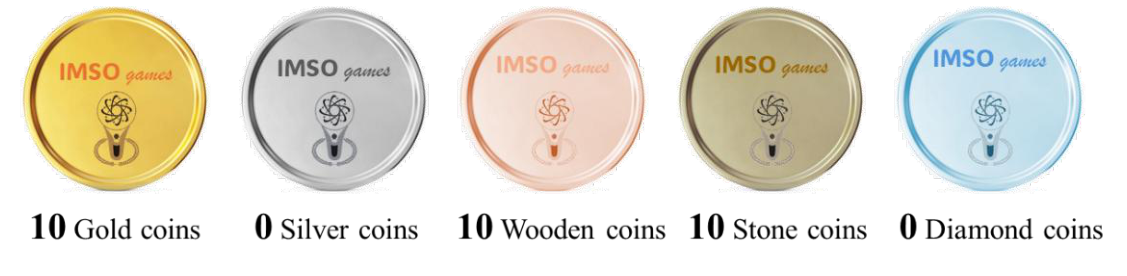
There are four trading options that are available:
a.) Trading gold coin(s) to a silver coin:
The cost increases by 1 gold coin each time you do a trade.
- First trade: exchange 1 gold coin → receive 1 silver coin.
- Second trade: exchange 2 gold coins → receive 1 silver coin.
- Third trade: exchange 3 gold coins → receive 1 silver coin, and so on.
b.) Trading wooden coin(s) to silver coins:
The cost increases by 1 wooden coin each time you do a trade.
- First trade: exchange 3 wooden coins → receive 2 silver coins.
- Second trade: exchange 4 wooden coins → receive 2 silver coins.
- Third trade: exchange 5 wooden coins → receive 2 silver coins, and so on.
c.) Trading stone coins(s) to a diamond coin:
The cost increases by 1 stone each time you do a trade.
- First trade: exchange 2 stone coins → receive 1 diamond coin.
- Second trade: exchange 3 stone coins → receive 1 diamond coin.
- Third trade: exchange 4 stone coins → receive 1 diamond coin, and so on.
d.) Trading a silver coin to a diamond coin:
Fixed rate: exchange 1 silver coin → receive 1 diamond coin.
Some additional trading conditions:
- You may perform trades in any order and any number of times, provided you have enough coins at the moment of the trade.
- If you do not have enough coins to perform the required condition for a trade, then you cannot perform that trade. (You cannot partially perform a trade).
- The counters for each of the different trade types are independent with each other.
What is the maximum number of diamond coins you can obtain? Give a full and detailed explanation and describe the general strategy that achieves the maximum.
Please write down your full solution at the reverse side of this sheet.