Question 10
Blue dyes were known to be expensive, necessitating extraction of pigments from rare minerals or organisms, so that painters reserved the blue color only for important subjects until the Renaissance. This was the case until 1703, when a Swiss chemist Johann Diesbach discovered how to make the dye Prussian blue, ushering a paintings with lively blue colors such as the Great Wave Off Kanagawa by Hokusai and Starry Night by van Gogh:
Image Credits : Hokusai — Metropolitan Museum of Art, online database : entry 45434, Puiblic domain, https://commons.wikimedia.org/w/index.php?curid=2798407 By Vincent van Gogh - bgEuwDxel93-Pg at Google Arts & Culture, Public Domain, https://commons.wikimedia.org/w/index.php?curid=25498286
An insoluble form of Prussian blue is synthesized from the reaction of a ferric salt and ferrocyanide complex:
2 Fe₂(SO₄)₃ (aq) + 3 K₄Fe(CN)₆ (aq) ⟶ Fe₄[Fe(CN)₆]₃ (s) + 6 K₂SO₄ (aq)
In this synthesis reaction, which species is the Lewis acid?
Hint: In this reaction, the potassium cation and sulfate anions may be considered as spectator ions so that the overall reaction is: 4 Fe³⁺ (aq) + 3 [Fe(CN)₆]⁴⁻ (aq) → Fe₄[Fe(CN)₆]₃ (s)
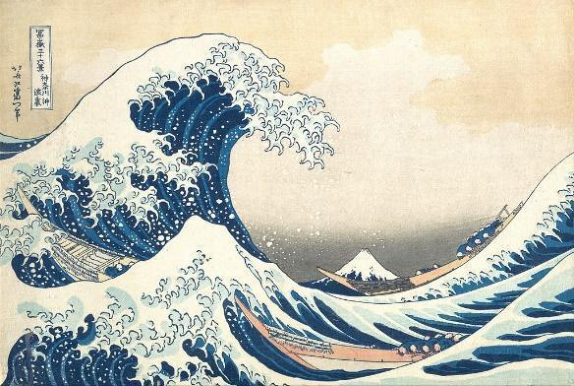
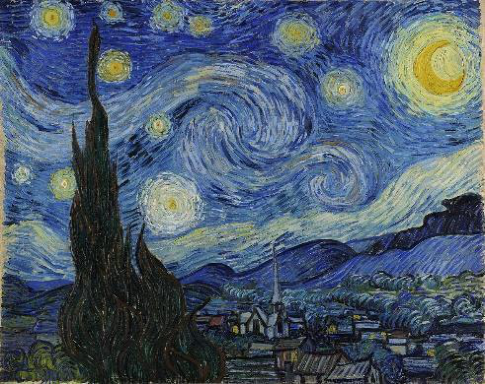
Image Credits : Hokusai — Metropolitan Museum of Art, online database : entry 45434, Puiblic domain, https://commons.wikimedia.org/w/index.php?curid=2798407 By Vincent van Gogh - bgEuwDxel93-Pg at Google Arts & Culture, Public Domain, https://commons.wikimedia.org/w/index.php?curid=25498286
An insoluble form of Prussian blue is synthesized from the reaction of a ferric salt and ferrocyanide complex:
2 Fe₂(SO₄)₃ (aq) + 3 K₄Fe(CN)₆ (aq) ⟶ Fe₄[Fe(CN)₆]₃ (s) + 6 K₂SO₄ (aq)
In this synthesis reaction, which species is the Lewis acid?
Hint: In this reaction, the potassium cation and sulfate anions may be considered as spectator ions so that the overall reaction is: 4 Fe³⁺ (aq) + 3 [Fe(CN)₆]⁴⁻ (aq) → Fe₄[Fe(CN)₆]₃ (s)