Question 11
A beaver wants to put four toys into the four boxes shown.
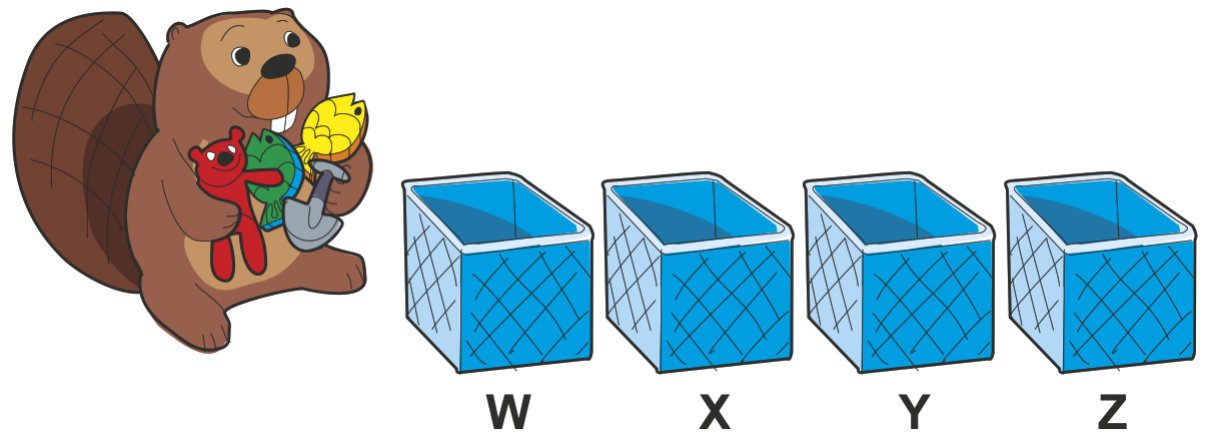
In each of the following groups, at least one of its three conditions must be true:
1. X contains a toy; Y contains no toy; Z contains no toy.
2. W contains a toy; X contains a toy; Z contains no toy.
3. X contains no toy; Y contains no toy; Z contains a toy.
4. W contains no toy; X contains no toy; Y contains no toy.
5. X contains no toy; Y contains a toy; Z contains no toy.
What is the greatest number of toys the beaver can store while satisfying these conditions?
Editorial convention (not stated explicitly in the source): each box holds at most one toy.