Question 113
Two bridges $TS$ and $VM$ cross a river. The banks $TV$ and $SM$ are concentric circular arcs, and each bridge lies on a line through the center, as shown. A person wants to travel from $T$ to $V$, choosing the shorter of two routes:
(1) Follow the river along the circular arc $TV$.
(2) Cross bridge $TS$, follow the other bank along $SM$, and cross bridge $MV$.
Let $\alpha$ be the angle subtended by the two arcs, $R=OT$, and $r=OS$. Which data must the person know to make the best choice?
(A) $R,r,\alpha$
(B) $\alpha$ and $R-r$
(C) Only $\alpha$
(D) Only $R-r$
(E) The first route is always shorter.
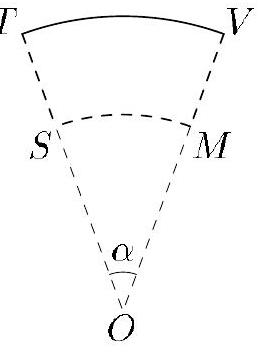
(1) Follow the river along the circular arc $TV$.
(2) Cross bridge $TS$, follow the other bank along $SM$, and cross bridge $MV$.
Let $\alpha$ be the angle subtended by the two arcs, $R=OT$, and $r=OS$. Which data must the person know to make the best choice?
(A) $R,r,\alpha$
(B) $\alpha$ and $R-r$
(C) Only $\alpha$
(D) Only $R-r$
(E) The first route is always shorter.