Question 5
Consider the arrangements of $n$ identical circles, without overlapping, such that there are at least two rows of circles. Each circle should touch the next one in the same row and each circle except those on the bottom row should touch two circles on the row below it. For example, there are 7 possible arrangements for $n=6$ as shown in the diagram below.
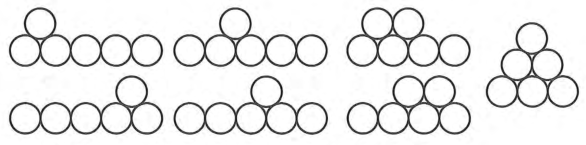
Draw all the possible arrangements for $n=8$.
Draw all the possible arrangements for $n=8$.