Question 22
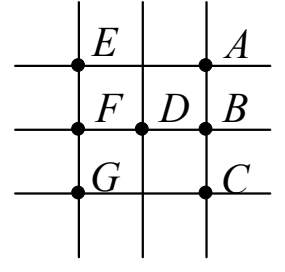
The diagram below shows 7 points $A, B, C, D, E, F$ and $G$.
| E | | A |
| --- | --- | --- |
| F | D | B |
| G | | C |
A flea starts from A, in each move the flea jumps from a given point to another given point and must always follow any one of the two types of jumps.
(1) Jumps two steps to the west (for instance from A to E), jumps two steps to the south (for instance from A to C), or jumps one step to the southwest (for instance from A to D).
(2) Jumps one step to the east (for instance from F to D) or jumps one step to the north (for instance from F to E).
The flea must make these two types of moves alternately ((1), (2), (1), (2) and so on, or (2), (1), (2), (1) and so on). It may not land on the same point twice, and it will stop when it gets to G. How many possible routes can it follow?
| E | | A |
| --- | --- | --- |
| F | D | B |
| G | | C |
A flea starts from A, in each move the flea jumps from a given point to another given point and must always follow any one of the two types of jumps.
(1) Jumps two steps to the west (for instance from A to E), jumps two steps to the south (for instance from A to C), or jumps one step to the southwest (for instance from A to D).
(2) Jumps one step to the east (for instance from F to D) or jumps one step to the north (for instance from F to E).
The flea must make these two types of moves alternately ((1), (2), (1), (2) and so on, or (2), (1), (2), (1) and so on). It may not land on the same point twice, and it will stop when it gets to G. How many possible routes can it follow?