Question 13
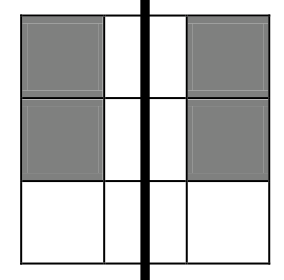
As shown in the diagram below, four unit squares of the $3\times3$ grid are painted gray and the thick line represents one line of symmetry of the $3\times3$ grid.
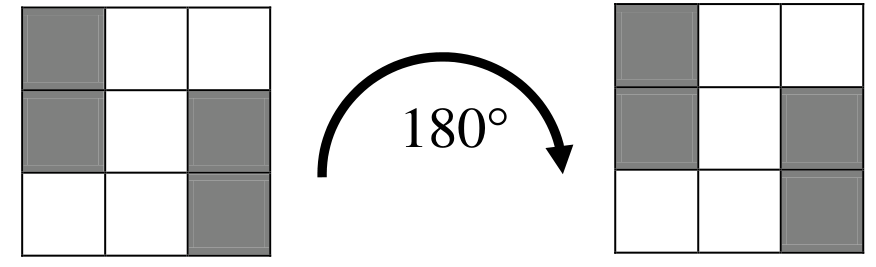
As shown in the diagram below, four unit squares of the $3\times3$ grid are painted gray so that the diagram looks exactly the same when rotated by $180^\circ$. We say that the pattern has $180^\circ$ rotational symmetry.
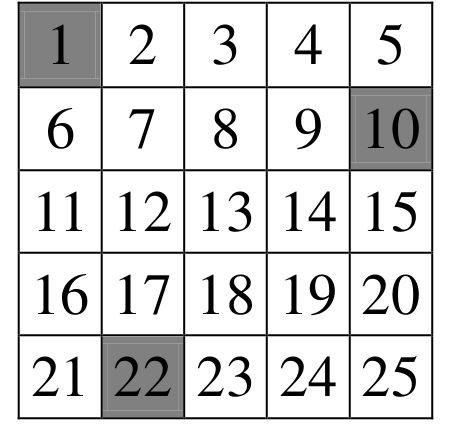
Now, three unit squares of the following $5\times5$ grid are painted gray. Ann needs to paint additional unit squares gray so that the resulting shape has at least one line of symmetry and looks exactly the same when rotated by $180^\circ$. If Ann paints the least possible number of squares, what is the sum of the numbers written inside the additional unit squares she paints, excluding the initial three? (Note: the orientation of the numbers written inside the squares is ignored when assessing the symmetry of the shaded pattern.)
As shown in the diagram below, four unit squares of the $3\times3$ grid are painted gray so that the diagram looks exactly the same when rotated by $180^\circ$. We say that the pattern has $180^\circ$ rotational symmetry.
Now, three unit squares of the following $5\times5$ grid are painted gray. Ann needs to paint additional unit squares gray so that the resulting shape has at least one line of symmetry and looks exactly the same when rotated by $180^\circ$. If Ann paints the least possible number of squares, what is the sum of the numbers written inside the additional unit squares she paints, excluding the initial three? (Note: the orientation of the numbers written inside the squares is ignored when assessing the symmetry of the shaded pattern.)