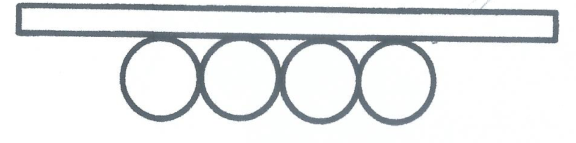
A wooden plank rests on four identical rollers on horizontal ground. The circumference of each roller is 1 m. Find the distance moved by the plank after the rollers have each made one complete revolution, assuming there is no slipping. Enter the distance in metres.
Both Jane and Mary had a sum of money each. They wanted to buy a Mathematics book. They were each short of 52 dollars and 2 dollars respectively and after pooling their money together they still could not afford the book. Given that the price of the book is a whole number, how much did the book cost? Enter the price in dollars.
Editorial convention: each girl initially has a positive amount of money, as intended by the supplied key.
Every morning Kevin has to reach school by 8 am. If he travels at 70 metres per minute, he would arrive 10 minutes earlier. If he travels at 60 metres per minute, he would arrive 8 minutes earlier. Given that he leaves home for school after 7 am, find the exact time he leaves for school.
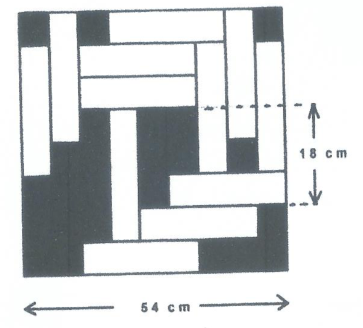
The diagram shows 12 identical rectangles within a larger rectangle with one side 54 cm long. Find the total area of the shaded regions in square centimetres.
The prices of 3 types of snacks, a chocolate bar, a potato pie and a piece of cake were 1.50 dollars, 2.10 dollars and 3.30 dollars respectively. Ben had 14 dollars to spend on these snacks and he bought the snacks in such a way that he maximized his spending. What was the amount he had left? Enter the amount in dollars.
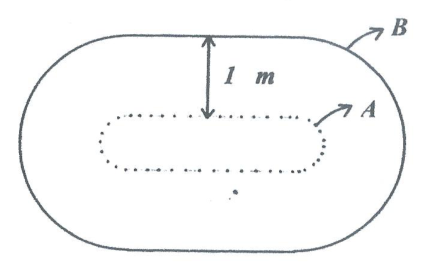
Two running tracks A (inner dotted track) and B (outer solid track) are each formed from straight parallel sides and semicircular ends. The tracks are 1 m apart. Track B is longer than track A by how many metres? Take $\pi=22/7$.
It takes 15 hours to fill up a tank when both taps A and B are turned on together. If tap A is turned on for 8 hours, then turned off, tap B will take another 50 hours to fill up the tank. How long will it take for the tank to be filled by tap B alone? Enter the time in hours.
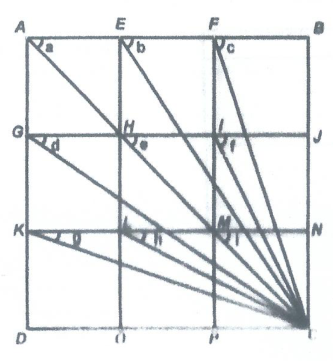
The diagram shows a square $ABCD$ formed by 9 identical squares. Vertices $A,E,F,G,H,I,K,L,M$ are each joined to vertex $C$. What is the sum of the angles $a,b,c,d,e,f,g,h,i$, in degrees?
There is a row of coins, numbered from 1 to 2006, each with head facing up. In the first round, coins whose numbers are divisible by 1 are turned over. In the second round, coins whose numbers are divisible by 2 are turned over. In the third round, coins whose numbers are divisible by 3 are turned over, and so on. In the 2006th round, coins whose numbers are divisible by 2006 are turned over. How many coins will have heads facing up after the 2006th round?
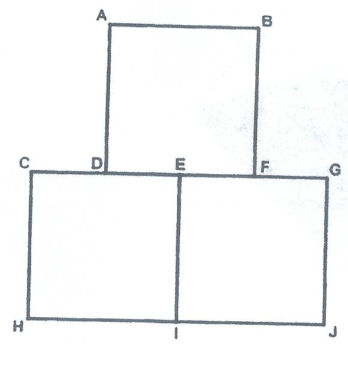
The diagram shows a figure consisting of three identical squares of side 1 m. 10 points $A,B,C,D,E,F,G,H,I,J$ are the vertices of the squares. How many triangles of area 1 m² can be formed using any 3 of the 10 points as vertices, given that the triangles must have one of their sides either horizontal or vertical?
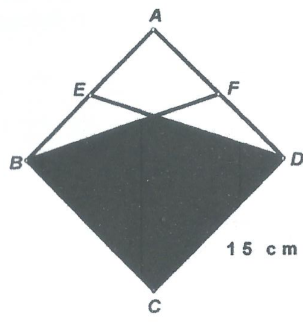
$ABCD$ is a square of side 15 cm. $E$ and $F$ are the midpoints of $AB$ and $AD$ respectively. Find the area of the shaded region in square centimetres.
There are 3 boxes. One box contains a white ball, one a black ball and one a doll. A sentence is written on the cover lid of each box. The sentence on the box containing the white ball is always true. The sentence on the box containing the black ball is always false. The sentence on the box containing the doll can be true or false.
Box 1: The sentence written on Box 2 is true.
Box 2: Box 1 contains a black ball.
Box 3: The doll is in Box 1.
Which box contains the doll? Enter the box number.
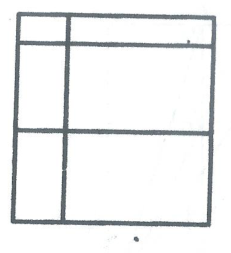
The diagram shows a square formed by 6 rectangles. Given that the total perimeter of the 6 rectangles is 220 cm, find the area of the square in square centimetres.