*Buffalo Shuffle-o* is a card game in which all the cards are distributed evenly among all players at the start of the game. When Annika and $3$ of her friends play *Buffalo Shuffle-o*, each player is dealt $15$ cards. Suppose $2$ more friends join the next game. How many cards will be dealt to each player?
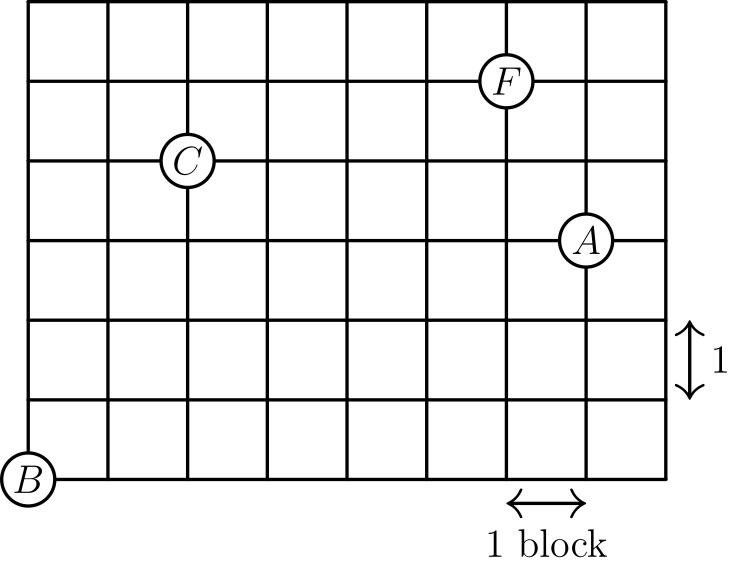
Betty drives a truck to deliver packages in a neighborhood whose street map is shown below. Betty starts at the factory (labeled $F$) and drives to location $A,$ then $B,$ then $C,$ before returning to $F.$ What is the shortest distance, in blocks, she can drive to complete the route?
Sekou writes the numbers $15,$ $16,$ $17,$ $18,$ $19.$ After he erases one of the numbers, the sum of the remaining four numbers is a multiple of $4.$ Which number did he erase?
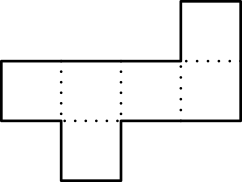
Isaiah cuts open a cardboard cube along some of its edges to form the flat shape shown, which has an area of $18$ square centimeters. What was the volume of the cube in cubic centimeters?
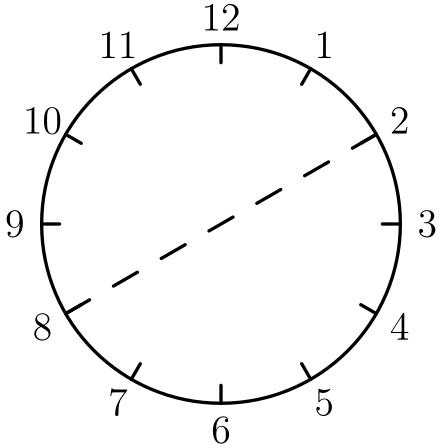
Ningli looks at the $6$ pairs of numbers directly across from each other on a clock. She takes the average of each pair of numbers. What is the average of the resulting $6$ numbers?
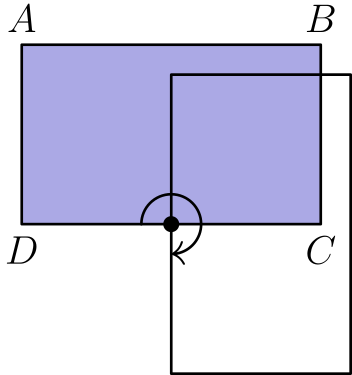
In the figure below, $ABCD$ is a rectangle with sides of length $AB = 5$ inches and $AD = 3$ inches. Rectangle $ABCD$ is rotated $90^\circ$ clockwise around the midpoint of side $DC$ to give a second rectangle. What is the total area, in square inches, covered by the two overlapping rectangles?
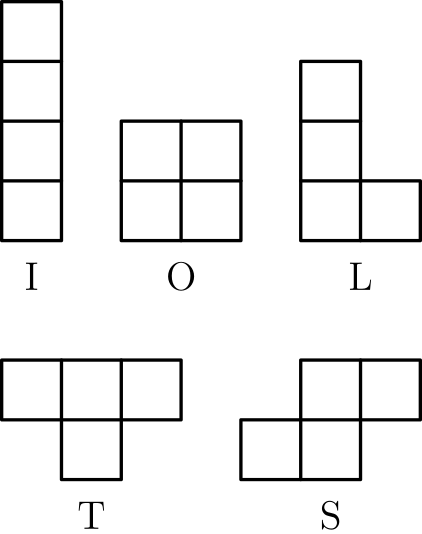
A *tetromino* consists of four squares connected along their edges. There are five possible tetromino shapes, $\mathrm{I}$, $\mathrm{O}$, $\mathrm{L}$, $\mathrm{T}$, and $\mathrm{S}$, shown below, which can be rotated or flipped over. Three tetrominoes are used to completely cover a $3 \times 4$ rectangle. At least one of the tiles is an $\mathrm{S}$ tile. What are the other two tiles?
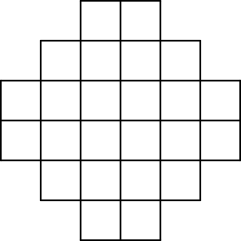
The region shown below consists of $24$ squares, each with side length $1$ centimeter. What is the area, in square centimeters, of the largest circle that can fit inside the region, possibly touching the boundaries?
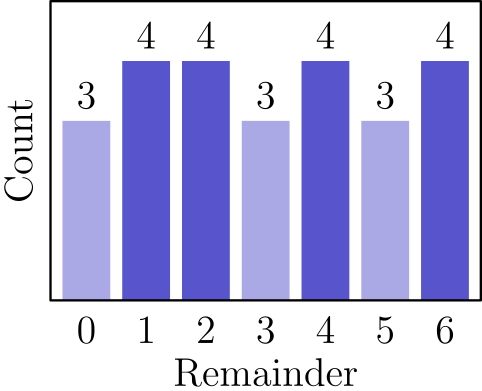
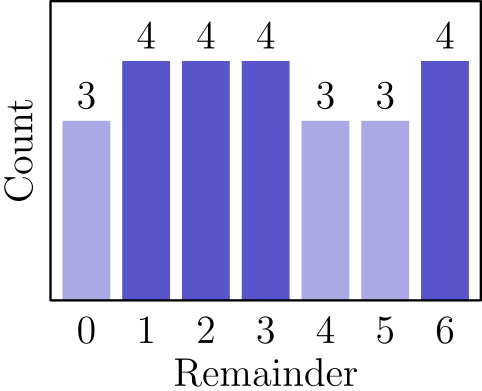
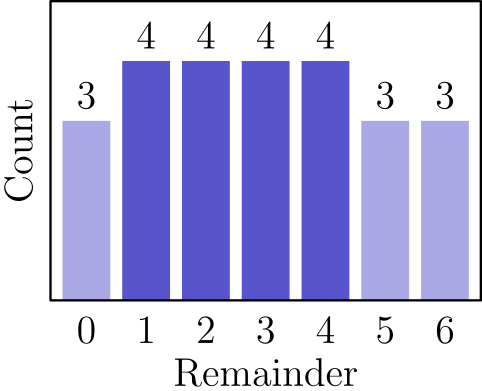
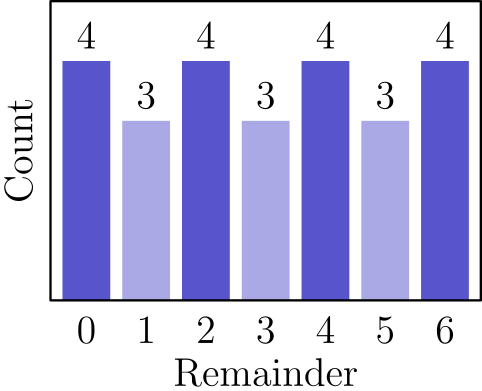
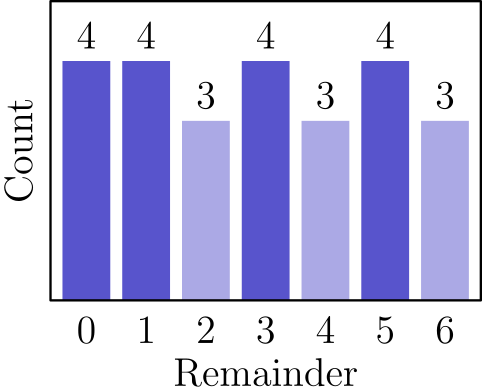
Each of the even numbers $2,$ $4,$ $6,$ $\dots,$ $50$ is divided by $7.$ The remainders are recorded. Which histogram displays the number of times each remainder occurs?
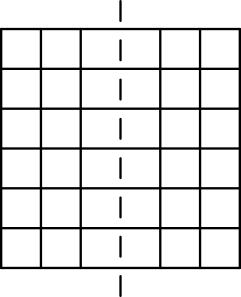
Kei draws a $6$-by-$6$ grid. He colors $13$ of the unit squares silver and the remaining squares gold. Kei then folds the grid in half vertically, forming pairs of overlapping unit squares. Let $m$ and $M$ equal the least and greatest possible number of gold-on-gold pairs, respectively. What is the value of $m+M?$
Five distinct integers from $1$ to $10$ are chosen, and five distinct integers from $11$ to $20$ are chosen. No two numbers differ by exactly $10.$ What is the sum of the ten chosen numbers?
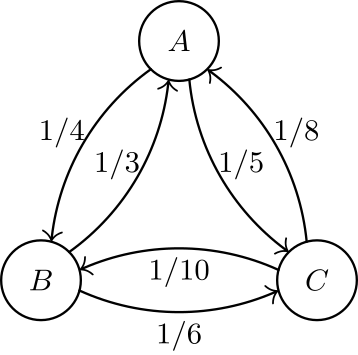
In the land of Markovia, there are three cities: $A,$ $B,$ and $C.$ There are $100$ people who live in $A,$ $120$ who live in $B,$ and $160$ who live in $C.$ Everyone works in one of the three cities, and a person may work in the same city where they live. In the figure below, an arrow pointing from one city to another is labeled with the fraction of people living in the first city who work in the second city. (For example, $\frac{1}{4}$ of the people who live in $A$ work in $B.$) How many people work in $A?$
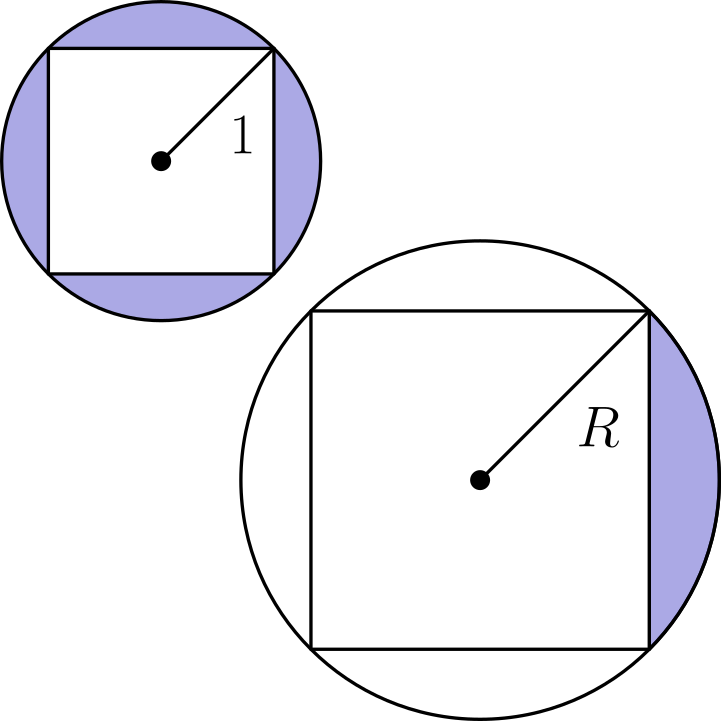
The circle shown below on the left has a radius of $1$ unit. The region between the circle and the inscribed square is shaded. In the circle shown on the right, one quarter of the region between the circle and the inscribed square is shaded. The shaded regions in the two circles have the same area. What is the radius $R,$ in units, of the circle on the right?
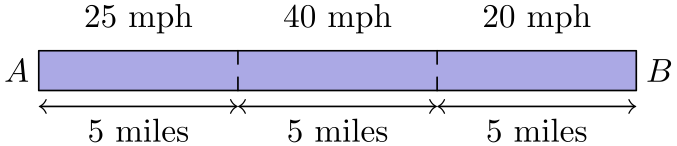
Two towns, $A$ and $B,$ are connected by a straight road, $15$ miles long. Traveling from town $A$ to town $B,$ the speed limit changes every $5$ miles: from $25$ to $40$ to $20$ miles per hour (mph). Two cars, one at town $A$ and one at town $B,$ start moving toward each other at the same time. They drive at exactly the speed limit in each portion of the road. How far from town $A,$ in miles, will the two cars meet?
Sarika, Dev, and Rajiv are sharing a large block of cheese. They take turns cutting off half of what remains and eating it: first Sarika eats half of the cheese, then Dev eats half of the remaining half, then Rajiv eats half of what remains, then back to Sarika, and so on. They stop when the cheese is too small to see. About what fraction of the original block of cheese does Sarika eat in total?