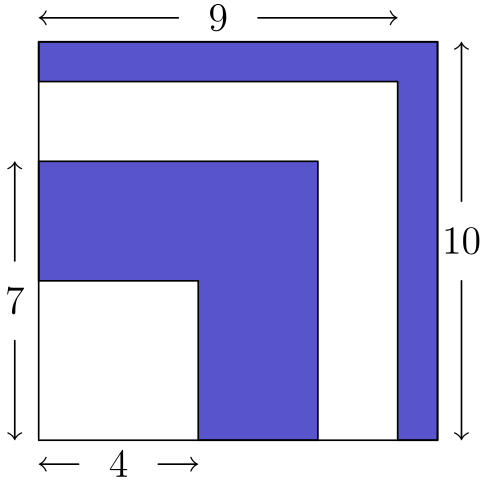
Four squares of side length $4,$ $7,$ $9,$ and $10$ units are arranged in increasing size order so that their left edges and bottom edges align. The squares alternate shaded and unshaded, as shown in the figure. What is the area of the visible shaded region in square units?
When Yunji added all the integers from $1$ to $9,$ she mistakenly left out a number. Her incorrect sum turned out to be a square number. Which number did Yunji leave out?
Aaliyah rolls two standard $6$-sided dice. She notices that the product of the two numbers rolled is a multiple of $6.$ Which of the following integers *cannot* be the sum of the two numbers?
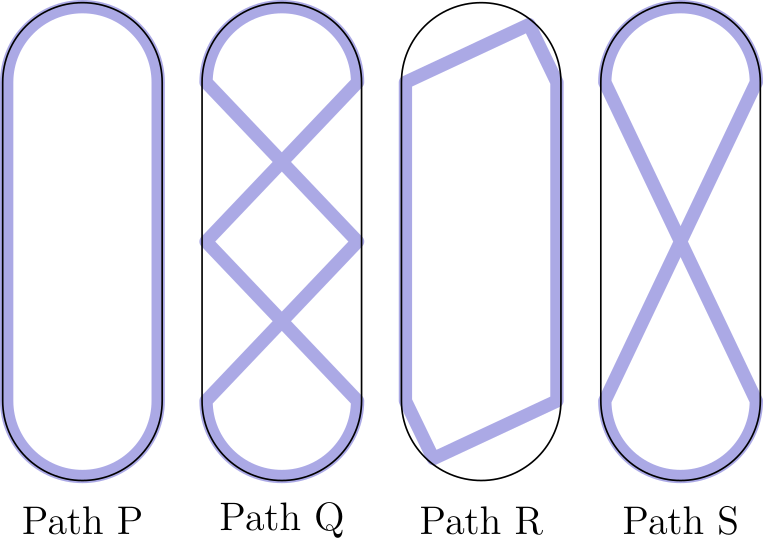
Sergei skated around an ice rink, gliding along different paths. The marked lines in the figures below show four of the paths labeled P, Q, R, and S. What is the sorted order of the four paths from shortest to longest?
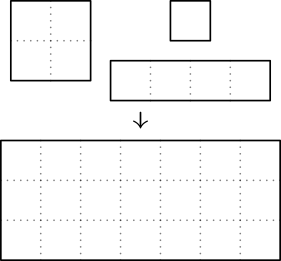
A $3 \times 7$ rectangle is covered without overlap by $3$ shapes of tiles: $2 \times 2,$ $1 \times 4,$ and $1 \times 1,$ shown below. What is the minimum possible number of $1 \times 1$ tiles used?
On Monday Taye has $\$2.$ Every day, he either gains $\$3$ or doubles the amount of money he had on the previous day. How many different dollar amounts could Taye have on Thursday, $3$ days later?
All of the marbles in Maria’s collection are red, green, or blue. Maria has half as many red marbles as green marbles and twice as many blue marbles as green marbles. Which of the following could be the total number of marbles in Maria’s collection?
In January $1980$ the Mauna Loa Observatory recorded carbon dioxide CO$_{2}$ levels of $338$ ppm (parts per million). Over the years the average CO$_{2}$ reading has increased by about $1.515$ ppm each year. What is the expected CO$_{2}$ level in ppm in January $2030?$ Round your answer to the nearest integer.
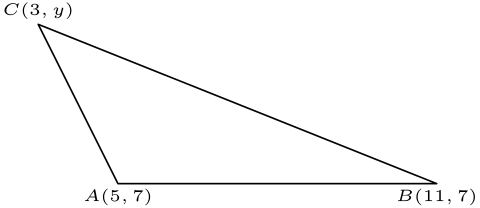
The coordinates of $\bigtriangleup ABC$ are $A(5, 7),$ $B(11, 7),$ and $C(3, y),$ with $y > 7.$ The area of $\bigtriangleup ABC$ is $12.$ What is the value of $y?$
Buzz Bunny is hopping up and down a set of stairs, one step at a time. In how many ways can Buzz start on the ground, make a sequence of $6$ hops, and end up back on the ground? (For example, one sequence of hops is up-up-down-down-up-down.)
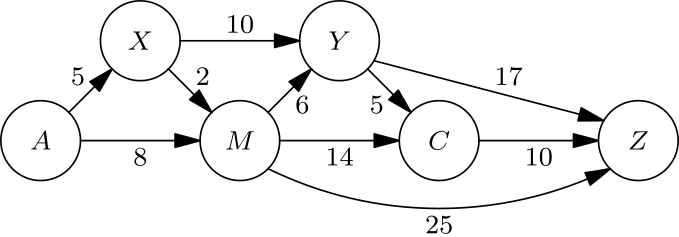
The one-way routes connecting towns $A,$ $M,$ $C,$ $X,$ $Y,$ and $Z$ are shown in the figure below (not drawn to scale). The distances in kilometers along each route are marked. Traveling along these routes, what is the shortest distance from $A$ to $Z$ in kilometers?
Let the letters $F,$ $L,$ $Y,$ $B,$ $U,$ $G$ represent distinct digits. Suppose $\text{FLYFLY}$ is the greatest number that satisfies the equation $$
8 \cdot \text{FLYFLY} = \text{BUGBUG}.
$$ What is the value of $\text{FLY} + \text{BUG}?$
Minh enters the numbers $1$ through $81$ into the cells of a $9 \times 9$ grid in some order. She calculates the product of the numbers in each row and column. What is the least number of rows and columns that could have a product divisible by $3?$
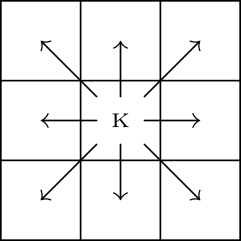
A chess king is said to *attack* all the squares one step away from it, horizontally, vertically, or diagonally. For instance, a king on the center square of a $3 \times 3$ grid attacks all $8$ other squares, as shown below. Suppose a white king and a black king are placed on different squares of a $3 \times 3$ grid so that they do not attack each other. In how many ways can this be done?
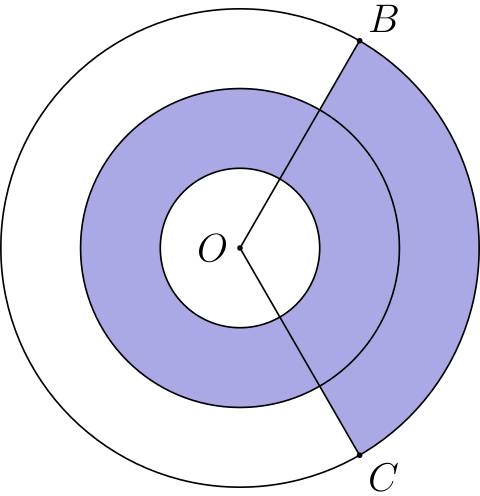
Three concentric circles centered at $O$ have radii of $1,$ $2,$ and $3.$ Points $B$ and $C$ lie on the largest circle. The region between the two smaller circles is shaded, as is the portion of the region between the two larger circles bounded by central angle $BOC,$ as shown in the figure below. Suppose the shaded and unshaded regions are equal in area. What is the measure of $\angle BOC$ in degrees?
Jordan owns $15$ pairs of sneakers. Three fifths of the pairs are red and the rest are white. Two thirds of the pairs are high-top and the rest are low-top. The red high-top sneakers make up a fraction of the collection. What is the least possible value of this fraction?
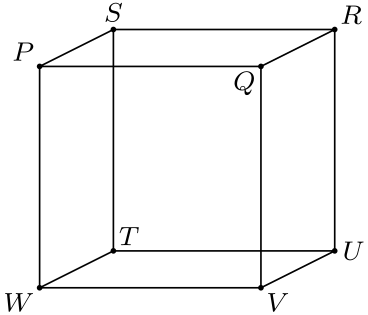
Any three vertices of the cube $PQRSTUVW,$ shown in the figure below, can be connected to form a triangle. (For example, vertices $P,$ $Q,$ and $R$ can be connected to form isosceles $\bigtriangleup PQR.$) How many of these triangles are equilateral and contain $P$ as a vertex?