Point $P$ is taken interior to a square with side-length $a$ and such that it is equally distant from two consecutive vertices and from the side opposite these vertices. If $d$ represents the common distance, then $d$ equals:
The arithmetic mean of a set of $50$ numbers is $38.$ If two numbers of the set, namely $45$ and $55,$ are discarded, the arithmetic mean of the remaining set of numbers is:
Three vertices of parallelogram $PQRS$ are $P(-3,-2),$ $Q(1,-5),$ $R(9,1)$ with $P$ and $R$ diagonally opposite. The sum of the coordinates of vertex $S$ is:
Given the equations $x^2+kx+6=0$ and $x^2-kx+6=0.$ If, when the roots of the equations are suitably listed, each root of the second equation is $5$ more than the corresponding root of the first equation, then $k$ equals:
A circle is inscribed in an equilateral triangle, and a square is inscribed in the circle. The ratio of the area of the triangle to the area of the square is:
Three numbers $a,$ $b,$ $c,$ none zero, form an arithmetic progression. Increasing $a$ by $1$ or increasing $c$ by $2$ results in a geometric progression. Then $b$ equals:
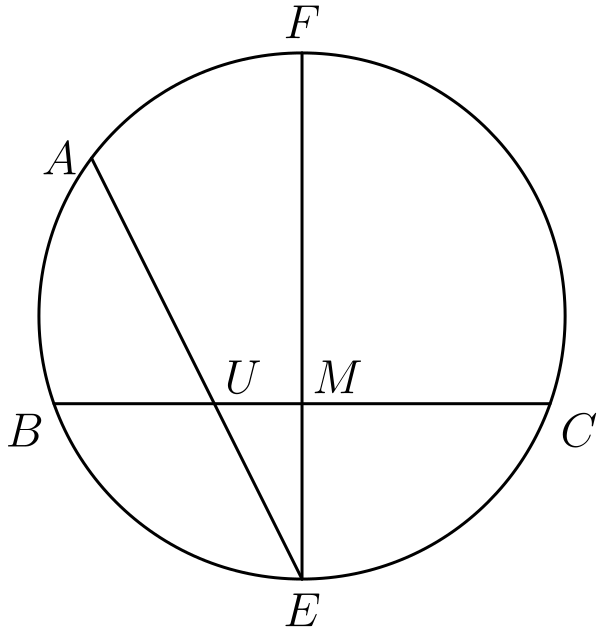
Chord $EF$ is the perpendicular bisector of chord $BC,$ intersecting it in $M.$ Between $B$ and $M$ point $U$ is taken, and $EU$ extended meets the circle in $A.$ Then, for any selection of $U,$ as described, triangle $EUM$ is similar to triangle:
In counting $n$ colored balls, some red and some black, it was found that $49$ of the first $50$ counted were red. Thereafter, $7$ out of every $8$ counted were red. If, in all, $90\%$ or more of the balls counted were red, the maximum value of $n$ is:
Two men at points $R$ and $S,$ $76$ miles apart, set out at the same time to walk towards each other. The man at $R$ walks uniformly at $4\dfrac12$ miles per hour; the man at $S$ walks at $3\dfrac14$ miles per hour for the first hour, at $3\dfrac34$ miles per hour for the second hour, and so on, in arithmetic progression. If the men meet $x$ miles nearer $R$ than $S$ in an integral number of hours, then $x$ is: