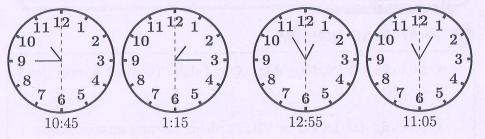
Two times are symmetric when both hour and minute hands reflect across the vertical axis, as illustrated: $10 : 45$ with $1 : 15$; $12 : 55$ with $11 : 05$. How many such pairs in one day are exactly $5$ hours $30$ minutes apart?
An has $12$ more candies than the other three’s mean. Binh has $15$ fewer than An, Chau $3$ fewer. After equal redistribution among four, how does Dung’s count change?
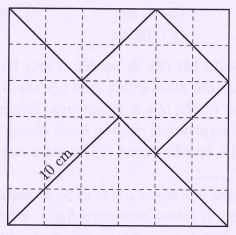
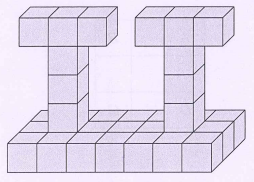
Six pieces (two large triangles, two medium, one small, and one square)form the pictured square. The marked triangle side is $10 \,\mathrm{cm}$. How much does the sum of piece perimeters exceed the outer perimeter?
The pictured $I , T , O , L$ tetrominoes use $1 \,\mathrm{cm}^{2}$ cells. Use equal numbers of all four types to tile a square. What is the smallest square’s perimeter?
An leaves for school $06 : 30$, studies $4 h = 45 m$, and returns home $12 : 00$. Speeds are $100 m /$ min outward, $80 m /$ min homeward. Find the distance.
Split $\frac{21}{22} = \frac{a}{b} + \frac{c}{d}$ witha $/ b , c / d , b / d$ all reduced and $a , b , c , d$ nonzero. Swapping fractions counts as the same decomposition. How many ways?
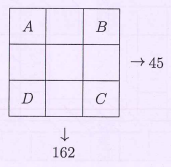
Fill $1 \text{--} 9$ once into the pictured $3 \times 3$ grid. The middle row product is $45$ and middle column product $162$. Find the sum of corner entries $A , B , C , D$.
There are $25$ points in the pictured $5 \times 5$ grid. Count squares with grid-point vertices whose every side passes through exactly two grid points (no additional point along the side).
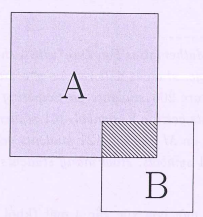
Two overlapping squares have natural-number side lengths that are not consecutive. Region A exceeds $B$ by $39 \,\mathrm{cm}^{2}$ as pictured. Find the larger square’s area.
A teacher gives An $13$ candies, then Binh one-tenth of the remainder, then Chau $16$, then Dung one-tenth of the remainder. An+Binh receive as many as Chau+Dung. Find the initial amount.
Two hundred pupils receive symbols $V , T , M , O$, with counts $173 , 161 , 145 , 121$ respectively, and nobody receives all four. How many have both $V$ and $O$?
Roll $a = 1 \text{--} 4$ die; odd outcomes move backward, even forward by the shown number. There are $42$ rolls, total $102$ steps in either direction. Counts of $2$ and $4$ are equal; count $1$ is twice count $3$. Find forward steps.