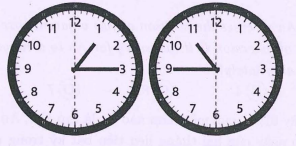
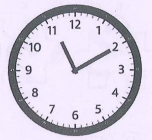
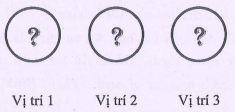
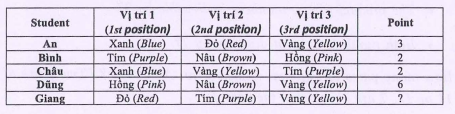
Two times are symmetric if both hands reflect across the clock’s vertical axis,e.g.$1 : 15$ and $10 : 45$. The pictured clock shows $11 : 10$. What is the least number of minutes until its symmetric time?
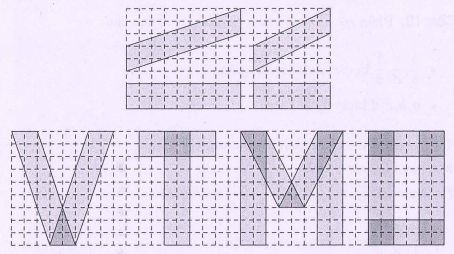
Four black boxes followed by four white boxes are arranged as shown. Each move swaps adjacent boxes. What is the minimum number of moves to alternate colors?
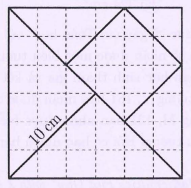
Six wooden pieces (two congruent large triangles, two congruent medium triangles, $a$ small triangle and a square) form the pictured square. The marked large-triangle side is $10 \,\mathrm{cm}$. Find the sum of the six perimeters minus the outer square’s perimeter.
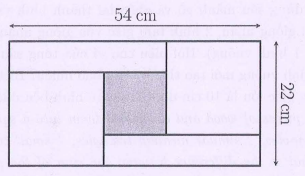
Two congruent squares and two congruent rectangles fit in a $54 \,\mathrm{cm}$ by $22 \,\mathrm{cm}$ rectangle, leaving the gray square shown. Find its area. The diagram is not to scale.
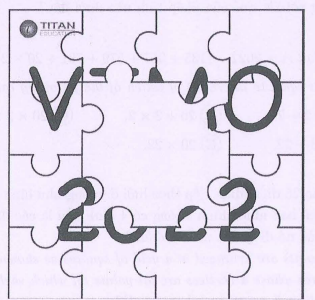
Among $200$ students, the counts receiving symbols $V , T , M , O$ are $173 , 161 , 145 , 121$; none receives all four. How many have both $V$ and $O$?
Write $\frac{21}{22} = \frac{a}{b} + \frac{c}{d}$ with nonzero natural $a , b , c , d$; $\frac{a}{b} , \frac{c}{d} , \frac{b}{d}$ all reduced. How many decompositions are there, ignoring order? For example $\frac{1}{2} + \frac{5}{11}$ and $\frac{5}{11} + \frac{1}{2}$ count as one.
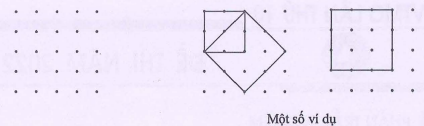
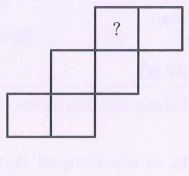
Fill the six staircase cells using $1 , 2 , 3 , 4 , 5 , 6$ once each. Cells sharing a vertex cannot contain consecutive numbers. What is the largest possible value at ??
An chooses three distinct digits and forms every $1 - , 2 - , 3$-digit number without repetition within a number. Their sum is $5635$. What is the sum of the chosen digits?
$A , B , C , D , E , F , G , H , I , J$ represent distinct digits, with $C , E$ nonzero. Given $\overline{3AB}\times(\overline{CD}\div\overline{EF})\times(G+H-I-J)=2022$, find the maximum $G + H + I + J$.
Initially An has $\frac{3}{4}$ as many cards as Binh. An gives Chau some cards, and Binh gives three times that amount, leaving An and Binh equal. Chau receives $48$ in total. How many did An initially have?
Hanh rolls a tetrahedral die numbered $1 , 2 , 3 , 4$. Even results move forward by their value; odd results backward by their value. After $42$ rolls, total forward plus backward steps is $102$. Counts of $2$ and $4$ match; count of $1$ is twice that of $3$. How many forward steps are there?
After An loses $10$ cards, An has half as many as Binh. Binh then gives An $10$, and Binh’s remaining count is $\frac{7}{5}$ of An’s. What was their initial total?
Choose two distinct natural numbers below $222$ whose product is divisible by $77$, but neither number is divisible by $77$. How many unordered pairs are there?