Duc and Hai initially have equal card counts. Duc gives Hai $20$ cards, leaving Hai with three times Duc’s remainder. How many did each have originally?
A sequence starts $1 , 2$, and each next digit is the last digit of the sum of the previous two, giving $1235831459437 \ldots$ . Which block cannot occur?
Express $12$ as a product of natural numbers whose sum is also $12$. How many unordered ways are there? For example $8 = 1 \times 1 \times 2 \times 4$ and $8 = 1 + 1 + 2 + 4$.
There are $15$ sticks of length $3 \,\mathrm{cm}$ and $10$ of length $2 \,\mathrm{cm}$. What is the fewest additional $1 \,\mathrm{cm}$ sticks needed to use all sticks as the perimeter of an integer-sided rectangle?
Twenty people count continuously from $1$ clockwise around a circle. Anyone saying a multiple of $2$ or $3$ is eliminated. Continue until one remains. Which number did the winner first say?
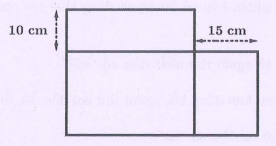
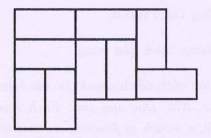
A square’s one dimension is reduced $10 \,\mathrm{cm}$ and the other increased $15 \,\mathrm{cm}$, making the rectangle shown. How much does its perimeter increase?
Blue and red candy bags initially contain equal amounts. Each pupil chooses $2$ blue $+ 2$ red or $1$ blue $+ 3$ red. Only $20$ blue remain. How many chose option $2$?
A year has two consecutive months totaling $60$ days and starts on Sunday $1$ January. What weekday is its last day? Codes: Sunday $001$, Monday $002$, Tuesday $003$.
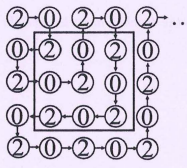
Digits $2 , 0 , 2 , 0 \ldots$ alternate as shown. $S _{n}$ denotes the sum in a chosen $n \times n$ square; the example has $S _{3} = 10$. Find $S _{6}$.
Give four distinct gifts—bear, flowers, robot, book—to Thao, Nhi, Duc, Hai, one each. Hai rejects flowers, Duc rejects book, Nhi rejects robot, Thao rejects bear. How many acceptable assignments exist?