A merchant sold 80% of all his flower vases at a profit of 30%. Then, upon checking, he saw that 17 of his vases were broken and could not be sold. He sold all the remaining vases at a loss of 10%. In the end, the merchant made a total profit of 5%. What was the number of vases that he had at the beginning?
In a competition, there were five competitors: Ali, Benny, Chin, Din and Eddy. Before the competition began, four spectators had made the following predictions:
Spectator 1: “Benny will get the 4th place and Eddy will get the 2nd place.”
Spectator 2: “Din will get the 1st place and Chin will get the 3rd place.”
Spectator 3: “Eddy will get the 3rd place and Ali will get the 4th place.”
Spectator 4: “Ali will get the 3rd place and Benny will get the 1st place.”
It turned out that each spectator had one prediction correct and one prediction incorrect. Who got the 3rd place in the competition?
The word IMSOHANOI is repeated 2019 times:
IMSOHANOIIMSOHANOIIMSOHANOI…
Then, the letters are coloured, starting from the left, each letter in one colour, in a repeating pattern: red, blue, yellow, green, red, blue, yellow, green, …
What is the colour of the 2019th “I” (counting from the left)?
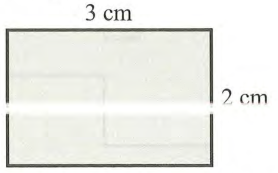
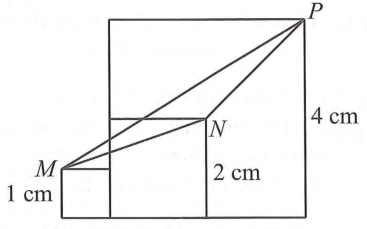
Ms. Liên combines ten rectangular cards of size $2\text{ cm}\times3\text{ cm}$ to make a larger rectangle.
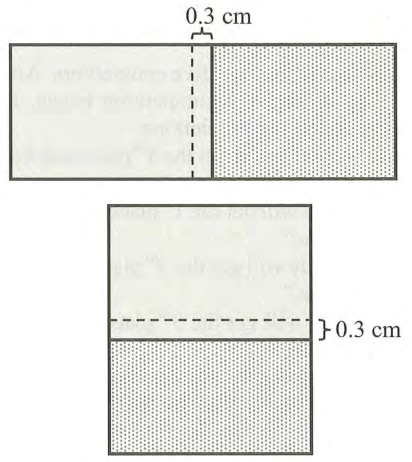
If the width of the overlapping part between any two adjacent cards is 0.3 cm (see the diagram below), what is the area, in cm², of the largest rectangle that she can make?
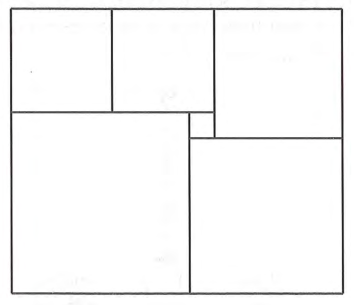
A rectangle is divided into some small squares, as shown in the diagram below. Given that the side length of the smallest square is 1 cm, what is the perimeter, in cm, of the rectangle?
In one afternoon, a ferry travelled from Island A to Island B and another ferry travelled from Island B to Island A at a different speed. They started at the same time and met for the first time at 3:50 pm. The two ferries continued to their destinations, stopped for 15 minutes before returning. They met again at 4:41 pm. If the two ferries travelled at uniform speeds throughout the whole journey, then at what time did they start their journey?
There are 120 scouts standing in a circle, equally spaced, around a campfire. They start calling out 1, 2, 3, … in the clockwise direction, and Keith calls out 55. If the calling starts with the same person but continues in the counter clockwise direction direction instead, what number will the scout opposite to Keith call out?
Mrs. Santos went to the market to buy apples. She bought 100 apples and put them in 6 bags. The number of apples in each bag contains at least a digit 6. What are the numbers of apples in each bag?
Answer entry (editorial guidance): Enter the numbers in ascending order, separated by commas, without units. Include repeated numbers as separate entries.
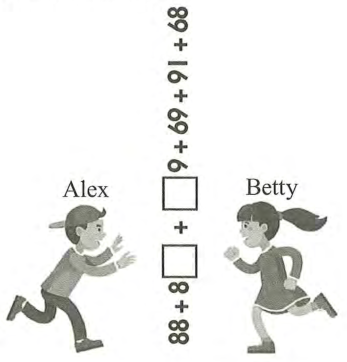
Alex and Betty are facing each other. Between them, written on the ground, is a sequence of digits and plus signs, as shown in the diagram below. From their points of view, Alex and Betty see two different expressions. A digit each can be filled in the two squares so that their respective expressions will have the same value. What is that value?
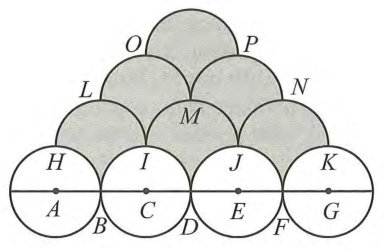
Ten circular cards of radius 2 cm each are arranged as shown in the diagram.
Given that the four collinear points $A$, $C$, $E$ and $G$ are the centres of the white cards, and $AHIC$, $CIJE$, $EJKG$ and $COPE$ are rectangles and $BLMD$ and $DMNF$ are squares, what is the area, in cm², of the shaded region?
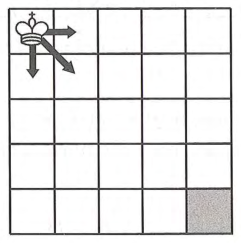
In each step, the chess piece in the board shown in the diagram can move 1 square in one of the three directions: right, down, or right-down. In how many ways can it move from the top-left corner to the bottom-right corner in exactly 6 steps?
The entrance tickets of a music show were numbered consecutively, starting from 1. It is known that one ticket number was sold twice by mistake and all the other ticket numbers were sold exactly once. The sum of all the ticket numbers sold is 1316. What is the ticket number that was sold twice?
An IMSO robot stands on the middle cell of a $1\times19$ board, as shown in the diagram below. It is programmed to make 5 moves. The directions of the moves alternate between left and right (the first move can be in either direction). For each move, the robot will move 1, 2, 3, 4 or 5 cells from its position; the robot should not move out of the board; moreover each number can be used exactly once. How many cells are there on this board on which the robot cannot end up after 5 moves?
Each of the 10 letters $A$, $B$, $C$, $D$, $E$, $F$, $G$, $H$, $I$ and $J$ in the addition below represents a different digit.
$$\begin{array}{r}AB\\CD\\EF\\+\ G\\\hline HIJ\end{array}$$
What is the largest possible value of the three-digit number $\overline{HIJ}$?
Jenny has a machine which can do one of the following two actions at each step: squaring the current number, or multiplying the current number by 2. Starting with the number 1, after at least how many steps can Jenny obtain $2^{2019}$?
Given fifty consecutive odd numbers: 1921, 1923, 1925, …, 2015, 2017, 2019. What is the least number of terms that one must select from the given numbers to make sure that at least one pair of selected numbers adds up to 3930?
Each letter in the subtraction $\overline{HANOI}-\overline{IMSO}$ represents one digit, where different letters represent different digits and the letters $H$ and $I$ are non-zero. How many possible values of $\overline{IMSO}$ are there such that the result of the subtraction is a three-digit number?