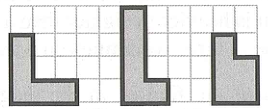
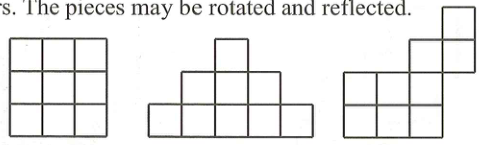
The diagram below shows the V-, L- and P-pentominoes.
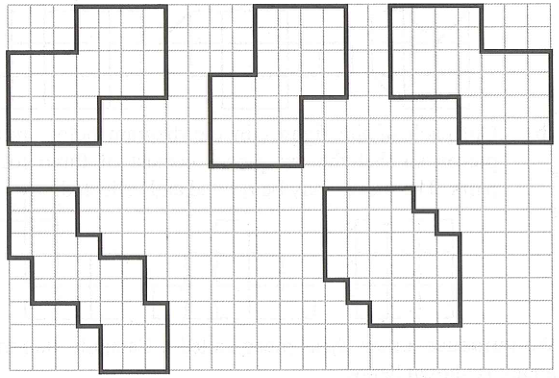
Use two copies of each V-, L- and P-pentomino to construct all of the given diagrams below.
The pieces may be rotated or reflected.
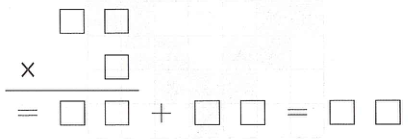
Find all the possible ways of filling in the nine boxes with the digits 1 to 9, using each exactly once, in order to make the addition and the multiplication correct.
There are 13 coins. Two of them are counterfeit and both have equal weights. The other 11 coins are genuine and have with equal weights as well, but they have a different weight from that of the counterfeit coins. We are not trying to identify the counterfeit coins but instead, we want to determine whether a counterfeit coin is heavier or lighter than a genuine coin. How can this be done in three weighings on a two-pan balance?
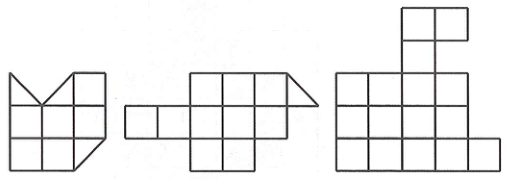
(a) Cut each of the figures in the diagram below into two pieces such that each piece has an axis of symmetry.
(b) Cut each of the figures in the diagram below into two pieces so that the six pieces consist of three identical pairs. The pieces may be rotated and reflected.
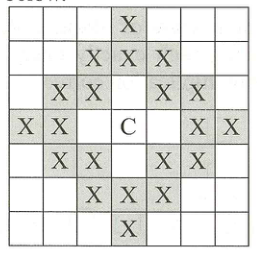
We introduce a new chess piece called a Catapult. Its range of attack is shown below.
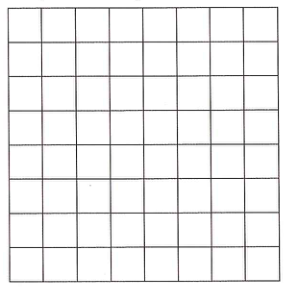
In the $8\times8$ chessboard below, place as many catapults as possible, so that no two them can attack each other. (Mark a C on the chessboard for a catapult)
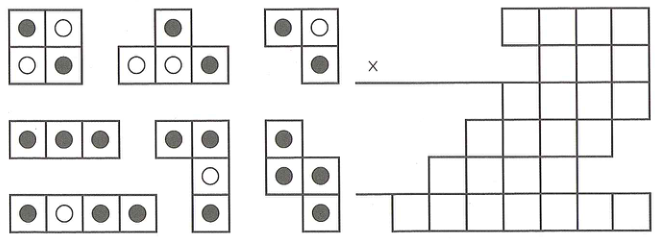
The diagram below shows seven pieces on the left and a board on the right. On the pieces are black circles which represent the binary digit 1, and white circles which represent the binary digit 0. Use the seven pieces to cover the board so that the resulting configuration is a correct multiplication in binary numbers. The pieces may be rotated or reflected.