Zoey read $15$ books, one at a time. The first book took her $1$ day to read, the second book took her $2$ days to read, the third book took her $3$ days to read, and so on, with each book taking her $1$ more day to read than the previous book. Zoey finished the first book on a Monday, and the second on a Wednesday. On what day of the week did she finish her $15$th book?
Laura added two three-digit positive integers. All six digits in these numbers are different. Laura’s sum is a three-digit number $S.$ What is the smallest possible value for the sum of the digits of $S?$
The ratio of the measures of two acute angles is $5:4,$ and the complement of one of these two angles is twice as large as the complement of the other. What is the sum of the degree measures of the two angles?
All three vertices of $\bigtriangleup ABC$ lie on the parabola defined by $y=x^2,$ with $A$ at the origin and $\overline{BC}$ parallel to the $x$-axis. The area of the triangle is $64.$ What is the length of $BC?$
A thin piece of wood of uniform density in the shape of an equilateral triangle with side length $3$ inches weighs $12$ ounces. A second piece of the same type of wood, with the same thickness, also in the shape of an equilateral triangle, has side length $5$ inches. Which of the following is closest to the weight, in ounces, of the second piece?
Carl decided to fence in his rectangular garden. He bought $20$ fence posts, placed one on each of the four corners, and spaced out the rest evenly along the edges of the garden, leaving exactly $4$ yards between neighboring posts. The longer side of his garden, including the corners, has twice as many posts as the shorter side, including the corners. What is the area, in square yards, of Carl’s garden?
At Megapolis Hospital one year, multiple-birth statistics were as follows: Sets of twins, triplets, and quadruplets accounted for $1000$ of the babies born. There were four times as many sets of triplets as sets of quadruplets, and there were three times as many sets of twins as sets of triplets. How many of these $1000$ babies were in sets of quadruplets?
How many squares whose sides are parallel to the axes and whose vertices have coordinates that are integers lie entirely within the region bounded by the line $y=\pi x,$ the line $y=-0.1$ and the line $x=5.1?$
All the numbers $1,$ $2,$ $3,$ $4,$ $5,$ $6,$ $7,$ $8,$ $9$ are written in a $3\times3$ array of squares, one number in each square, in such a way that if two numbers are consecutive then they occupy squares that share an edge. The numbers in the four corners add up to $18.$ What is the number in the center?
The sum of an infinite geometric series is a positive number $S,$ and the second term in the series is $1.$ What is the smallest possible value of $S?$
All the numbers $2,$$ 3, $$4, $$5,$$ 6,$$ 7$ are assigned to the six faces of a cube, one number to each face. For each of the eight vertices of the cube, a product of three numbers is computed, where the three numbers are the numbers assigned to the three faces that include that vertex. What is the greatest possible value of the sum of these eight products?
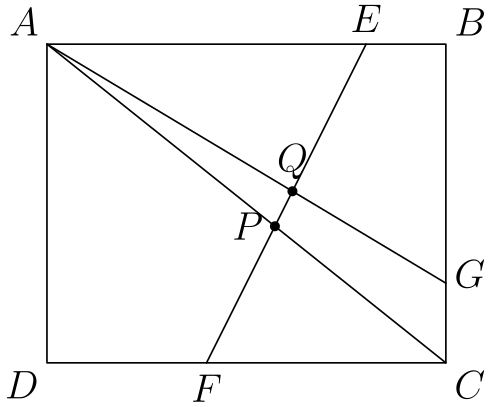
Rectangle $ABCD$ has $AB=5$ and $BC=4.$ Point $E$ lies on $\overline{AB}$ so that $EB=1,$ point $G$ lies on $\overline{BC}$ so that $CG=1,$ and point $F$ lies on $\overline{CD}$ so that $DF=2.$ Segments $\overline{AG}$ and $\overline{AC}$ intersect $\overline{EF}$ at $Q$ and $P,$ respectively. What is the value of $\dfrac{PQ}{EF}?$
A dilation of the plane—that is, a size transformation with a positive scale factor—sends the circle of radius $2$ centered at $A(2,2)$ to the circle of radius $3$ centered at $A'(5,6).$ What distance does the origin $O(0,0),$ move under this transformation?