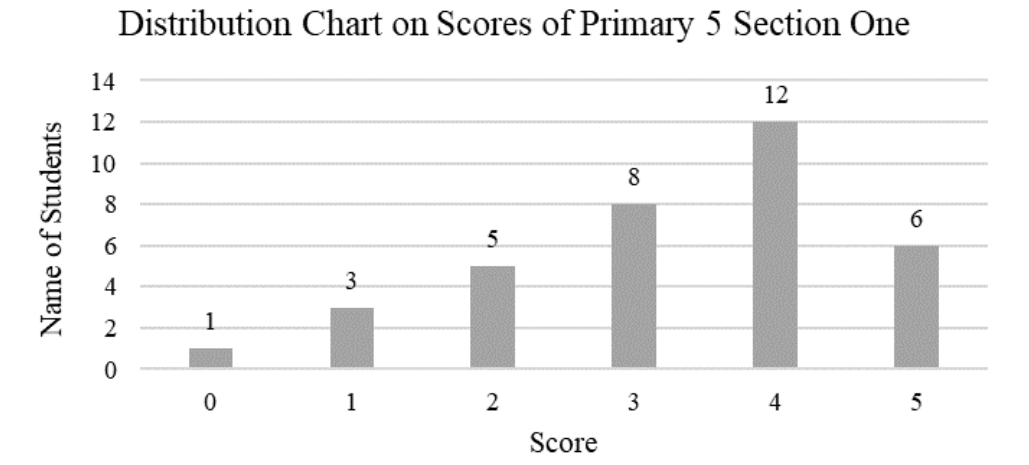
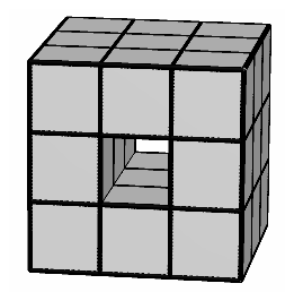
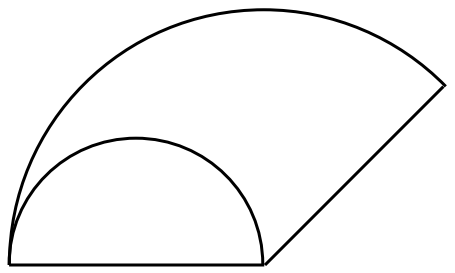
The numbers 0, 1, 2, 3, 4 and 5 are six possible scores in a math contest, and below is the score distribution of all students in primary 5 section-one. What is the median score of this contest in this class? (Note: The median of a group of data is the middle datum when the data are arranged in ascending order of magnitude.)
How many of the following five statements are true? I. Only if a multi-digit number has units digit equal to 0, then it has factors of 2 and 5 at the same time. II. All those numbers whose units digit is 3, 6, 9, are divisible by 3. III. The sum of all digits of a number that is divisible by 9 is not necessarily divisible by 9. IV. The smallest three-digit number divisible by 2, 3, and 5 is 150. V. For those numbers divisible by 6, it’s not only the units digit that is an even number, but also the sum of all digits is divisible by 3.
The degree measure of each interior angle of a triangle is a positive integer and their greatest common factor is 15. Which of the following do not match the degrees of the interior angles of this triangle?
A certain bus company gives discount to passengers who buy a monthly bus ticket in the form of stored-value card. The discounts are as follow: 5% discount per trip for the first 15 trips per month, 40% discount per trip starting on the 16th trip. If Ricky, going to office each morning by bus, uses the stored-value card of which its original price is USD6 per trip and if he took 40 trips last month, how much did he actually spend last month?
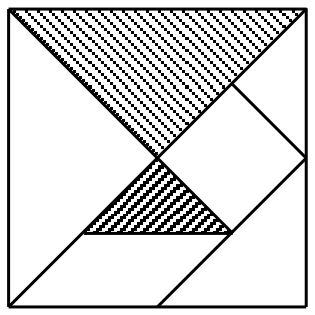
Below is a tangram which was invented in China. It is a famous puzzle with seven ingenious pieces: five isosceles right triangles of three sizes, one square and one parallelogram. If the area of one of the smallest isosceles right triangle in the 7-piece puzzle is 6 cm² , what is the area, in cm² , of the largest isosceles right triangle in this puzzle?
Warren bought some raffle tickets. There were a total of 600 raffle tickets for sale with the following prizes: 1 first prize, 2 second prizes, 3 third prizes and all other tickets had no prizes. How many tickets should Warren buy to have $\frac14$ chance to win a prize?
Mark can finish reading a novel in three days. It is known that on the first day he read $\frac14$ of the text, on the second day he read 20 more pages of the text than that on the first day, and on the third day he read 25 more pages than on the second day. How many pages does the text of the novel have in total?
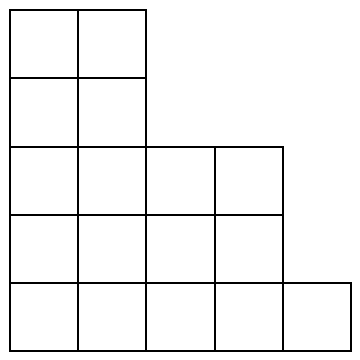
In the figure below, color five unit squares black such that any two black unit squares are not located in the same row or column. How many ways can we color the figure?
There are four rectangular pieces with dimensions of $1\ \mathrm{cm}\times2\ \mathrm{cm}$ , $3\ \mathrm{cm}\times4\ \mathrm{cm}$ , $5\ \mathrm{cm}\times6\ \mathrm{cm}$ and $7\ \mathrm{cm}\times8\ \mathrm{cm}$ respectively. They are to be placed on a larger rectangular graphing paper without overlapping. The sides of each piece should be parallel to the edges of the graph paper and that one vertex from each of the four pieces should coincide at a point (that is, this point is also the vertex of four rectangles). What is the smallest possible area, in cm² , of the graphing paper?
The four digits 2, 0, 1 and 9 are used to form all 18 possible four-digit numbers, then add a positive integer n to each of these numbers, so that the remainder of each sum when divided by 11 is not 1. Now, all positive integers n satisfying the above conditions are listed from small to large. What is the sum of the first five numbers?
There are 20 students taking a contest with 20 questions. If each student solves exactly 12 questions, and each question is solved exactly by 12 students, show that there are three students such that each question is solved by at least one of these three students.