Four students went mountain climbing together. They spent \$50 in total on bus fare. While at the mountain top, each of them spent \$5 on beverages. What is the average expense for each student?
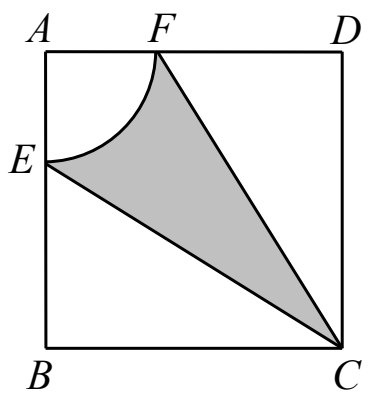
In the figure below, the side length of the square ABCD is 8 cm and the radius of the sector AEF is 3 cm. What is the area, in cm² , of the shaded region? (Take π as
3.14, and round off to TWO decimal places)
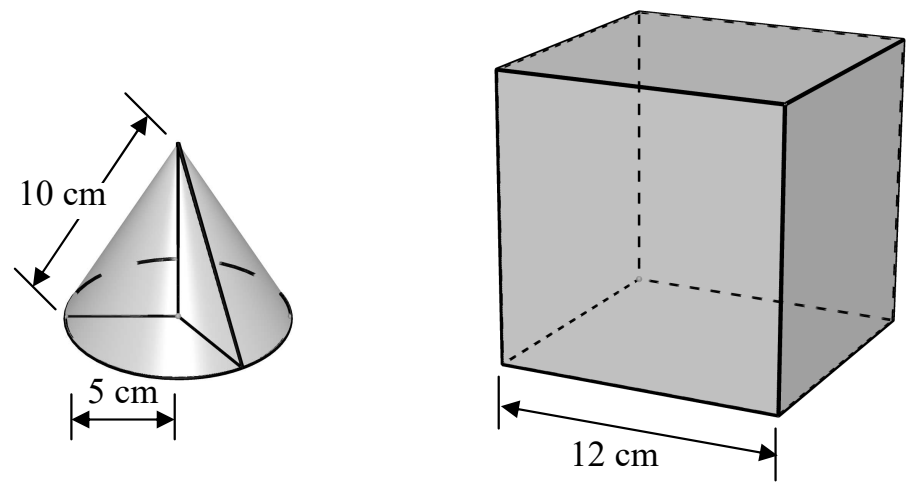
In the figure below, a circular cone and a cube are shown. If a solid shape is formed by attaching the two shapes together, what is the least surface area, in cm² , of the resulting shape? (Take π as 3.14,, and round off to ONE decimal place)
Given four distinct non-zero digits a, b, c and d, if $\overline{ab}+\overline{cd}=\overline{dc}+\overline{ba}$ , then this expression is called a palindrome expression and the sum of the two numbers $\overline{ab}+\overline{cd}$ is called a palindrome sum. For example, $53+46=64+35=99$ . What is the minimum possible value of a palindrome sum?
There are a total of 40 students in a class. 23 of them are able to ride bikes, 33 of them are able to swim and 5 of them are unable to do either. How many students in this class are able to ride bikes but are not able to swim?
One day, Adam drove from Town A to Town B at a speed of 60 km/h. After an hour, the car stopped because of a breakdown, and because of this, Adam immediately called Bob for help. Bob then drove from A along the same route at a speed of 80 km/h. When Bob met Adam, he towed Adam’s car to B, at a speed of 40 km/h. The distance between A and B is 180 km. How long did Adam spend travelling for the whole trip?
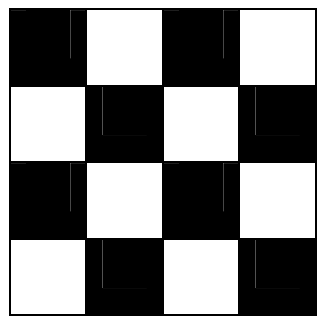
Four identical chess pieces are to be placed into a $4\times4$ chess board that is colored black and white alternately, as shown in the figure below. You can place at most one chess piece on each square. All chess pieces must be placed in squares of the same color and no two pieces are on the same row or on the same column. In how many different ways can the chess pieces be placed?
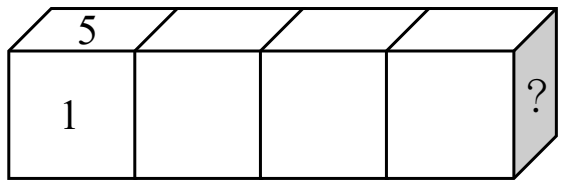
The numbers 1, 2, 3, 4, 5 and 6 are written on the six faces of a unit cube without repetition. Each face contains one number and the sum of the numbers in every two opposite faces is 7. Put four such cubes side by side as shown in the figure below, such that sum of every two numbers of every two touched faces is 8. Find the number marked with “?” in the figure.
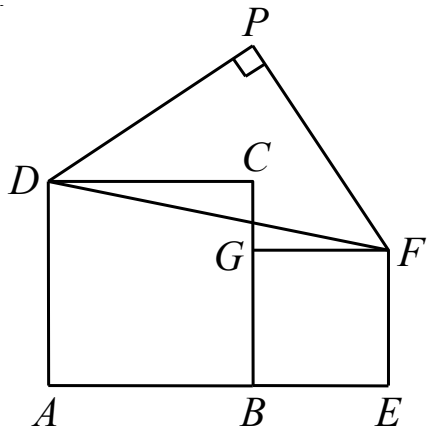
In the figure below, the side lengths of squares ABCD and BEFG are 6 cm and 4 cm respectively and triangle DFP is an isosceles right triangle. What is the area, in cm² , of triangle DFP?
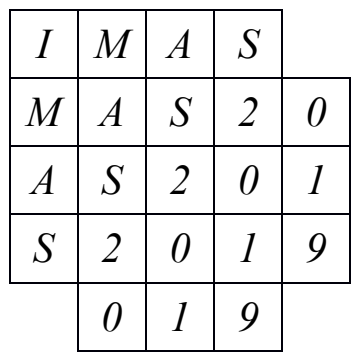
A mouse starts from the top left-most unit square marked with “I”, follows a route to form the word “IMAS2019” by moving from one square to another square that share a common side. How many different routes of eight squares are there?
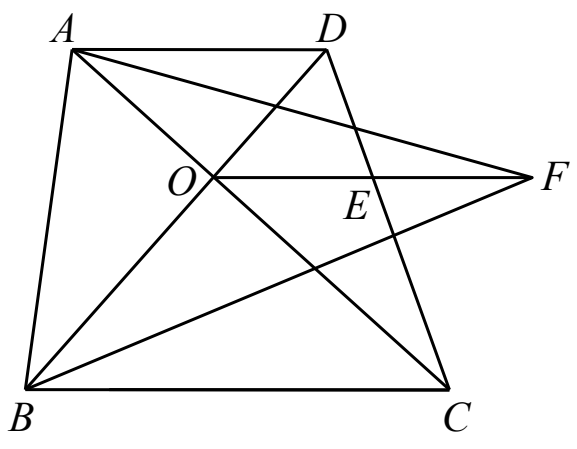
In the figure, ABCD is a trapezoid, with side AD that is parallel to BC, diagonals AC and BD intersect at point O, and line OE is parallel to BC and intersects CD at point E. Now, extend OE to point F such that $OE=EF$ . If AD = 6 cm, BC =10 cm and the area of trapezoid ABCD is 64 cm² , what is the area, in cm² , of triangle ABF?
A robot can generate a set of digit codes according to user’s reasonable instructions. Wayne gives out the following commands: (1) Each code is a three-digit number (nonzero for the left-most digit). (2) Every two codes in the set have identical digits at no more than one corresponding positions. Find the maximum number of codes in a set the robot can generate.