Walter has two options when going to school. He can (a) walk 3 minutes to the bus stop and then ride the bus for 15 minutes to the school, or (b) walk 5 minutes to the subway stop and then ride the subway for 6 minutes and walk 5 minutes to school. If he does not have to wait for the bus at the bus stop, nor the train on the subway station, what is the minimum number of minutes required for him to get to school?
Zachary has a computer program which accepts an input and produced an output. Some of the data are shown in the following table. Input 1 2 3 4 5 6 7 Output 4 7 10 13 16 ? 22 What is the output when the input is 6?
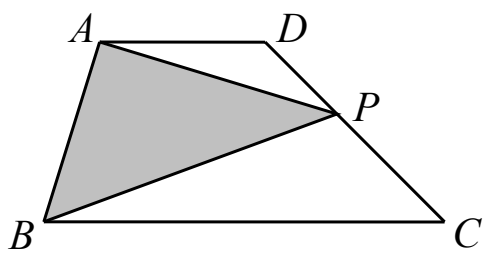
In the diagram, AD is parallel to BC. A point P moves from C to D along the side CD. Which of the following is the accurate description of the change in the area of triangle ABP during the motion?
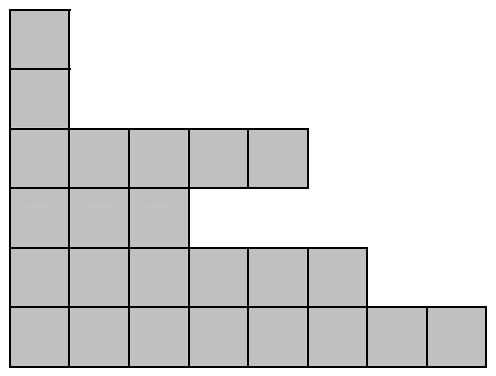
Langford has a square piece of chocolate divided into unit squares. After eating some of the unit squares, what is left of the square piece is shown in the diagram. At least how many unit squares of chocolate must Langford have eaten?
When $\frac{22}{7}$ is expressed as a decimal without rounding, how many decimal places should we take so that the positive difference between this result and
3.14159 is as small as possible?
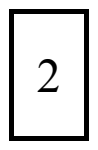
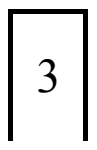
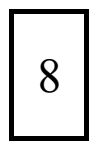
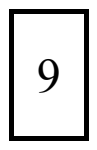
The diagram shows nine cards numbered 1 to 9. One of the cards is removed, and the sum of the numbers on the remaining cards is 8 times the number on the card that was removed. What is the number on the card that was removed?
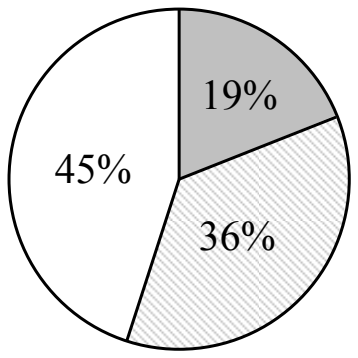
Mrs. Huang spent three days making ornaments. The diagram shows the percentage of the total number of ornaments that she made on each day. If she made 152 ornaments on the first day, how many ornaments did she make on the third day?
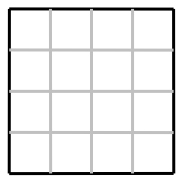
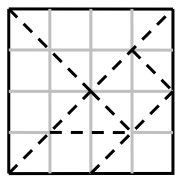
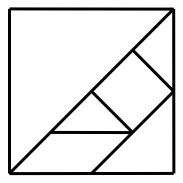
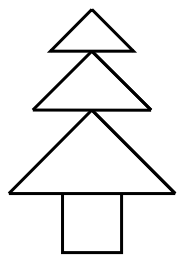
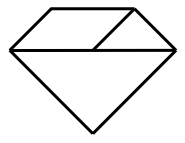
The tangram puzzle is made as shown in the diagram. Start with a 4 by 4 grid as shown in figure (a) and cut along the dotted lines as shown in (b). This will result with seven pieces as in (c). Both figures (d) and (e) are constructed from some of these pieces. What is the ratio between the area of the figure in (d) and the area of the figure in (e)?
The two digits of each of four consecutive two-digit numbers are multiplied and the respective products are 24, 28, 32 and 36. What is the sum of the four consecutive numbers?
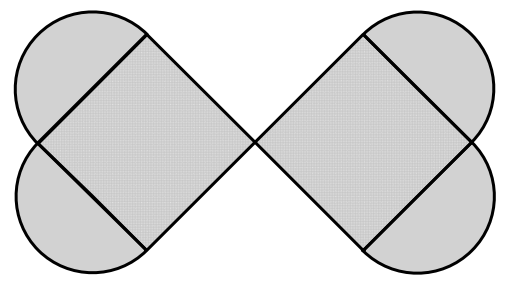
Lily constructs a figure, in the shape of a butterfly, as shown in the diagram. She uses two squares of side length 6 cm and four semicircles with diameter 6 cm. If we take π to be 3.14, what is the area of the figure?
A box contains ten black balls and ten white balls and there are no balls outside the box. In each step Mickey is allowed to do one of the two things. (a) He may take a white ball and a black ball from the box and place them outside. (b) If there is at least one black ball outside the box, he may take a white ball from the box and place it outside, and return a black ball from outside into the box. After six steps Mickey counts the number of balls outside the box. How many possible answers are there?
Bucket A is one-sixth full of water while bucket B contains 60 litres of water. If we empty the water in bucket B into bucket A then bucket A is half full of water. If instead we empty the water in bucket A into bucket B then bucket B is full. What is the capacity, in litres, of bucket B?
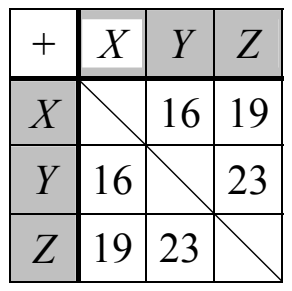
The diagram shows an addition table on three numbers X, Y and Z. A number in the table is the sum of the two numbers, one in the same row and the other in the same column, which are represented by letters. For instance, X+Y=16. What is the product of the numbers X, Y and Z?
Mickey is asked to multiply three positive integers, but he adds them instead. Amazingly, his correct answer is equal to the correct answer for the multiplication problem. What is the sum of these three numbers?
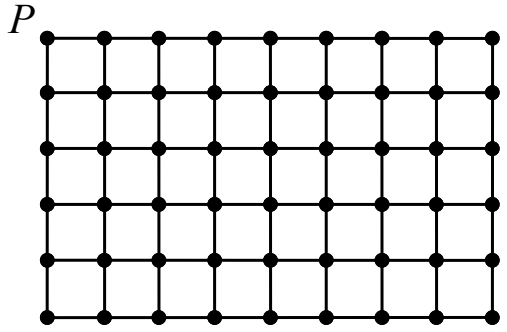
There are 54 grid points on the 5 by 8 grid, shown in the diagram, where the side of each small square is 1 cm. Starting from point P, an ant crawls from grid point to grid point along the grid lines, visiting each grid point exactly once before returning to P. What is the maximum length of its path, in cm?
When asked to find $\frac45+\frac56+\frac79+\frac9{11}$, each of four children makes a mistake. Peter interchanges the numerator and denominator in $\frac45$, Quentin does that to $\frac56$, Rachel does that to $\frac79$ and Sarah does that to $\frac9{11}$. Whose answer is closest to the correct answer?