A gallon is defined as the volume of a rectangular prism with dimensions $11$ inches $\times7$ inches $\times3$ inches. A barrel is equal to $42$ gallons. Let $n$ be a positive integer such that the volume of a cube with side length $n$ inches is closest to the volume of one barrel. What is the value of $n$?
A nine-digit integer is formed by using nine different non-zero digits. Reading the digits consecutively produces $7$ three-digit numbers. For example, $542687931$ gives $542,426,268,687,879,793,931$. Among all such nine-digit integers, what is the minimum possible sum of the seven three-digit numbers?
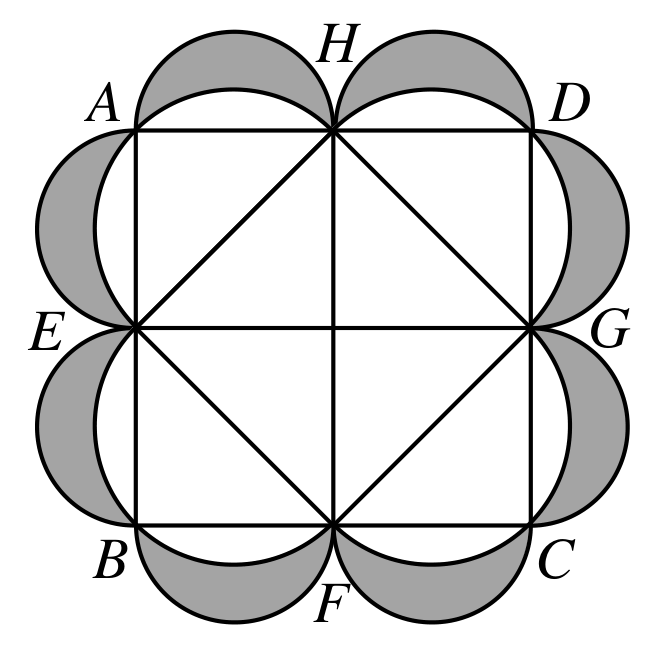
As shown, $ABCD$ is a square, and $E,F,G,H$ are the midpoints of $AB,BC,CD,DA$, respectively. Semicircles are drawn with diameters $EF,FG,GH,HE,AE,EB,BF,FC,CG,GD,DH,HA$. If the area of square $ABCD$ is $314\text{ cm}^2$, what is the total shaded area, in $\text{cm}^2$? Take $\pi=3.14$.
A machine accepts only $3$-dollar coins and $5$-dollar coins. To pay exactly $2026$ dollars, let $m$ and $M$ be the minimum and maximum possible numbers of coins. What is $M-m$?
A factory produced $50$ robots of types A and B in one month. The average weight in kg of each type is an integer equal to the number of robots of that type produced. Fewer type A robots than type B robots were produced, and the average weight of all $50$ robots was $26$ kg. How many type A robots were produced?
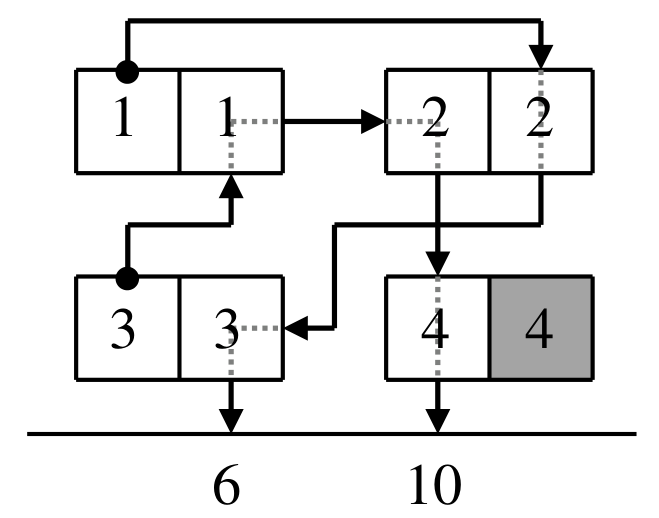
In the first configuration, the numbers $11,22,33,44$ are placed in the boxes. Two paths start at the marked dots and follow arrows and dotted segments. The sum of the digits in boxes along each path is shown below it. The shaded box is the only box on neither path.
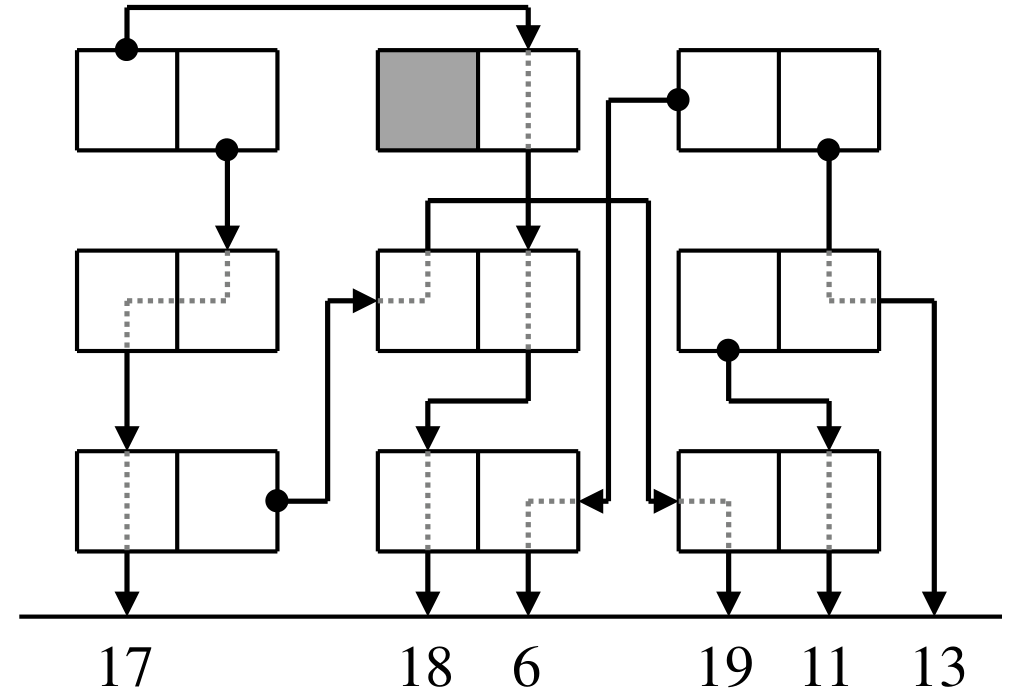
Now place $11,22,33,44,55,66,77,88,99$ into the boxes of the second configuration. Six paths follow the same rules, and the shaded box is again the only box on no path. What is the sum of all the different possible digits that can be placed in the shaded box?
One day, Father Bear, Mother Bear and Baby Bear ate honey. Initially their bowls held $120$, $80$ and $40$ spoonfuls, respectively.
- If only Father Bear had eaten from Mother Bear’s bowl, eating one third of his actual total consumption, then Baby Bear would have eaten half of what Mother Bear had left.
- If only Father Bear had eaten from his own bowl, eating his actual total consumption, then Mother Bear would have eaten half of what Father Bear had left.
- If only Mother Bear had eaten from Baby Bear’s bowl, eating one third of her actual total consumption, then Father Bear would have eaten what Baby Bear had left.
How many spoonfuls did all three bears eat in total?
On a robot planet there are red, green and blue colour-shifting robots. Whenever two differently coloured robots meet, both change into the third colour. Same-coloured meetings change nothing. Initially there are $68$ red, $44$ blue and $75$ green robots. What is the minimum number of meetings required for all robots to become one colour?
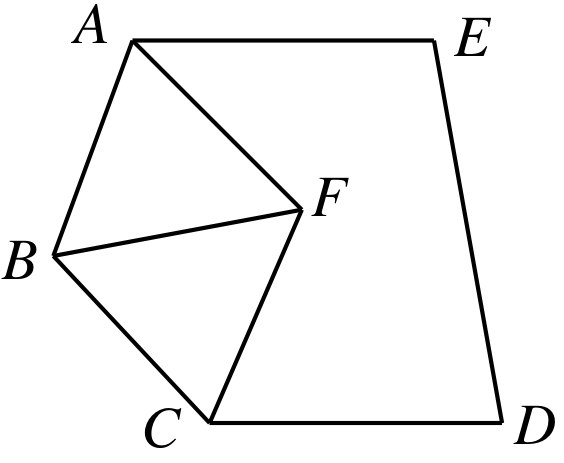
As shown, $ABCDE$ is a convex pentagon with $AB=BC$, $\angle EAB=110^\circ$, $\angle CDE=80^\circ$ and $\angle DEA=100^\circ$. The bisectors of $\angle EAB$ and $\angle BCD$ meet at $F$. Find $\angle ABF$ in degrees.
A field has fully grown grass. Each cow eats at the same constant daily rate, while grass grows at another constant rate. With $12$ cows the grass is exhausted in $21$ days; with $15$ cows it is exhausted in $14$ days. How many cows exhaust it in $9$ days? The daily growth stays constant regardless of how much grass is left.
In the Pawukon calendar, the Dwiwara system classifies days using two ritual values $x,y$.
- $x$ follows the 7-day cycle $5,4,3,7,8,6,9$.
- $y$ follows the 5-day cycle $9,7,4,8,5$.
- An even $x+y$ means a Menga day; an odd sum means a Pepet day.
- On January 1, 2026, $x=8$ and $y=4$.
Let $a$ and $b$ be the maximum possible numbers of consecutive Menga and Pepet days, respectively. Find $100a+b$.
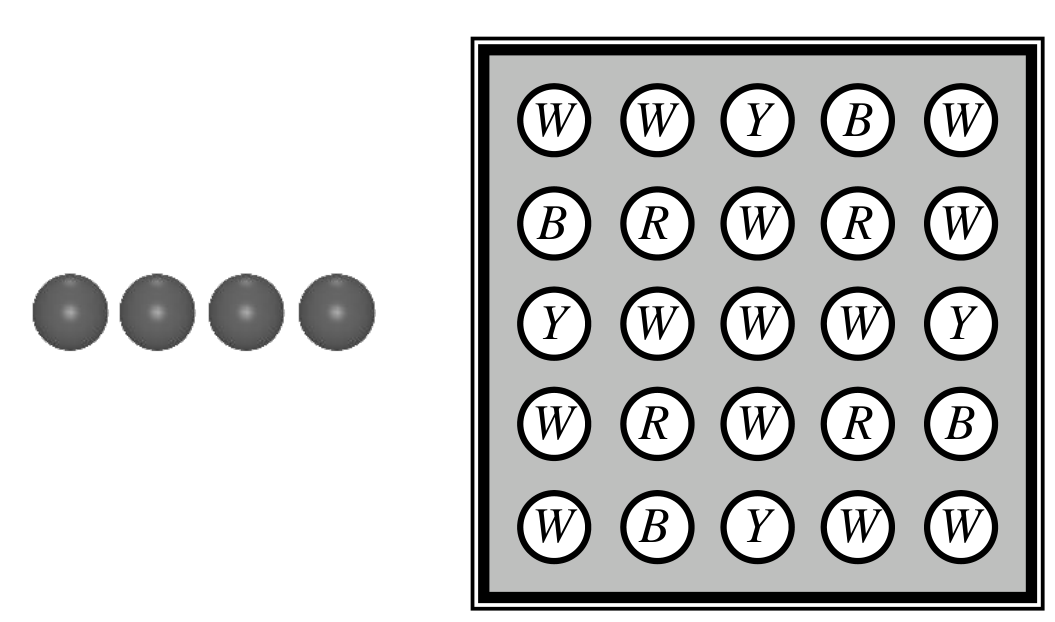
In Wiffle Ball Toss, a player tosses $4$ balls, one at a time, onto a table with white, blue, yellow and red holes.
White scores $0$, blue $1$, yellow $2$ and red $4$ points. A total of at least $4$ wins a prize. For example, Yellow-Blue-White-Blue scores $2+1+0+1=4$ and wins; White-Blue-Blue-White scores $0+1+1+0=2$ and does not. Each toss lands in exactly one hole and there are at least $4$ holes of each colour. How many different colour sequences win a prize?
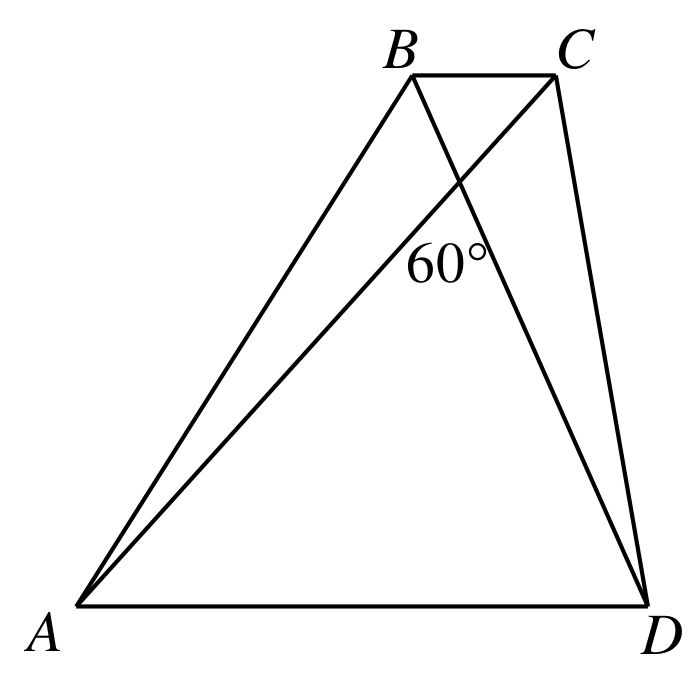
As shown, $ABCD$ is a quadrilateral with $AD\parallel BC$, $AD=20$ cm, $BC=6$ cm and $AC=26$ cm. The angle between $AC$ and $BD$ is $60^\circ$. What is the difference, in cm, between the lengths of $AB$ and $CD$? Give a detailed solution.
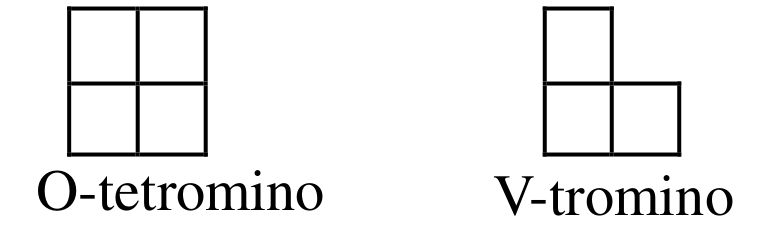
David has unlimited O-tetrominoes (left) and V-trominoes (right).
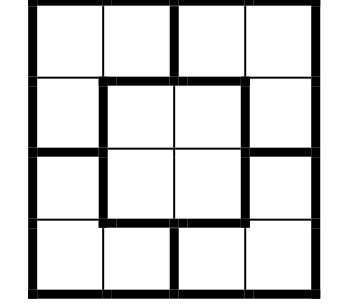
He places pieces along the grid lines to cover a board completely, with no overlap and no part outside. The following $4\times4$ example uses four V-trominoes.
For a $9\times18$ board, what is the minimum number of V-trominoes needed? Prove that fewer are impossible and illustrate a placement achieving the minimum.