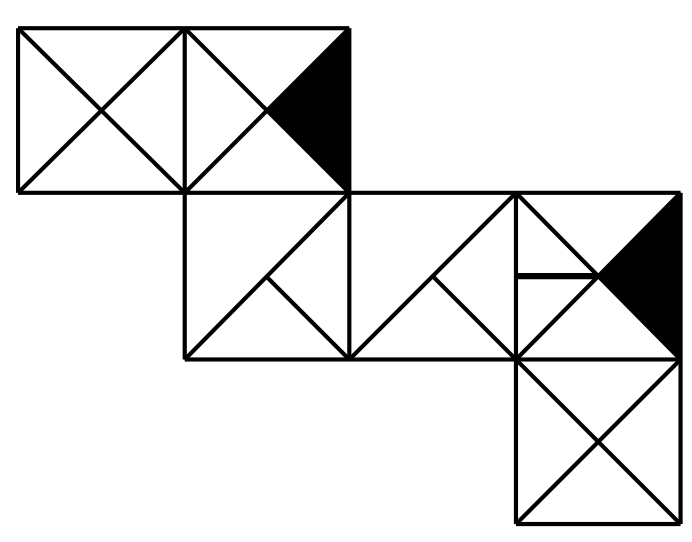
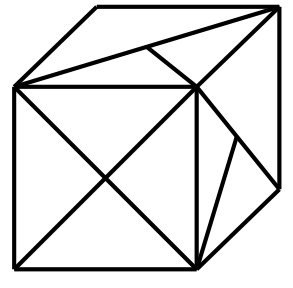
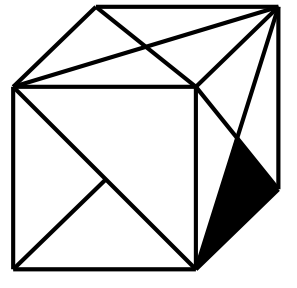
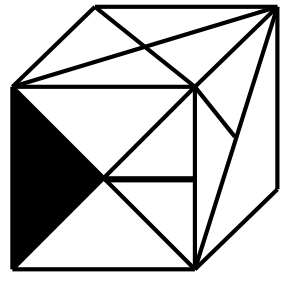
A family has four children. On January 1, 2020, their ages were in the ratio $2:3:4:5$ and the sum of their birth years is 8038. What is the sum of the children’s ages on January 1, 2026?
A car and a truck travel in the same direction along a straight highway. At a certain moment, the truck is 1 km ahead of the car. The truck travels at a constant speed of 88 km/h, while the car travels at a constant speed of 100 km/h. What is the distance, in m, between the truck and the car one minute before the car catches up with the truck?
A party had between 41 and 48 attendees. In each dance, every attendee who participates in the dance is paired with exactly one person of the opposite sex. At the end of the party, it is known that each boy had danced with exactly four different girls, and each girl had danced with exactly five different boys. How many girls attended the party in total?
Along the path between Alice’s house and Ben’s house is a line of flowers consisting of 25 peonies and 25 tulips. One day, Alice walks from her house toward Ben’s house, watering the flowers one by one as she encounters them. After watering the 20th tulip, her water runs out, leaving exactly 10 flowers unwatered. The next day, Ben walks from his house toward Alice’s house, picking the flowers one by one as he encounters them. After picking the 6th tulip, he decides that he has enough flowers for a bouquet. How many flowers remain along the path?
An ant goes out to look for food. After finding food, it immediately returns to its nest and brings back 15 more ants. These ants are still unable to move the food, so half of them return to the nest, and each brings back 10 more ants. They are still unable to move the food, so one-third of the ants return to the nest, and each brings back 8 more ants. Still unable to move the food, one-fourth of the ants return to the nest, and each brings back 6 more ants. Again, unable to move the food, one-fifth of the ants return to the nest, and each brings back 4 more ants. Finally, the ants are able to move the food. How many ants were there in total when the food was moved?
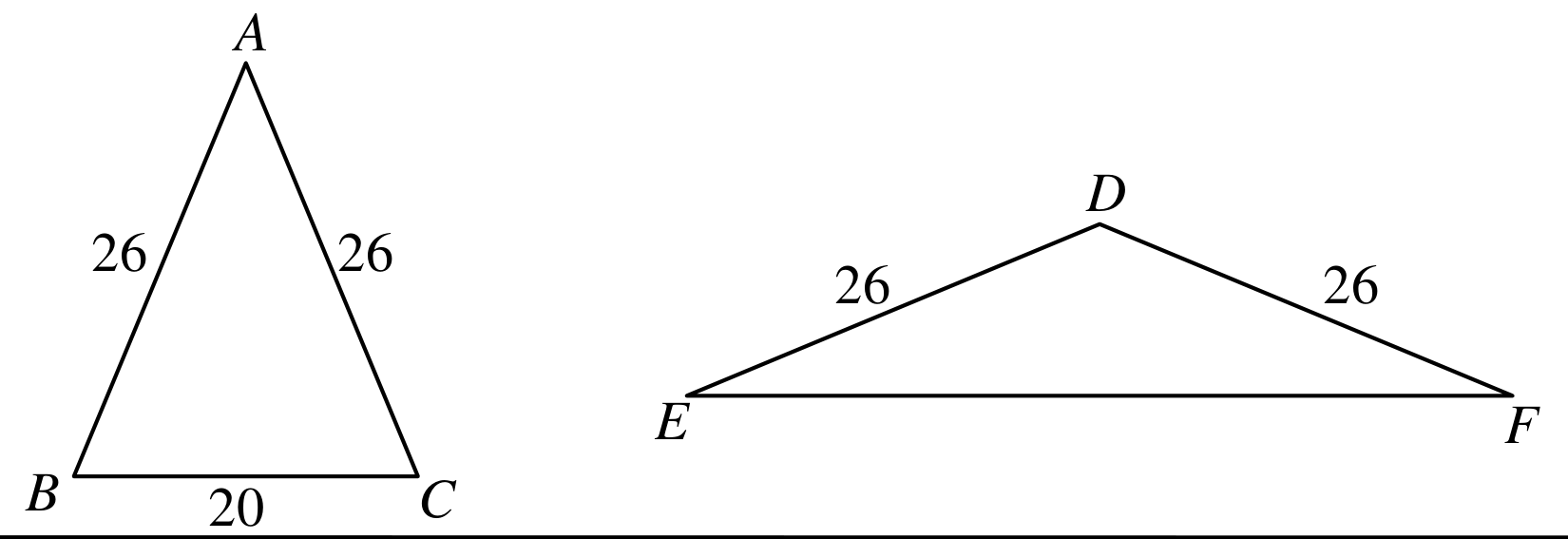
In triangle $ABC$, $AB=AC=26$ cm and $BC=20$ cm. In triangle $DEF$, $DE=DF=26$ cm, where the length of $EF$ is an integer, in cm, with $EF\ne BC$. It is known that the two triangles have the same area. What is the length, in cm, of $EF$?
Start with the number 2. At each turn, you may either add 4 to the current number or multiply the current number by 3. For example, it is possible to reach exactly 82 in 18 turns as shown below:
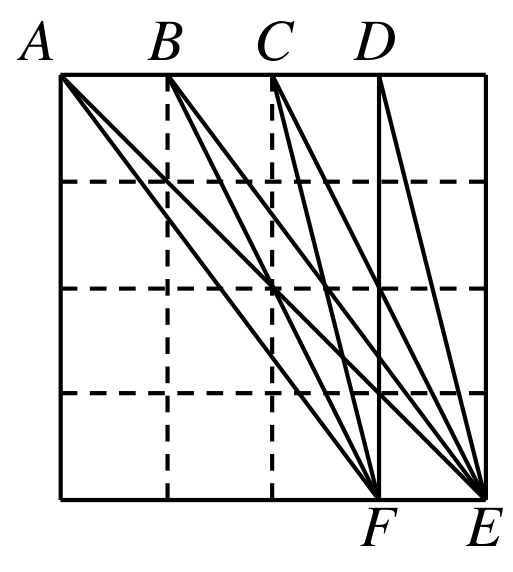
As shown in the diagram below, points $A,B,C,D,E$ and $F$ are grid points marked on the $4\times4$ square. What is the sum, in degrees, of $\angle EAF+\angle EBF+\angle ECF+\angle EDF$?
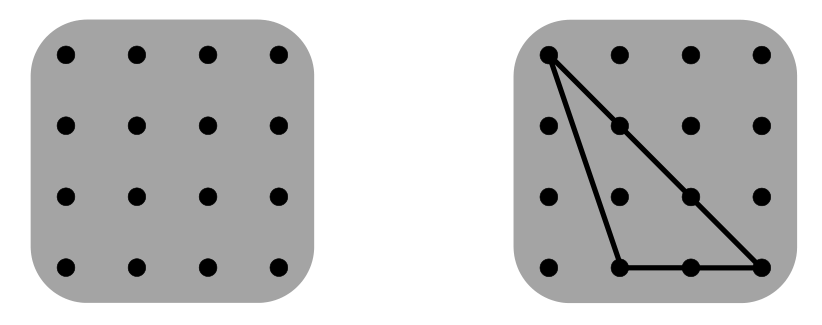
As shown in the diagram on the left below, a $4\times4$ grid is created on a wall by using sixteen nails, with the distance between any two adjacent nails, whether horizontally or vertically, equal to 10 cm. A rubber band is then used to connect three non-collinear points on the grid to form a triangle. The diagram on the right below shows one example of a triangle formed in this manner.
How many different possible values can the area of the resulting triangle formed in this manner take?
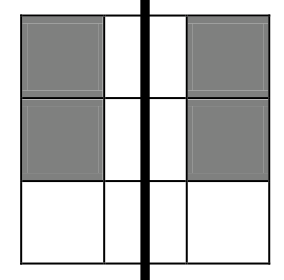
As shown in the diagram below, four unit squares of the $3\times3$ grid are painted gray and the thick line represents one line of symmetry of the $3\times3$ grid.
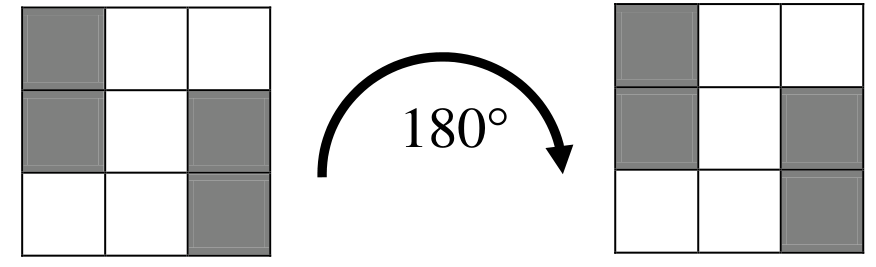
As shown in the diagram below, four unit squares of the $3\times3$ grid are painted gray so that the diagram looks exactly the same when rotated by $180^\circ$. We say that the pattern has $180^\circ$ rotational symmetry.
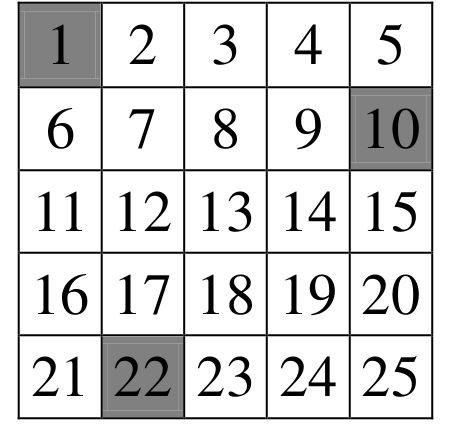
Now, three unit squares of the following $5\times5$ grid are painted gray. Ann needs to paint additional unit squares gray so that the resulting shape has at least one line of symmetry and looks exactly the same when rotated by $180^\circ$. If Ann paints the least possible number of squares, what is the sum of the numbers written inside the additional unit squares she paints, excluding the initial three? (Note: the orientation of the numbers written inside the squares is ignored when assessing the symmetry of the shaded pattern.)
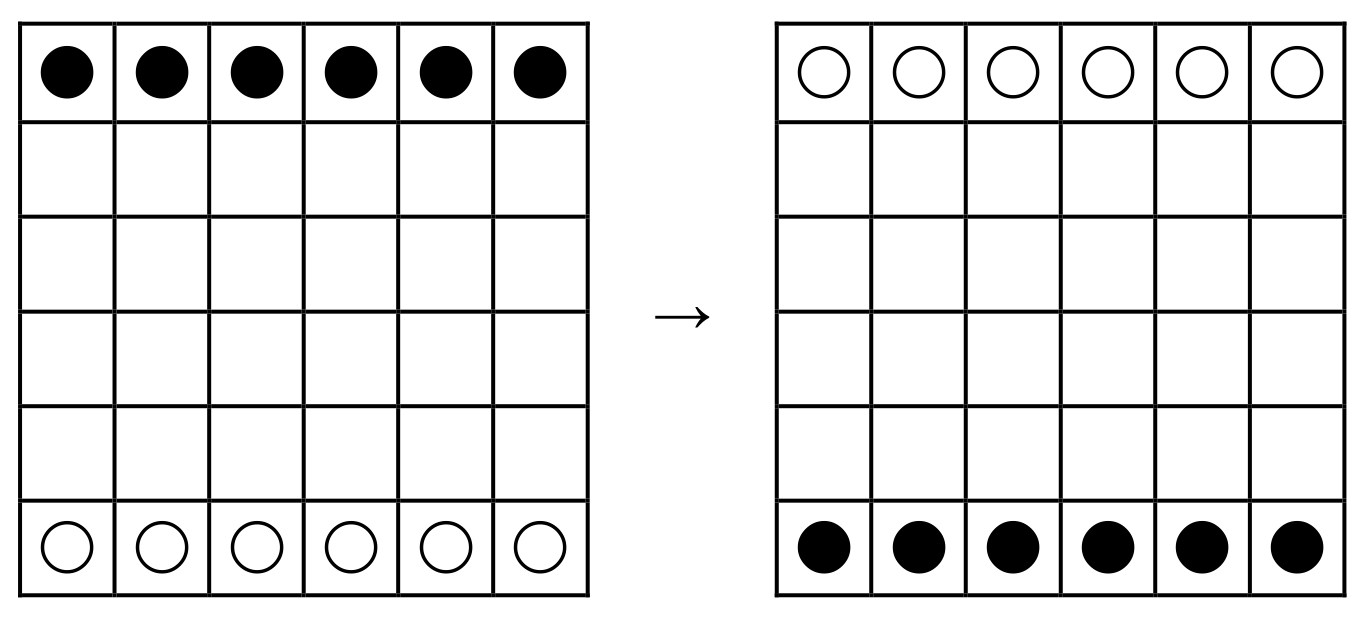
As shown in the diagram on the left below, there are six identical black circles in the first row of a $6\times6$ chessboard and six identical white circles in the last row. The circles can move one at a time, horizontally, vertically or diagonally (parallel to the main diagonals) by any number of squares as long as no other circle blocks the path. Black and white circles move alternately. What is the minimum number of moves required to interchange the black and white circles as shown in the diagram on the right below? You must prove that achieving the goal in fewer moves is impossible and provide one sequence of moves that accomplishes the interchange using the minimum number of moves.
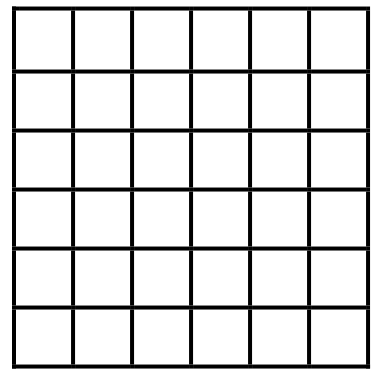
Give a sequence of moves that accomplishes the interchange. The source provides 30 identical blank boards for recording moves; one reusable template is shown here.
In Braille code, a positive integer is represented by the number sign followed by the Braille symbols for each of its digits, as shown in the table below. For example, the number 27 is represented as shown here, using a total of 10 dots:
Including the number sign, how many positive integers require exactly 8 dots to represent?