Three farmers Alvin, Benny and Charlie harvested 116, 112 and 96 chestnuts respectively. On the way home, one gave $\frac14$ of his chestnuts to one of the other two. Then another farmer gave $\frac14$ of his chestnuts to one of the other two. Finally the third farmer gave $\frac14$ of his chestnuts to another farmer. Afterwards all three had the same number. Which farmer first gave $\frac14$ of his chestnuts to which farmer?
Peter will be attending a two-day summer camp, where he plans to wear different
colour of socks in both days. He keeps all of his socks in a messy non-transparent
drawer under his bed and it is known that he has 8 black socks and 6 white socks.
If he takes out 1 sock at a time, how many socks does he need to get to be sure
that he gets 2 pairs of socks of different colour?
In the sequence,
1, 2, 4, 8, 6, …
Starting from the second term, each term is formed by multiplying the previous term
by 2 and then taking the remainder when divided by 10. What is the 2022nd term?
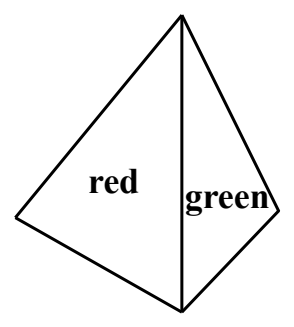
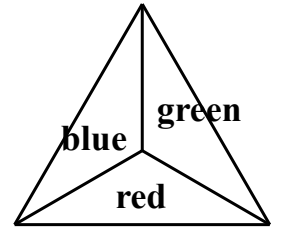
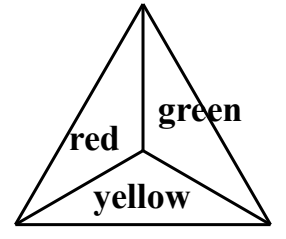
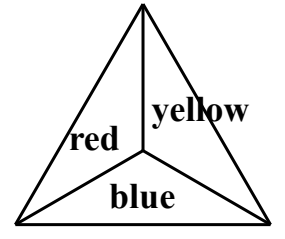
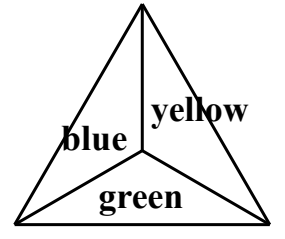
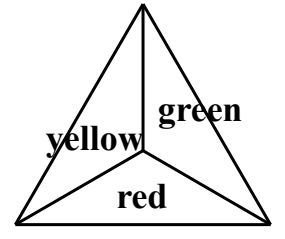
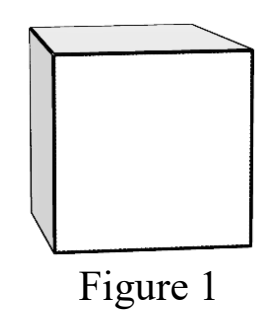
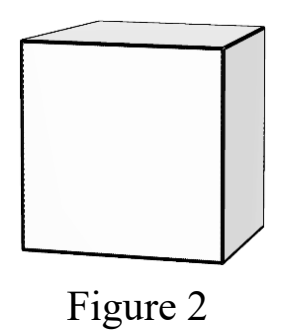
A tetrahedron is a regular pyramid with four equilateral triangular faces. Paint the faces red, green, yellow and blue, one colour per face. Five views are shown. Which is inconsistent with the other four?
One day, Robert went to a library 1600 meters away from home to meet with his
classmates at 13 : 20. Robert leaves home at 13 : 00, walking at a constant speed
of 80 meters per minute. At exactly 13 : 05, Robert's mother noticed that he left
his wallet at home, so she chased him walking at a speed of 120 meters per
minute. Robert only realized he left his wallet at home at 13 : 10, so he walked
back casually at a speed of 80 meters per minute. Robert and his mother met
halfway through. After taking his wallet, he again walked back towards the
library at a speed of 80 meters per minute. If we ignore the time Robert took to
get the wallet from his mother, how much time, in minutes, did he waste?
Mr. Andrew's office is located in City T, while he lives in City S. Every day after
timing-off from work, he takes the same train to return to his home city. The train
station in city S is still some distance away from his home, and his wife travels
by car to the train station to pick him up. It is known that the train and his wife
arrive at the train station at the same time. One day, due to some reasons, his wife
left their house 30 minutes later than usual. Upon arriving at the train station in
City S, Andrew noticed that his wife hasn’t arrived yet so he decided to walk
home. On his way walking home, he met his wife along the way and rode the car
immediately. Upon reaching home, Andrew observed that they arrived home 22
minutes later than usual. How long, in minutes, did Andrew walk?
Station Mr. Andrew’s home
There are four cards with digits 0, 1, 2 and 3 written on each of them. Choose
three different cards and arrange them to form all possible three-digit numbers,
where 0 is not allowed be leading digit. What is the sum of all those three-digit
numbers that are odd?
Three positive 9-digit numbers A, B and C each contains all the digits from 1 to 9
exactly once. If A−B =C, then what is the largest possible value of integer C?
In a line, there is at least one girl and at least one boy. Two children with exactly
4 or 7 other children between them are of the same gender. What is the maximum
number of children in this line?
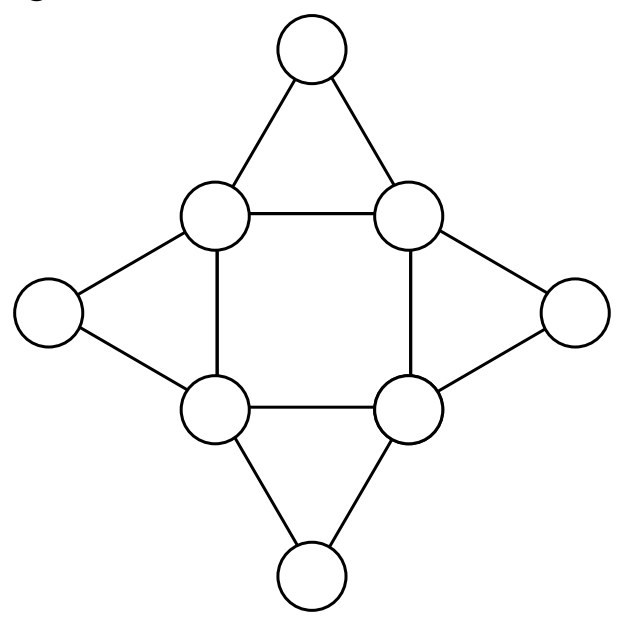
Numbers 1, 2, 3 and 4 are to be placed into the circles in the diagram below,
where each circle must be filled with exactly one number. If two circles
connected by a line should not contain the same number, find the total number of
ways in filling the diagram.
A continuous look-and-say sequence is formed this way: Start with three 1’s;
read the terms as “three 1’s” and write down what you read as “31” at the end of
the sequence; read the next group of unread identical numbers as “one 3” and
write “13” at the end; continue this process to get an infinite sequence 1, 1, 1, 3,
1, 1, 3, 2, 1, ….
(a) What is the largest possible digit you could write down? Why? (5 points)
(b) What is the 20th term of this sequence? Why? (5 points)
(c) Will the number “333” appear in the sequence? Why or why not? (10 points)
(b) The 20th term of this sequence is . The reason is:
(c) □ Yes. □ No. The reason is: