Divide the number 10 into the sum of three distinct positive integers. How many different ways are there altogether? (Note: if the arrangement of same three positive integers are in different order, they are regarded as the same).
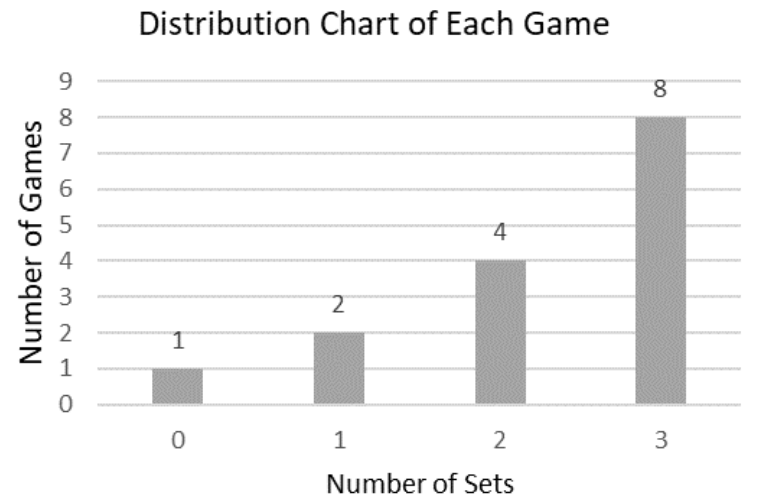
In a volleyball tournament, each game adopts the best three sets out of five sets game, in which each team has 0, 1, 2, or 3 possible sets of winning. The distribution chart shows a number of sets that a team can win as follows.
Distribution Chart of Each Game
What is the median of the number of sets won by the team in the tournament? (Note: The median of a group of data is the middle datum when the data are arranged in ascending order of magnitude.)
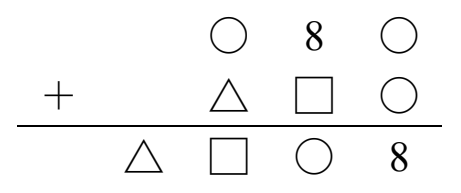
In the following addition expression, the same symbol represents the same number, and different symbols represent different numbers. It is known the leftmost digit in both the addend and the sum is nonzero. What is the value of $ \triangle + \Box + \bigcirc $?
Allan and Benny are computing the sum of a three-digit number and a two-digit number. The computation of Allan is correct with an answer of 136, while Benny is not doing it correctly because of a misalignment of digits in the vertical format mistakenly adding the tens digit of three-digit number with the units digit of the two-digit number and obtaining the tens digit in the sum. This is followed by adding the hundreds digit of the three-digit number and the tens digit of the two-digit number to get the hundreds digit in the sum with the final answer becoming 244. What is the difference between the three-digit number and the two-digit number?
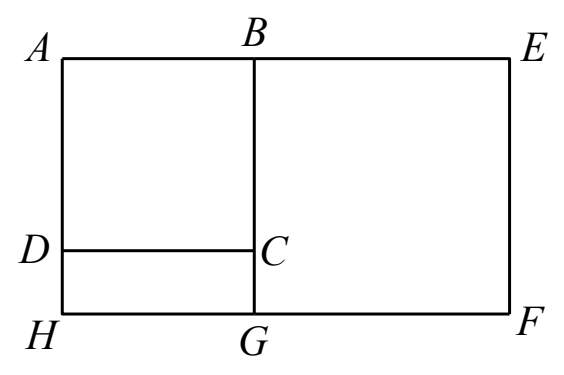
As shown in the figure, both quadrilateral ABCD and quadrilateral BEFG are squares, and AE = 28 cm, AH = 16 cm. What is the perimeter, in cm, of the rectangle CDHG?
There are 45 students in the class sitting in a row. The position of the student A is 28th from left, and the position of student B is 35th from right. How many students are there between student A and student B?
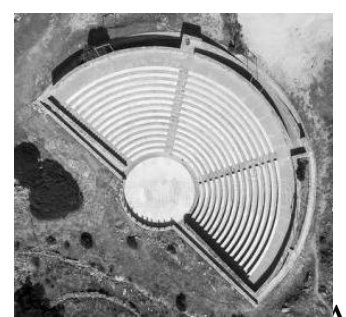
There are 14 rows of seats in a semi-circular auditorium. In a certain performance, 18 spectators are seated at the first row, and, starting from the second row, each row has three more spectators than the previous one. How many spectators are there in the auditorium during the performance?
What is the value of $ (1\times2\times3\times\cdots\times11)\div(22\times24\times25\times27) $? (if the answer is a fraction, express the answer with simplest form)
In a certain examination, Lily's average score in the three subjects - Foreign Language, Mathematics and Nature Science - was 90 points while the English examination still needs to be scheduled to a further date. How many points must Lily need to have in English to make the average score of the four subjects to be 92 points?
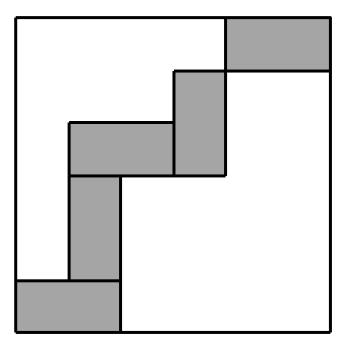
As shown in the figure, place five congruent small rectangles inside a large square such that each side of all the rectangles is parallel to one of the sides of the square. If the side length of the given large square is 48 cm, what is the area, in cm², of a small rectangle?
An electronic watch shows 7 o'clock thirty-one minutes on the surface of the watch as 7:31. From 7:00 to 8:00 in the morning, how many times will three distinct digits appear as a point of time on the surface of watch?
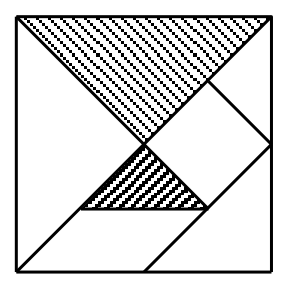
Below is a tangram which was invented in China. It is a famous puzzle with seven ingenious pieces: five isosceles right triangles of three sizes, one square and one parallelogram. If the area of one of the smallest isosceles right triangle in the 7-piece puzzle is 6 cm², what is the area, in cm², of the largest isosceles right triangle in this puzzle?
After arranging 1000 consecutive positive integers in a certain order, followed by computing the sum of each successive three numbers from the beginning, a total of 998 sums can be obtained. What is the largest possible number of odd integers among these 998 sums?
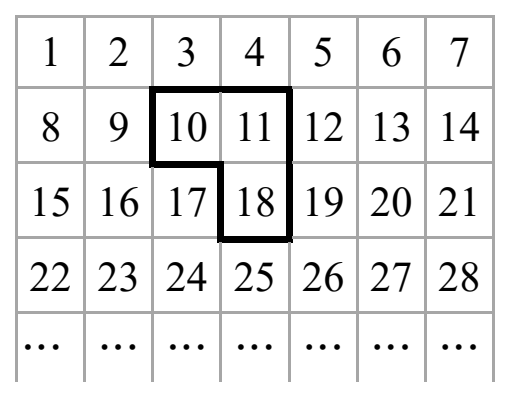
Fill in the grid with the positive integers starting from 1 as shown in the figure, and then use an “L-shaped block” (that is composed of three unit squares which can be rotated or flipped) to frame three numbers and compute their sum. For example, in the figure below, the sum of the three numbers framed by the L-shaped block is $ 10+11+18=39 $. It is known that the sum of the three numbers framed by an L-shaped block is 2019. What is the largest possible value of the largest number among the three numbers framed by an L-shaped block?