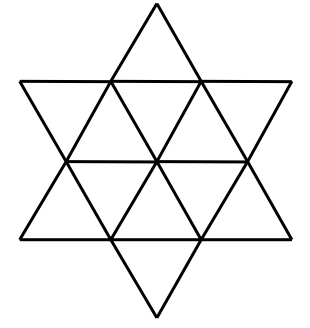
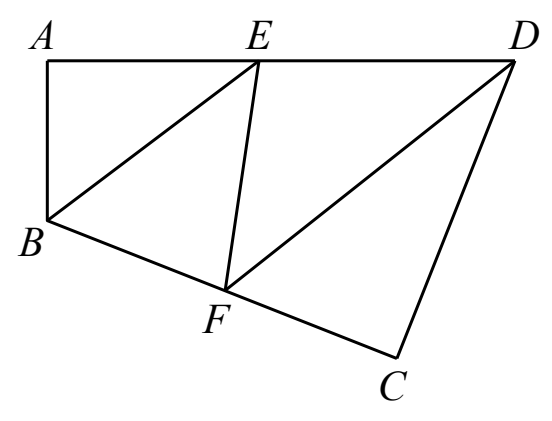
The figure below is formed by using 12 identical equilateral triangles. How many equilateral triangles of different sizes (and which are located in different places) are there?
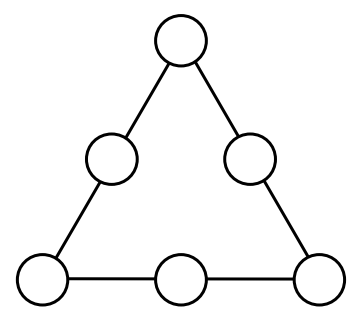
Place the numbers 1, 2, 3, 4, 5 and 6, without repetition, into the six circles in the figure below, where each circle should only have one number, such that the sum of the three numbers on each side of the triangle are all equal. What is the maximum possible value of this sum?
Multiply a two-digit number by 3 then add 10 to it. Now, we swap the order of the two digits of the result. The resulting number is an integer among 95, 96, 97, 98 and 99. What is the original number?
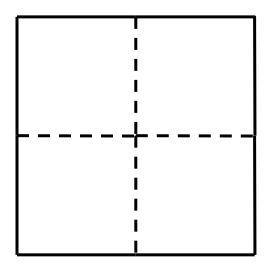
A square has a perimeter 48 cm. Cut it into four identical small squares along the dashed lines as shown below. What is the sum of the perimeters of the four smaller squares?
Lily went shopping and bought three items from three different stores. She then noticed that whenever she was paying for an item, the money in her pocket was exactly five times the amount to be paid. After shopping, she noticed that she has 64 dollars left in her pocket. How much money did she have before she went shopping?
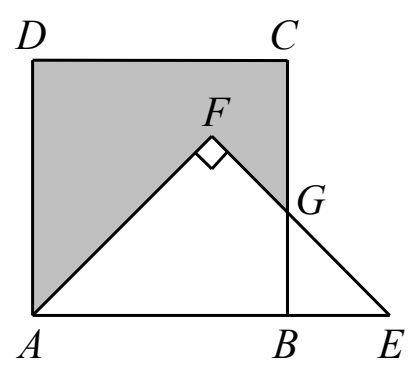
In the figure below, $ ABCD $ is a square with side length of 10 cm and $ AFE $ is an isosceles right triangle with hypotenuse of length 14 cm, where $ E $ is on the extension of line $ AB $. What is the area, in cm², of the shaded region?
There are a total of 40 students in a class. 23 of them are able to ride bikes, 33 of them are able to swim and 5 of them are unable to do either. How many students in this class are able to ride bikes but are not able to swim?
A bridge is 1500 m long. A train passes through the bridge at a speed of 30 m per second. The train is 300 m long. How long, in seconds, does it take for the train to pass the bridge completely, starting from the time it entered the bridge?
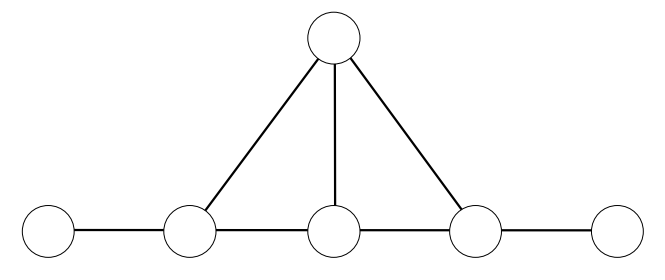
In the figure below, color each of the six circles into 4 colors: Red, Yellow, Blue and Black. Each circle should contain only one color, and any two circles connected by a line segment should have different colors. In how many different ways can we color the figure below? (Note: Coloring methods that are identical by a reflection of the figure are NOT considered the same)
In quadrilateral $ABCD$, $\angle BAD = \angle BCD = 90^{\circ}$. Points $E$ and $F$ are on sides $AD$ and $BC$ respectively and $AB = 5\,cm$, $CD = 10\,cm$, $DE = 8\,cm$, $BF = 6\,cm$, as shown in the figure below. If the area of triangle $BEF$ is $4\,cm^2$ less than the area of triangle $DEF$. What is the area, in $cm^2$, of triangle $DEF$?
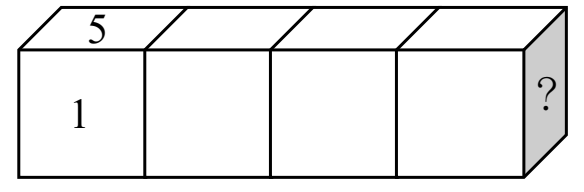
The numbers 1, 2, 3, 4, 5 and 6 are written on the six faces of a unit cube without repetition. Each face contains one number and the sum of the numbers in every two opposite faces is 7. Put four such cubes side by side as shown in the figure below, such that sum of every two numbers of every two touched faces is 8. Find the number marked with “?” in the figure.
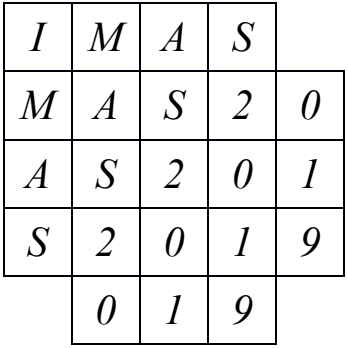
A mouse starts from the top left-most unit square marked with “ $ I $”, follows a route to form the word “IMAS2019” by moving from one square to another square that share a common side. How many different routes of eight squares are there?
| I | M | A | S | |
| --- | --- | --- | --- | --- |
| M | A | S | 2 | 0 |
| A | S | 2 | 0 | 1 |
| S | 2 | 0 | 1 | 9 |
| | 0 | 1 | 9 | |
An infinite sequence of numbers 1, 2, 3, 5, 8, 3, 1, 4, 5, 9, 4, ... follows the pattern such that starting from the third number, each number is equal to the units digit of the sum of the two numbers in the sequence immediately preceding it. What is the 2019th number of the sequence?