Skip to content / Đến nội dung
ThichHocToan.com

ASMO Science Olympiad 2018 — Level 3 (Years 7, 8 & 9)

Question 1

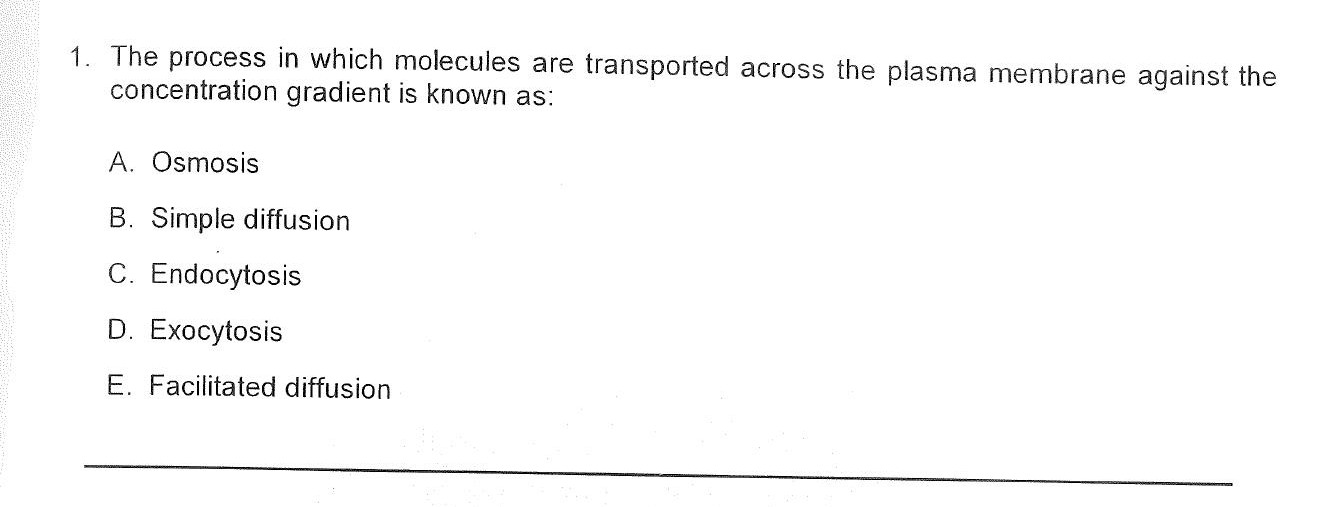
The process in which molecules are transported across the plasma membrane against the concentration gradient is known as:

Question illustration
  1. Osmosis
  2. Simple diffusion
  3. Endocytosis
  4. Exocytosis
  5. Facilitated diffusion

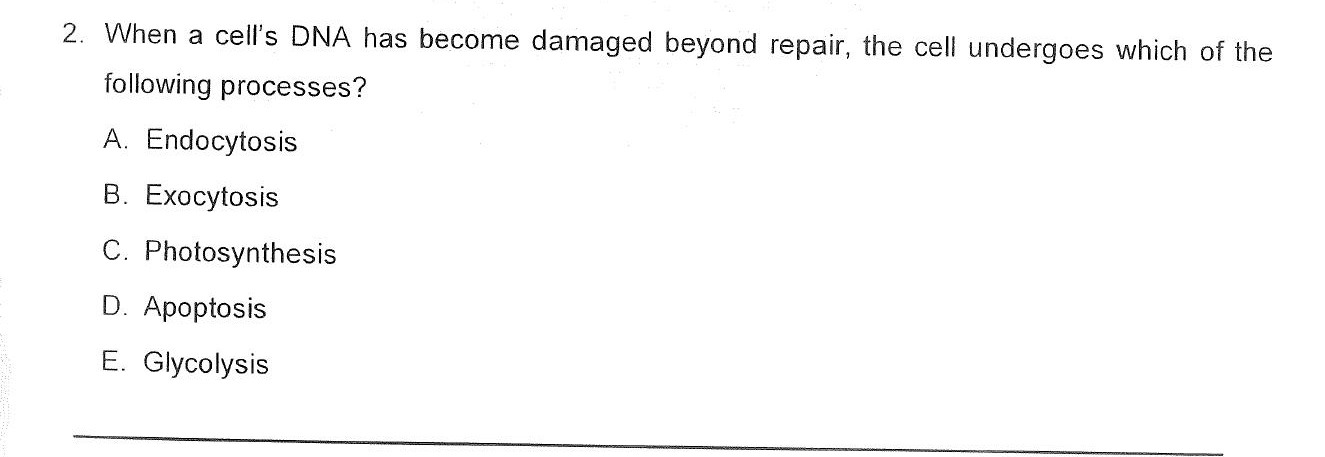
Question 2

When a cell’s DNA has become damaged beyond repair, the cell undergoes which of the following processes?

Question illustration
  1. Endocytosis
  2. Exocytosis
  3. Photosynthesis
  4. Apoptosis
  5. Glycolysis

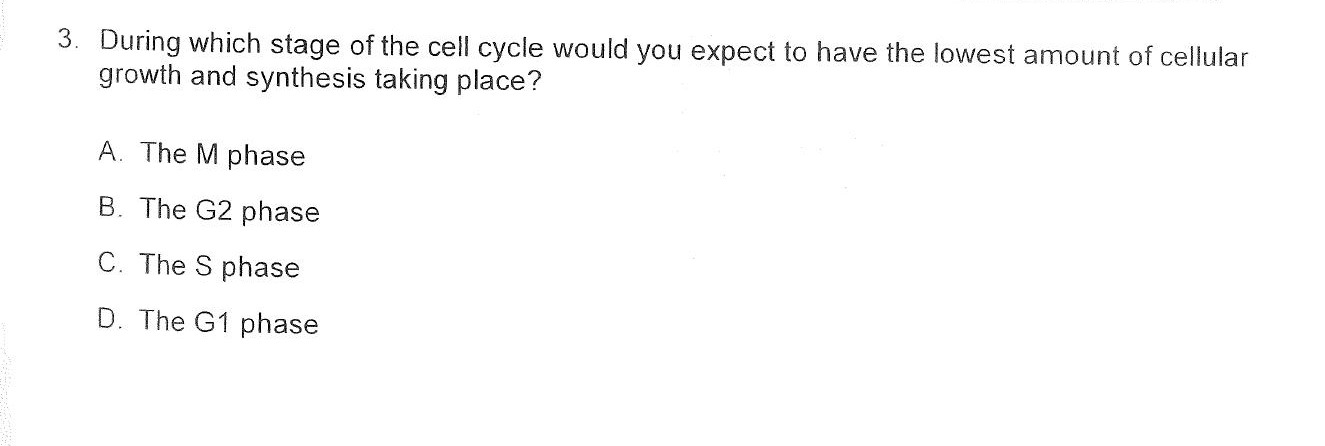
Question 3

During which stage of the cell cycle would you expect to have the lowest amount of cellular growth and synthesis taking place?

Question illustration
  1. The M phase
  2. The G2 phase
  3. The S phase
  4. The G1 phase

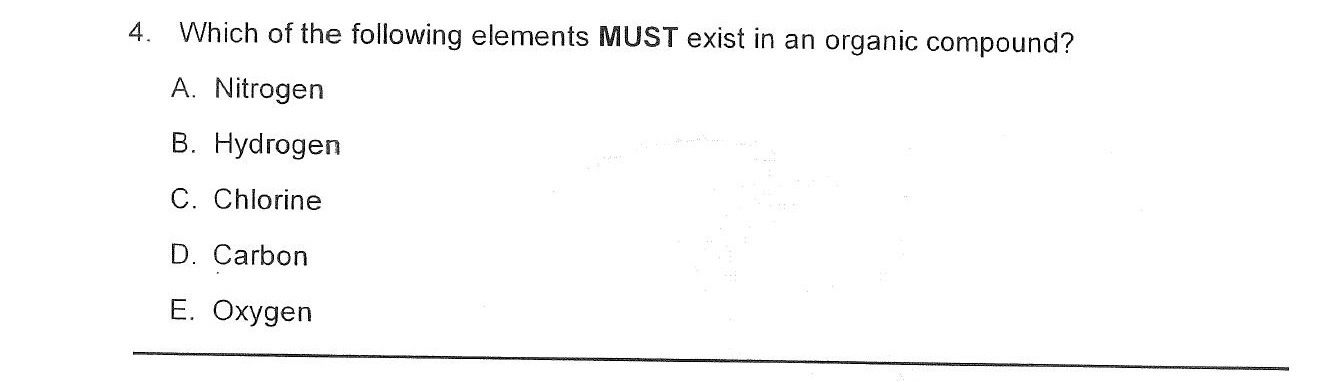
Question 4

Which of the following elements MUST exist in an organic compound?

Question illustration
  1. Nitrogen
  2. Hydrogen
  3. Chlorine
  4. Carbon
  5. Oxygen

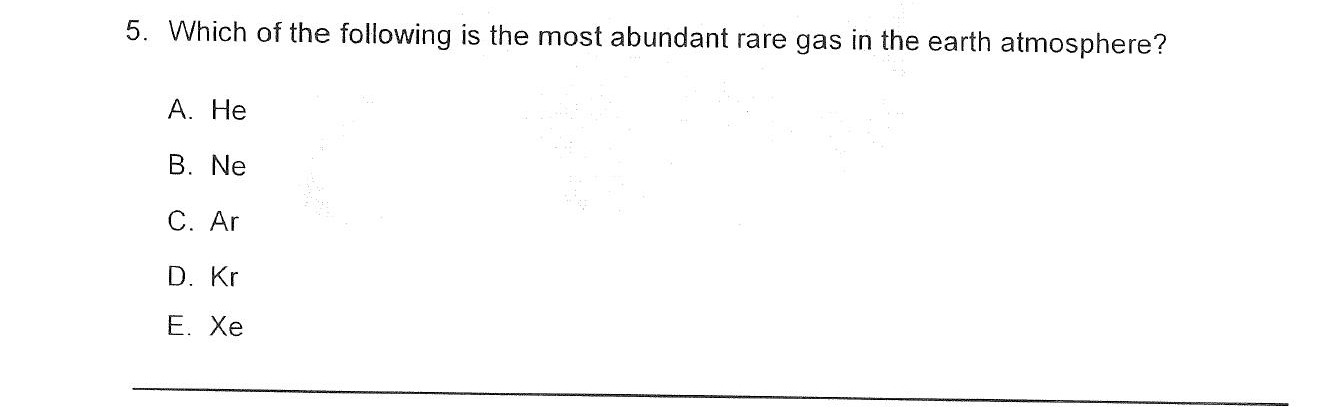
Question 5

Which of the following is the most abundant rare gas in the earth atmosphere?

Question illustration
  1. He
  2. Ne
  3. Ar
  4. Kr
  5. Xe

Question 6

Which of the following is the most malleable metal?

Question illustration
  1. Silver
  2. Gold
  3. Platinum
  4. Iron
  5. Copper

Question 7

Which of the following is the hardest form of carbon?

Question illustration
  1. Coke
  2. Graphite
  3. Diamond
  4. Charcoal
  5. None of above

Question 8

Which of the following contains the most neutrons?

Question illustration
  1. Oxygen-15
  2. Nitrogen-14
  3. Carbon-14
  4. Boron-12
  5. Carbon-12

Question 9

The high reactivity of fluorine is due to

Question illustration
  1. Its high electronegativity
  2. The small size of fluorine atom
  3. Availability of d-orbitals
  4. Strong F-F bonding
  5. None of above

Question 10

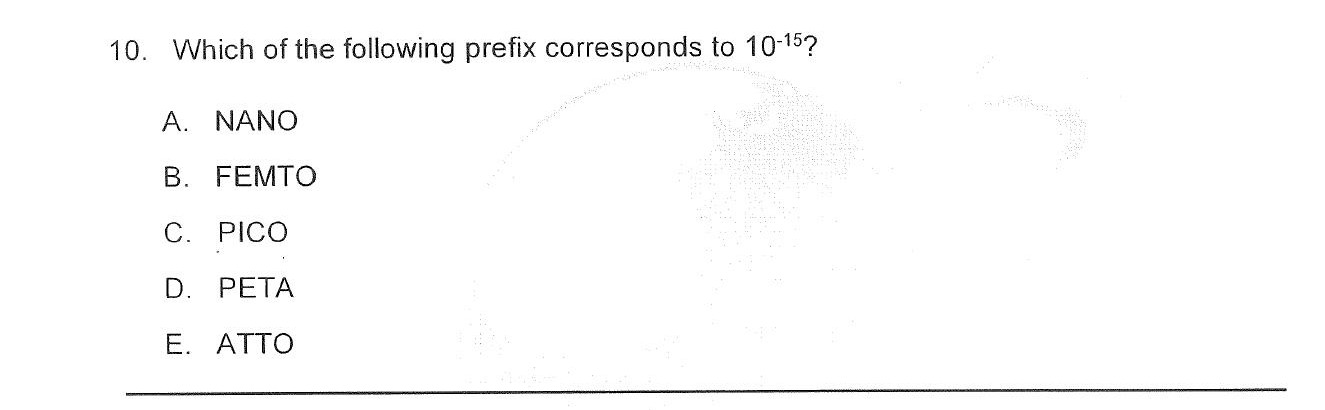
Which of the following prefix corresponds to 10⁻¹⁵?

Question illustration
  1. NANO
  2. FEMTO
  3. PICO
  4. PETA
  5. ATTO

Question 11

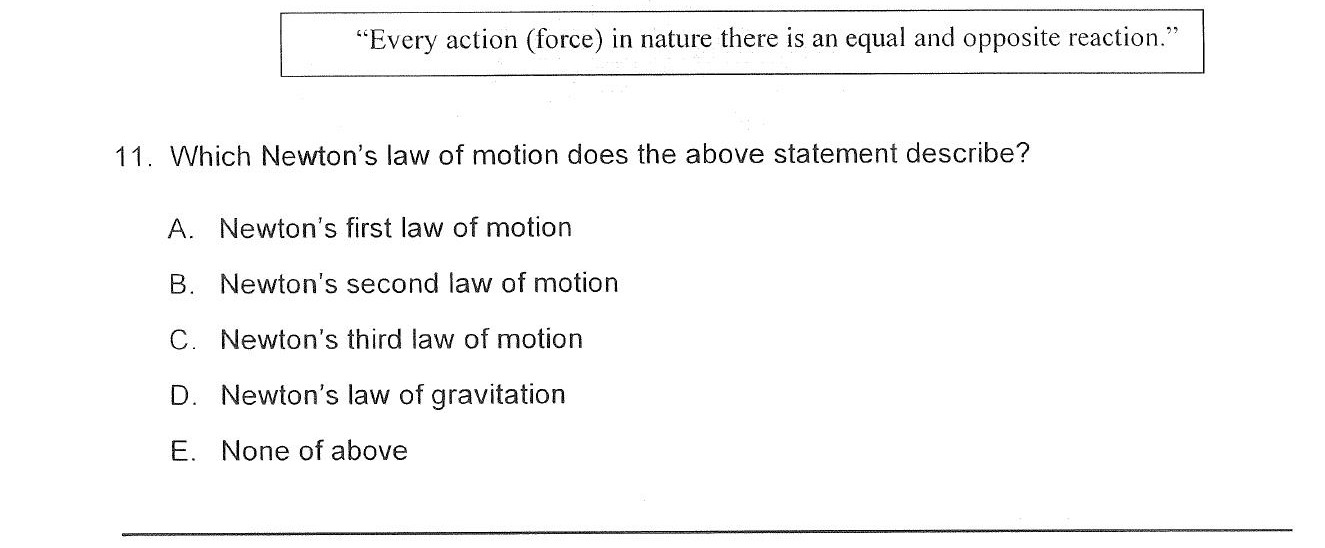
“Every action (force) in nature there is an equal and opposite reaction.”

Which Newton’s law of motion does the above statement describe?

Question illustration
  1. Newton’s first law of motion
  2. Newton's second law of motion
  3. Newton's third law of motion
  4. Newton’s law of gravitation
  5. None of above

Question 12

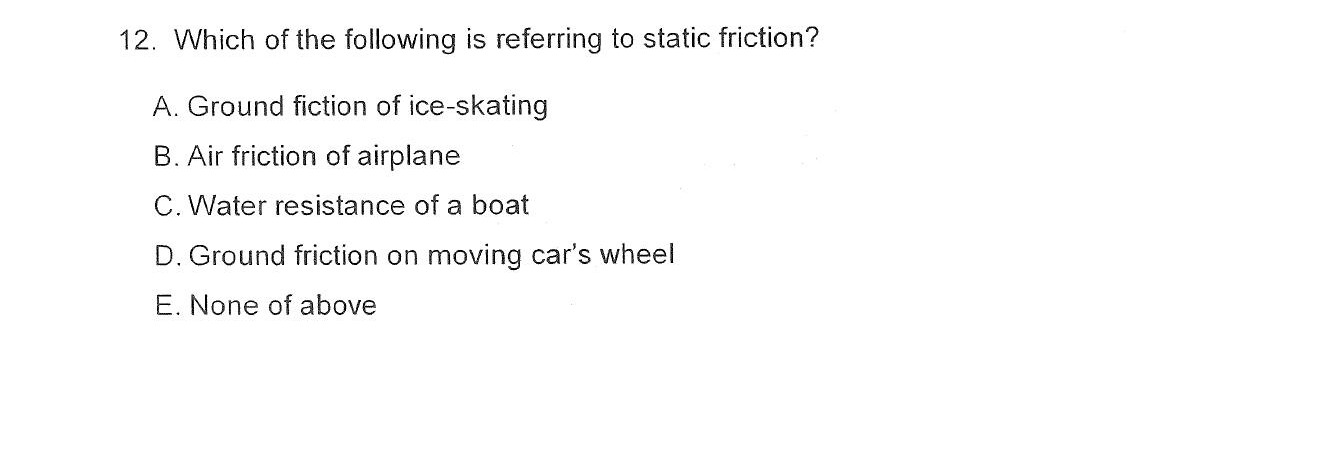
Which of the following is referring to static friction?

Question illustration
  1. Ground fiction of ice-skating
  2. Air friction of airplane
  3. Water resistance of a boat
  4. Ground friction on moving car’s wheel
  5. None of above

Question 13

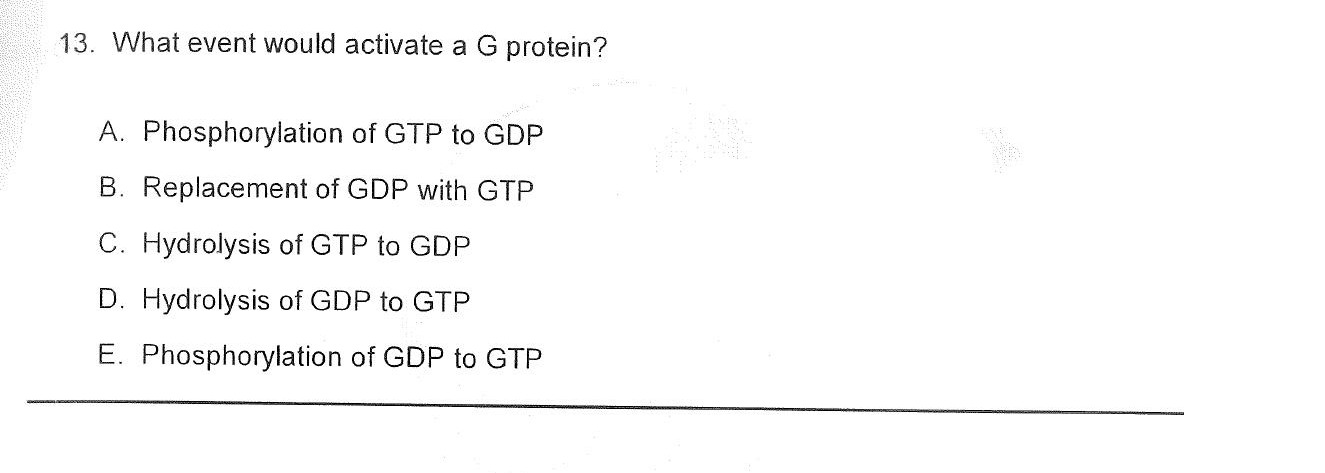
What event would activate a G protein?

Question illustration
  1. Phosphorylation of GTP to GDP
  2. Replacement of GDP with GTP
  3. Hydrolysis of GTP to GDP
  4. Hydrolysis of GDP to GTP
  5. Phosphorylation of GDP to GTP

Question 14

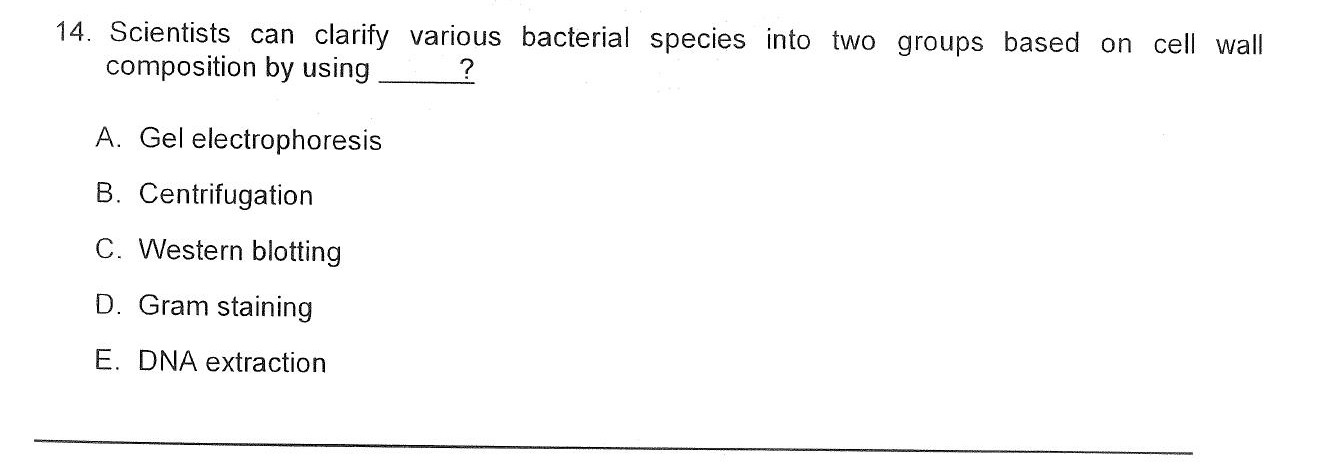
Scientists can clarify various bacterial species into two groups based on cell wall composition by using _____?

Question illustration
  1. Gel electrophoresis
  2. Centrifugation
  3. Western blotting
  4. Gram staining
  5. DNA extraction

Question 15

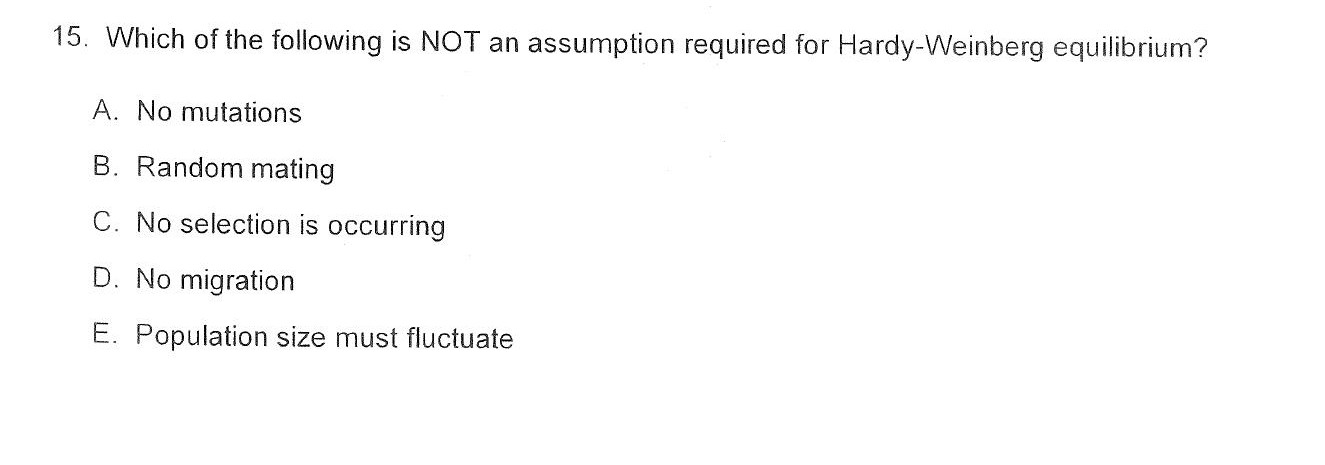
Which of the following is NOT an assumption required for Hardy-Weinberg equilibrium?

Question illustration
  1. No mutations
  2. Random mating
  3. No selection is occurring
  4. No migration
  5. Population size must fluctuate

Question 16

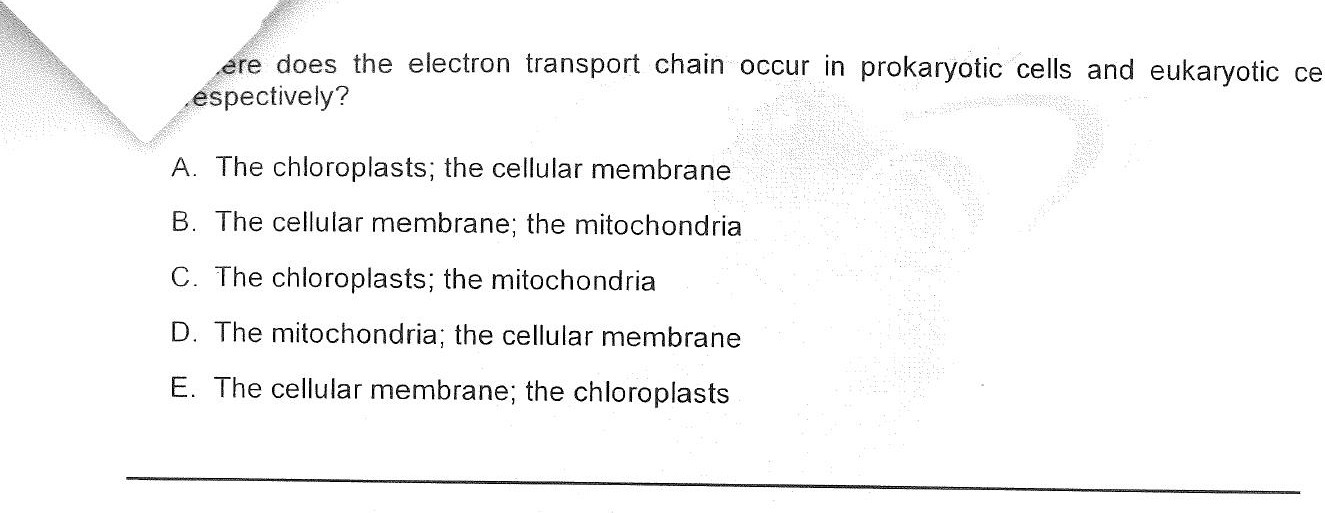
Where does the electron transport chain occur in prokaryotic cells and eukaryotic cells respectively?

Question illustration
  1. The chloroplasts; the cellular membrane
  2. The cellular membrane; the mitochondria
  3. The chloroplasts; the mitochondria
  4. The mitochondria; the cellular membrane
  5. The cellular membrane; the chloroplasts

Question 17

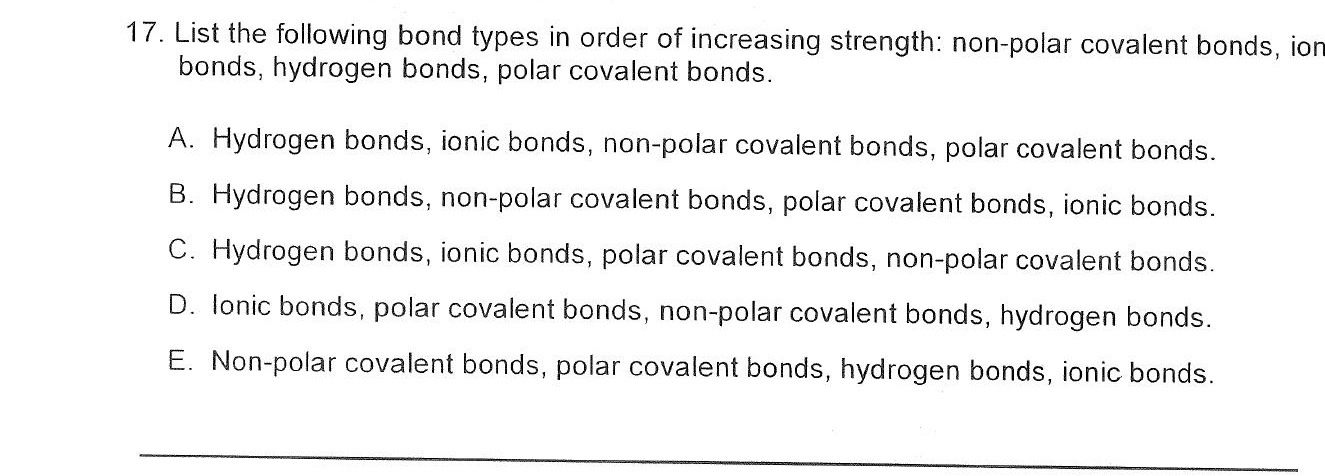
List the following bond types in order of increasing strength: non-polar covalent bonds, ionic bonds, hydrogen bonds, polar covalent bonds.
Question illustration
  1. Hydrogen bonds, ionic bonds, non-polar covalent bonds, polar covalent bonds.
  2. Hydrogen bonds, non-polar covalent bonds, polar covalent bonds, ionic bonds.
  3. Hydrogen bonds, ionic bonds, polar covalent bonds, non-polar covalent bonds.
  4. Ionic bonds, polar covalent bonds, non-polar covalent bonds, hydrogen bonds.
  5. Non-polar covalent bonds, polar covalent bonds, hydrogen bonds, ionic bonds.
Question 18

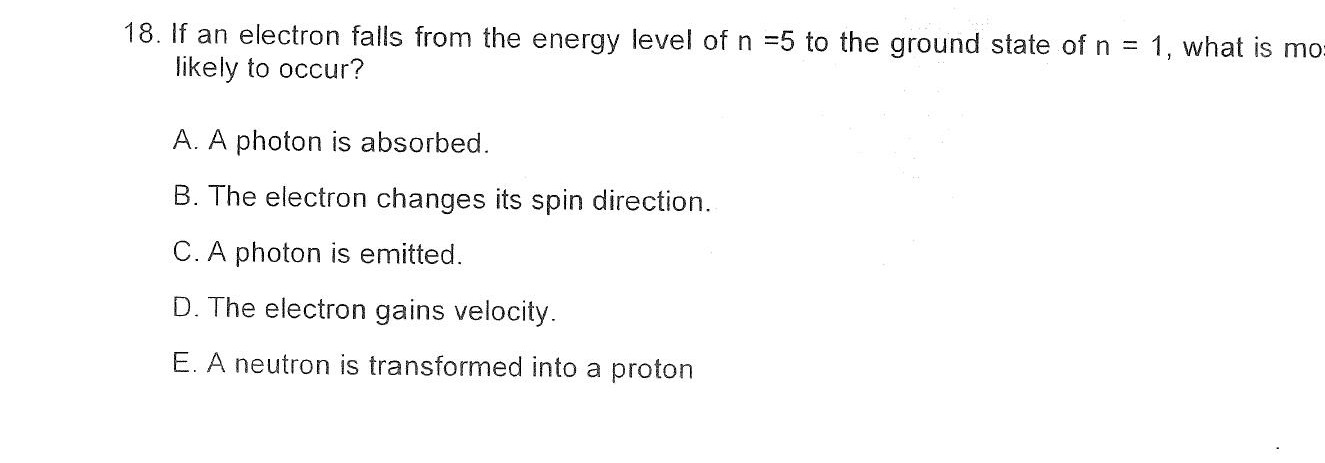
If an electron falls from the energy level of n =5 to the ground state of n = 1, what is most likely to occur?

Question illustration
  1. A photon is absorbed.
  2. The electron changes its spin direction.
  3. A photon is emitted.
  4. The electron gains velocity.
  5. A neutron is transformed into a proton

Question 19

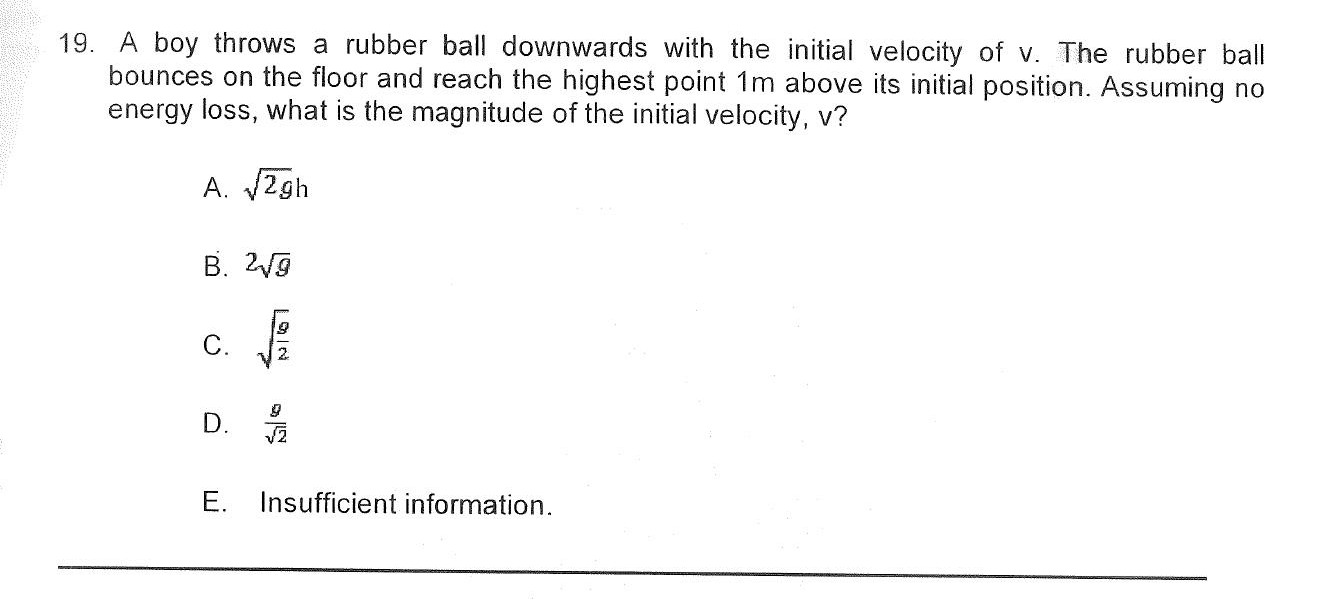
A boy throws a rubber ball downwards with the initial velocity of v. The rubber ball bounces on the floor and reach the highest point 1m above its initial position. Assuming no energy loss, what is the magnitude of the initial velocity, v?

Question illustration
  1. √(2gh)
  2. 2√g
  3. √(g/2)
  4. g/√2
  5. Insufficient information.

Question 20

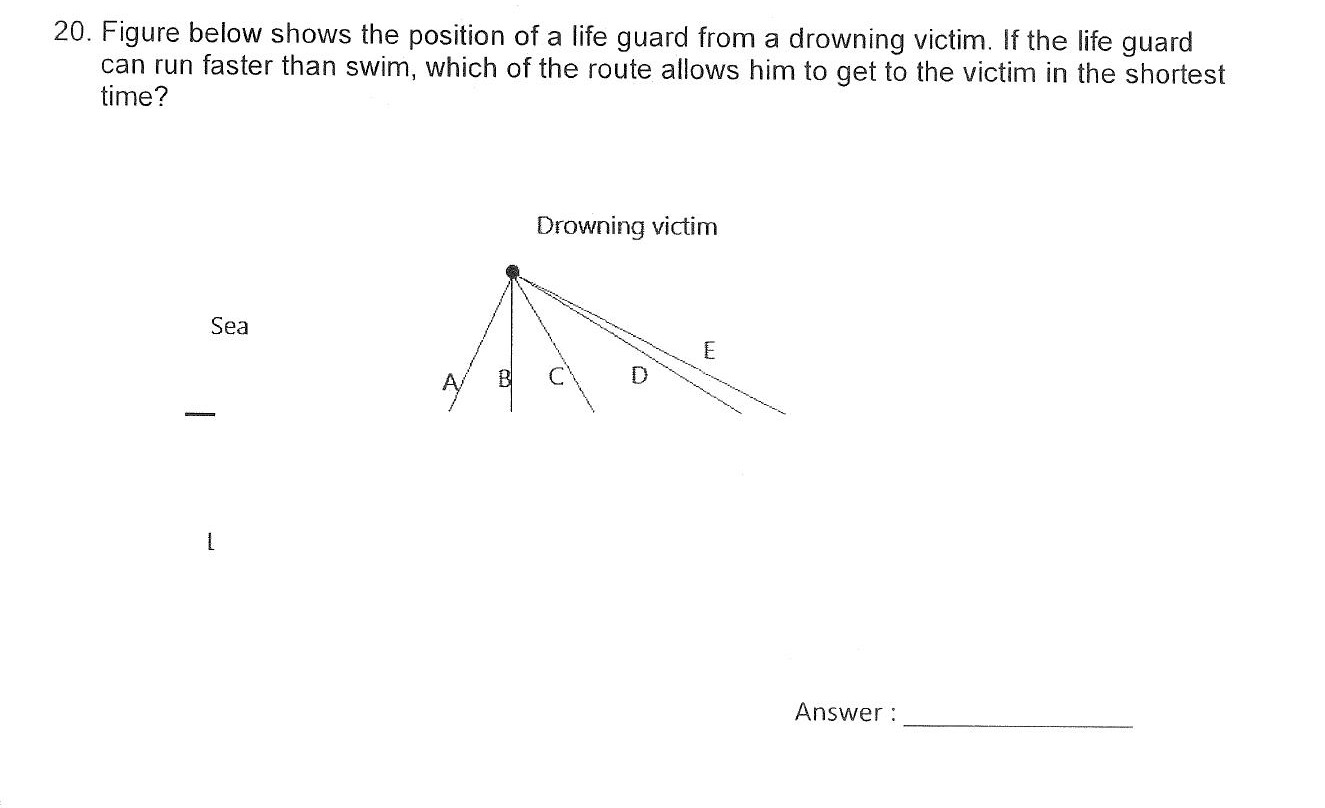
Figure below shows the position of a life guard from a drowning victim. If the life guard can run faster than swim, which of the route allows him to get to the victim in the shortest time?

Answer: ______

Question illustration