Skip to content / Đến nội dung
ThichHocToan.com

ASMO Science Olympiad 2014 — Division P, Level 2 (Years 5 & 6)

Question 1

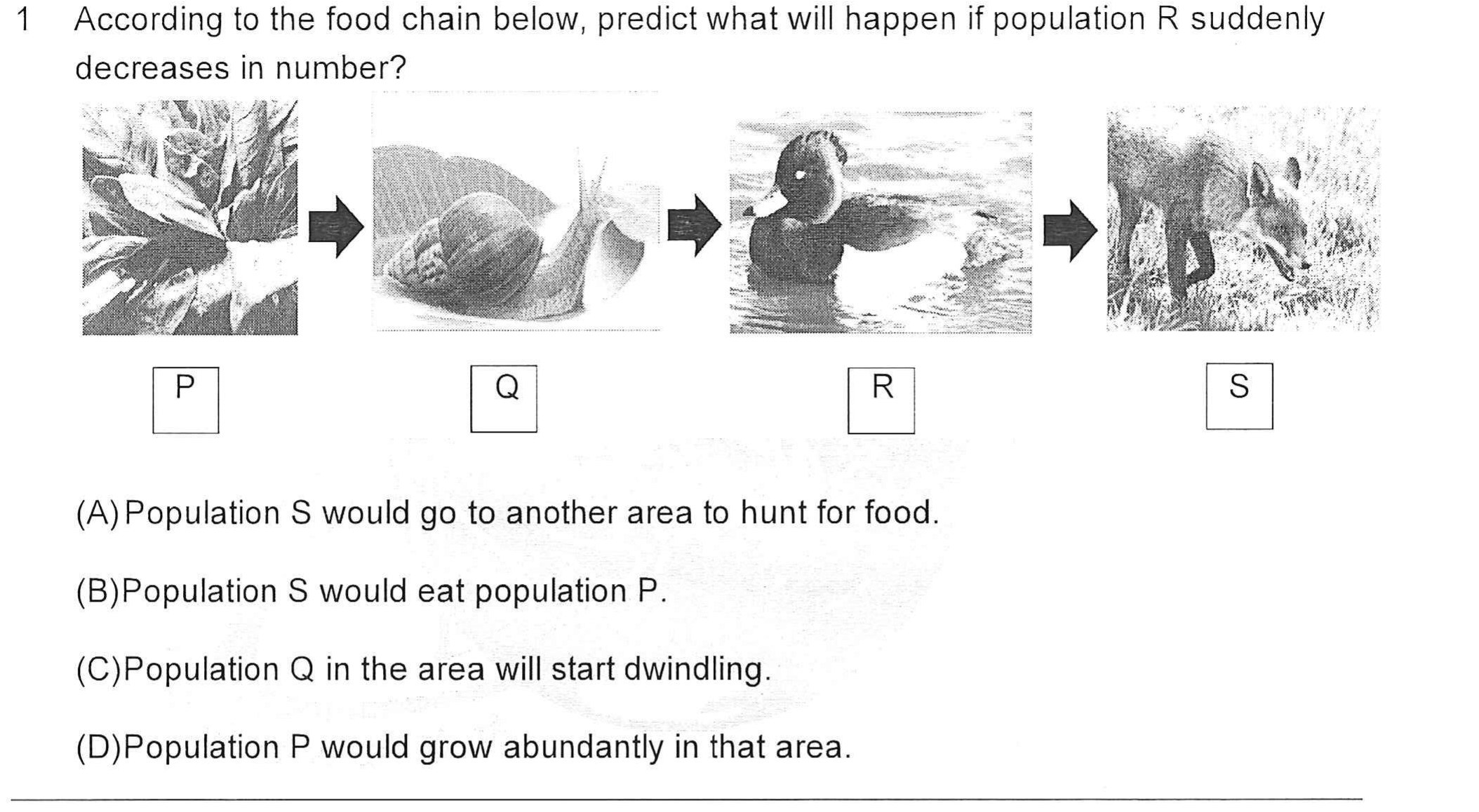
According to the food chain below, predict what will happen if population R suddenly decreases in number?

Question illustration
  1. Population S would go to another area to hunt for food.
  2. Population S would eat population P.
  3. Population Q in the area will start dwindling.
  4. Population P would grow abundantly in that area.

Question 2

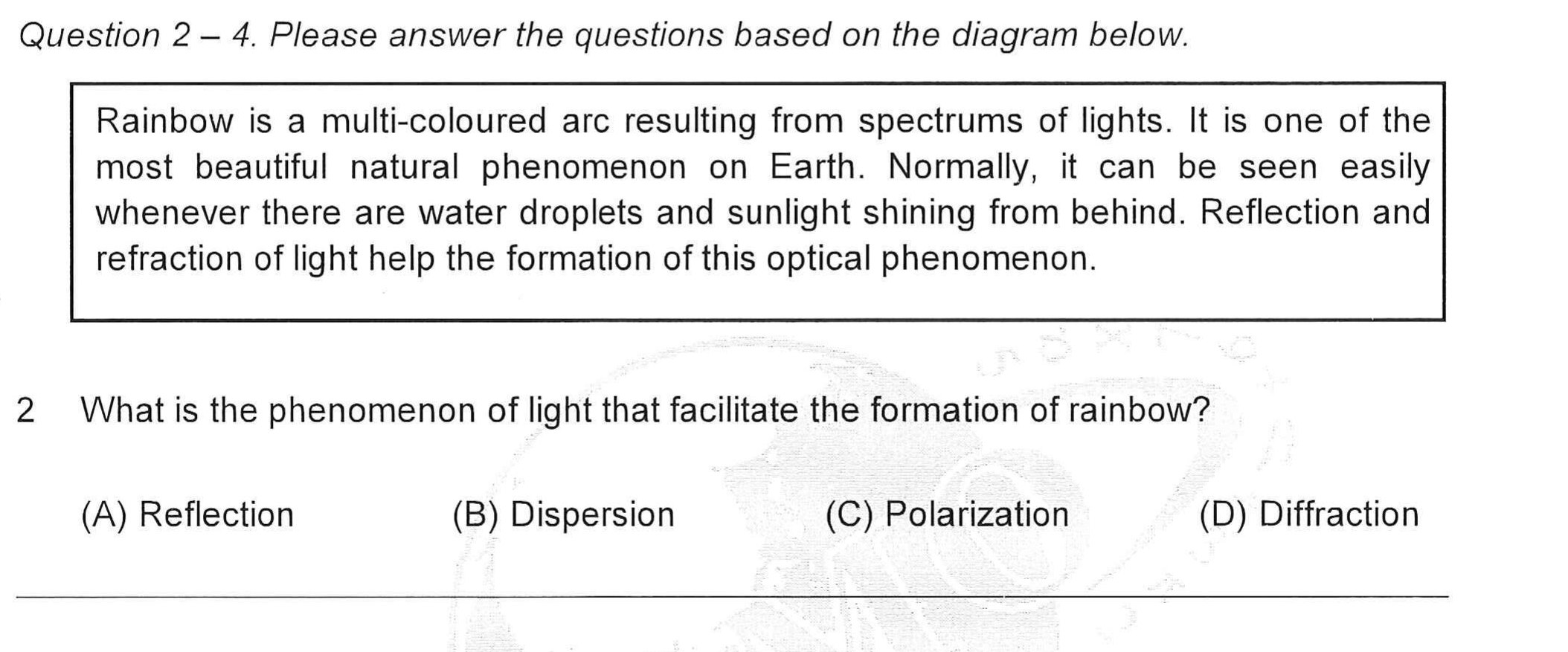
Rainbow is a multi-coloured arc resulting from spectrums of lights. It is one of the most beautiful natural phenomenon on Earth. Normally, it can be seen easily whenever there are water droplets and sunlight shining from behind. Reflection and refraction of light help the formation of this optical phenomenon.

What is the phenomenon of light that facilitate the formation of rainbow?

Question illustration
  1. Reflection
  2. Dispersion
  3. Polarization
  4. Diffraction

Question 3

Rainbow is a multi-coloured arc resulting from spectrums of lights. It is one of the most beautiful natural phenomenon on Earth. Normally, it can be seen easily whenever there are water droplets and sunlight shining from behind. Reflection and refraction of light help the formation of this optical phenomenon.

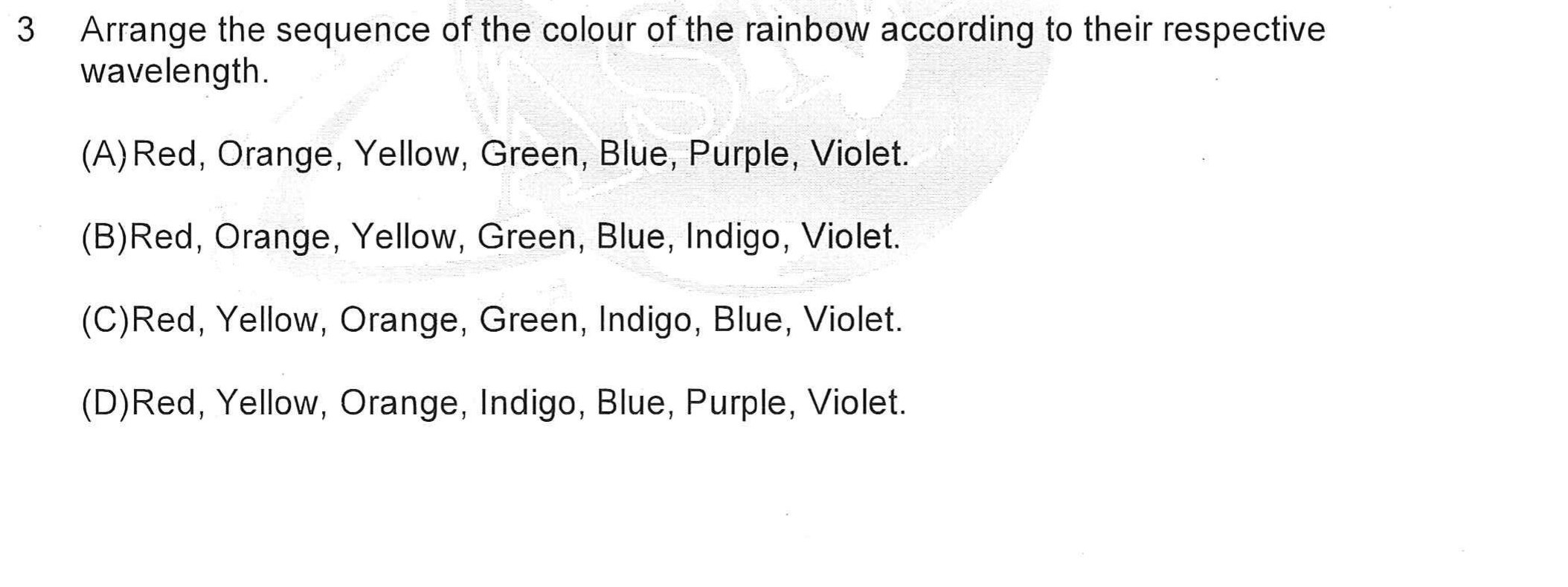
Arrange the sequence of the colour of the rainbow according to their respective wavelength.

Question illustration
  1. Red, Orange, Yellow, Green, Blue, Purple, Violet.
  2. Red, Orange, Yellow, Green, Blue, Indigo, Violet.
  3. Red, Yellow, Orange, Green, Indigo, Blue, Violet.
  4. Red, Yellow, Orange, Indigo, Blue, Purple, Violet.

Question 4

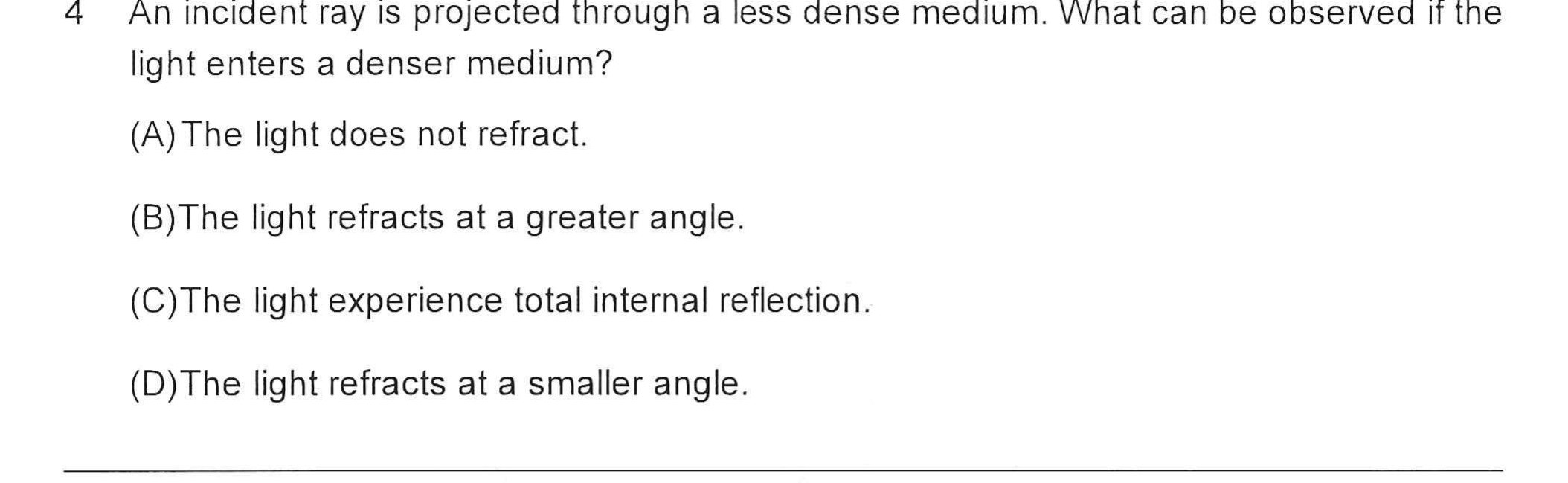
An incident ray is projected through a less dense medium. What can be observed if the light enters a denser medium?

Question illustration
  1. The light does not refract.
  2. The light refracts at a greater angle.
  3. The light experience total internal reflection.
  4. The light refracts at a smaller angle.

Question 5

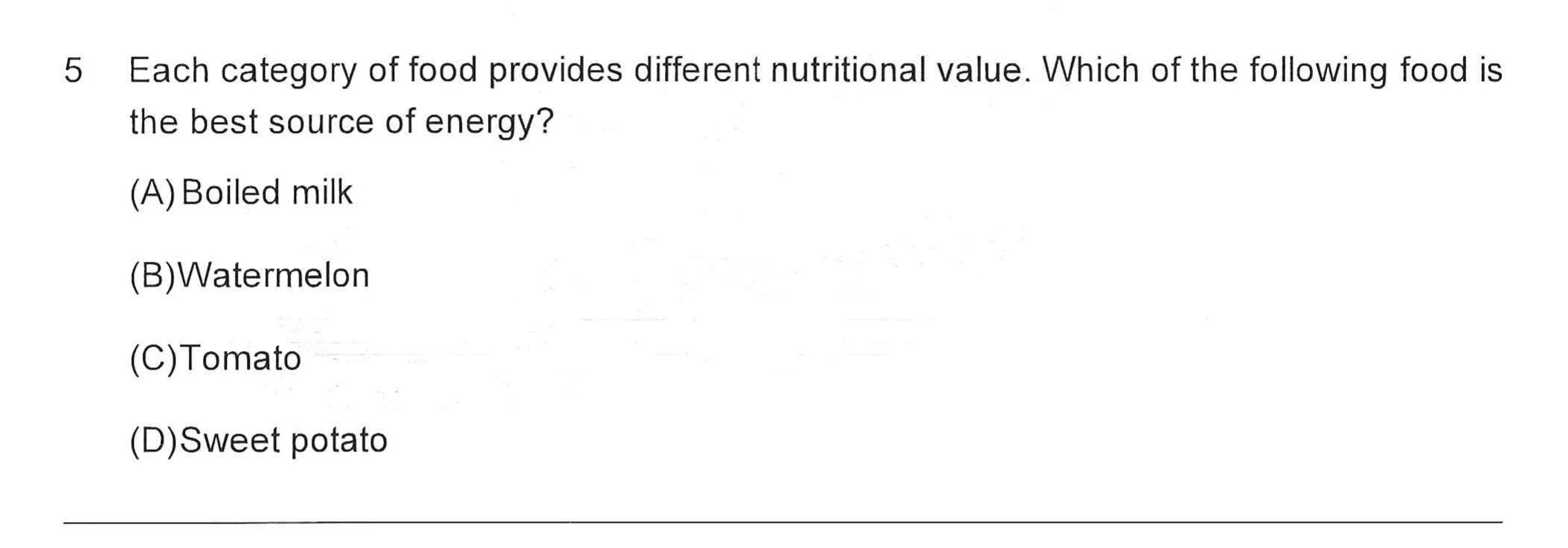
Each category of food provides different nutritional value. Which of the following food is the best source of energy?

Question illustration
  1. Boiled milk
  2. Watermelon
  3. Tomato
  4. Sweet potato

Question 6

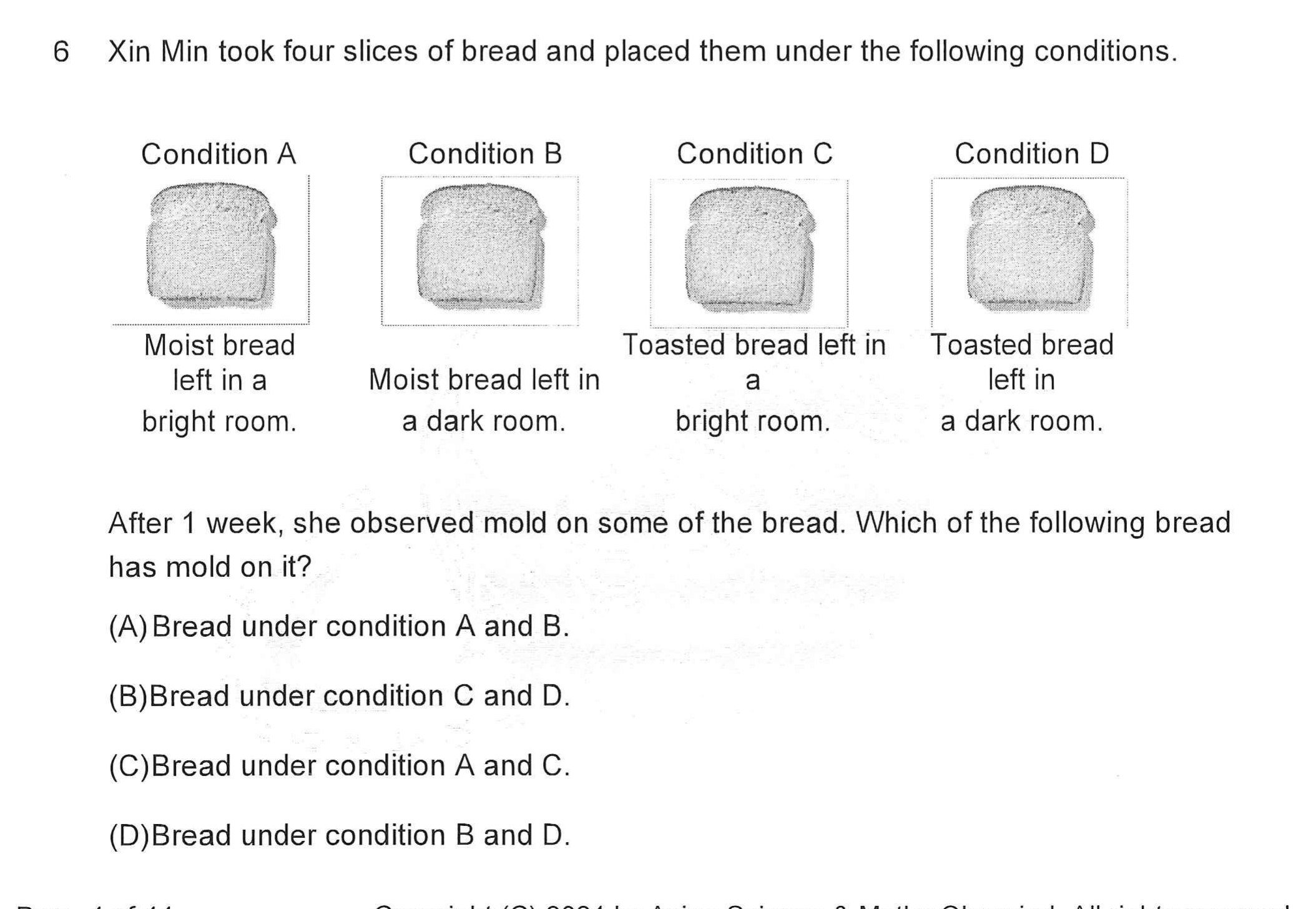
Xin Min took four slices of bread and placed them under the following conditions.

Condition A: Moist bread left in a bright room.
Condition B: Moist bread left in a dark room.
Condition C: Toasted bread left in a bright room.
Condition D: Toasted bread left in a dark room.

After 1 week, she observed mold on some of the bread. Which of the following bread has mold on it?
Question illustration
  1. Bread under condition A and B.
  2. Bread under condition C and D.
  3. Bread under condition A and C.
  4. Bread under condition B and D.

Question 7

In the definition of physics, force is an energy, power or strength which is able to change the movement, direction or physical appearance of an object. There are many type of forces, for example tension force, friction force, air resistance force, gravitational force and magnetic force.

What is/are the important force(s) needed to overcome before an airplane can take off?

Question illustration
  1. Tension and magnetic force.
  2. Air resistance and gravitational force.
  3. Friction and air resistance force.
  4. Resistance force and gravitational force.

Question 8

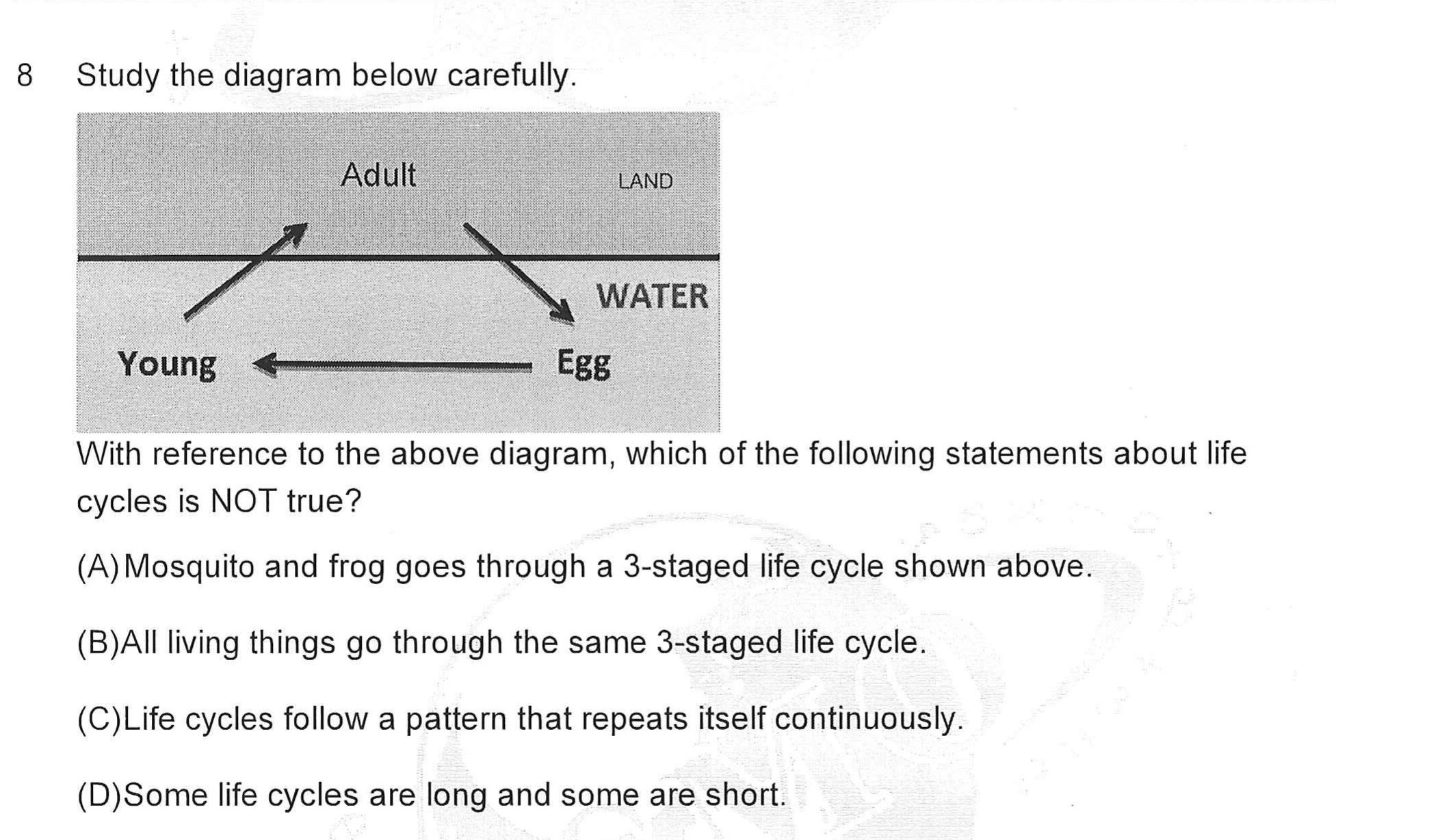
Study the diagram below carefully.

With reference to the above diagram, which of the following statements about life cycles is NOT true?

Question illustration
  1. Mosquito and frog goes through a 3-staged life cycle shown above.
  2. All living things go through the same 3-staged life cycle.
  3. Life cycles follow a pattern that repeats itself continuously.
  4. Some life cycles are long and some are short.

Question 9

Different living organism uses different parts of their body to exchange gases with the environment. Which part of their body do whales use?

Question illustration
  1. Gills
  2. Skin
  3. Mouth
  4. Lung

Question 10

Magnetic fields are area where an object exhibits a magnetic influence. For an attraction or repulsion to occur, there must be a positively and negatively charged particles. Magnetic fields can be produced by moving charges, either by shifting the magnet or changing the direction of the current flow constantly.

How do the magnetic fields flow?

Question illustration
  1. From Negative to Negative.
  2. From Positive to Positive.
  3. From Positive to Negative.
  4. From Negative to Positive.

Question 11

Sea breeze and land breeze occur every day. These natural occurrences will take effect whenever there are temperature differences between the land and water. Cooler air with higher pressure will flows towards warmer air with lower pressure.

During night time, what type of breeze will normally occur?

Question illustration
  1. Sea breeze
  2. Night breeze
  3. Land breeze
  4. Onshore breeze

Question 12

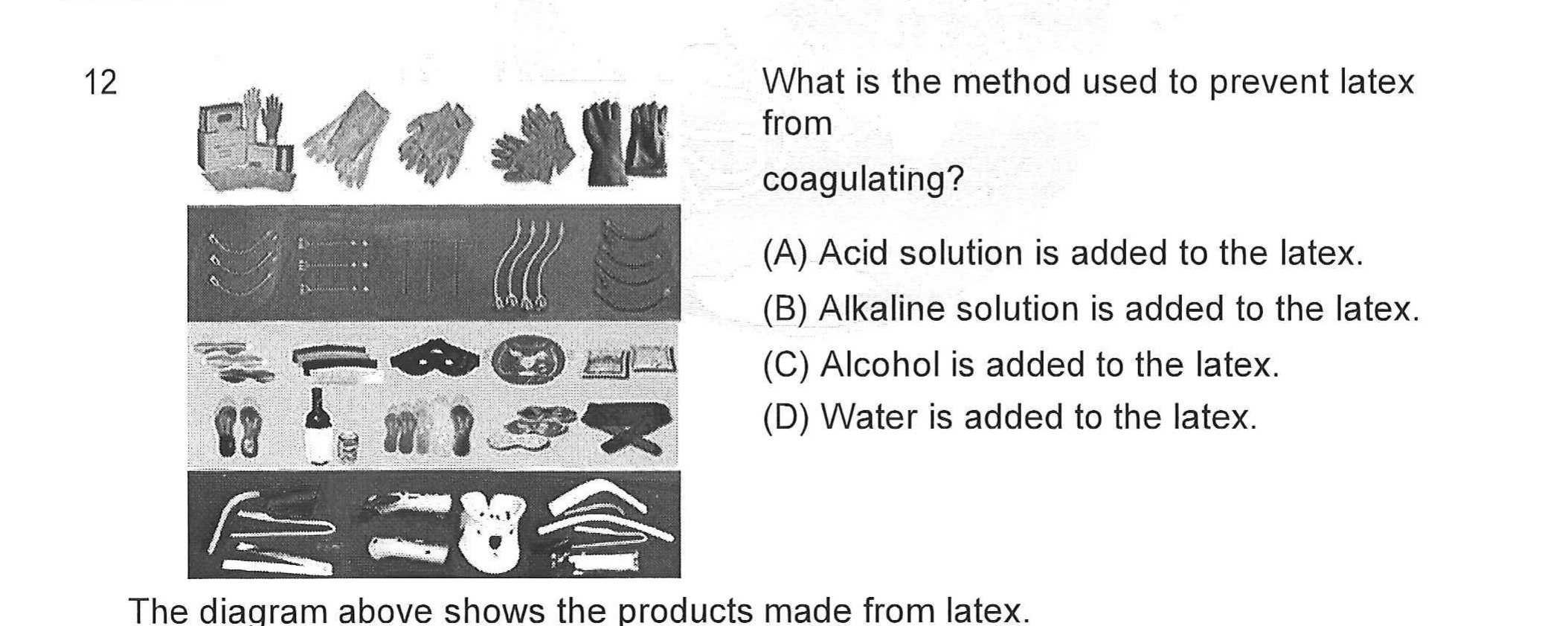
The diagram above shows the products made from latex.

What is the method used to prevent latex from coagulating?

Question illustration
  1. Acid solution is added to the latex.
  2. Alkaline solution is added to the latex.
  3. Alcohol is added to the latex.
  4. Water is added to the latex.

Question 13

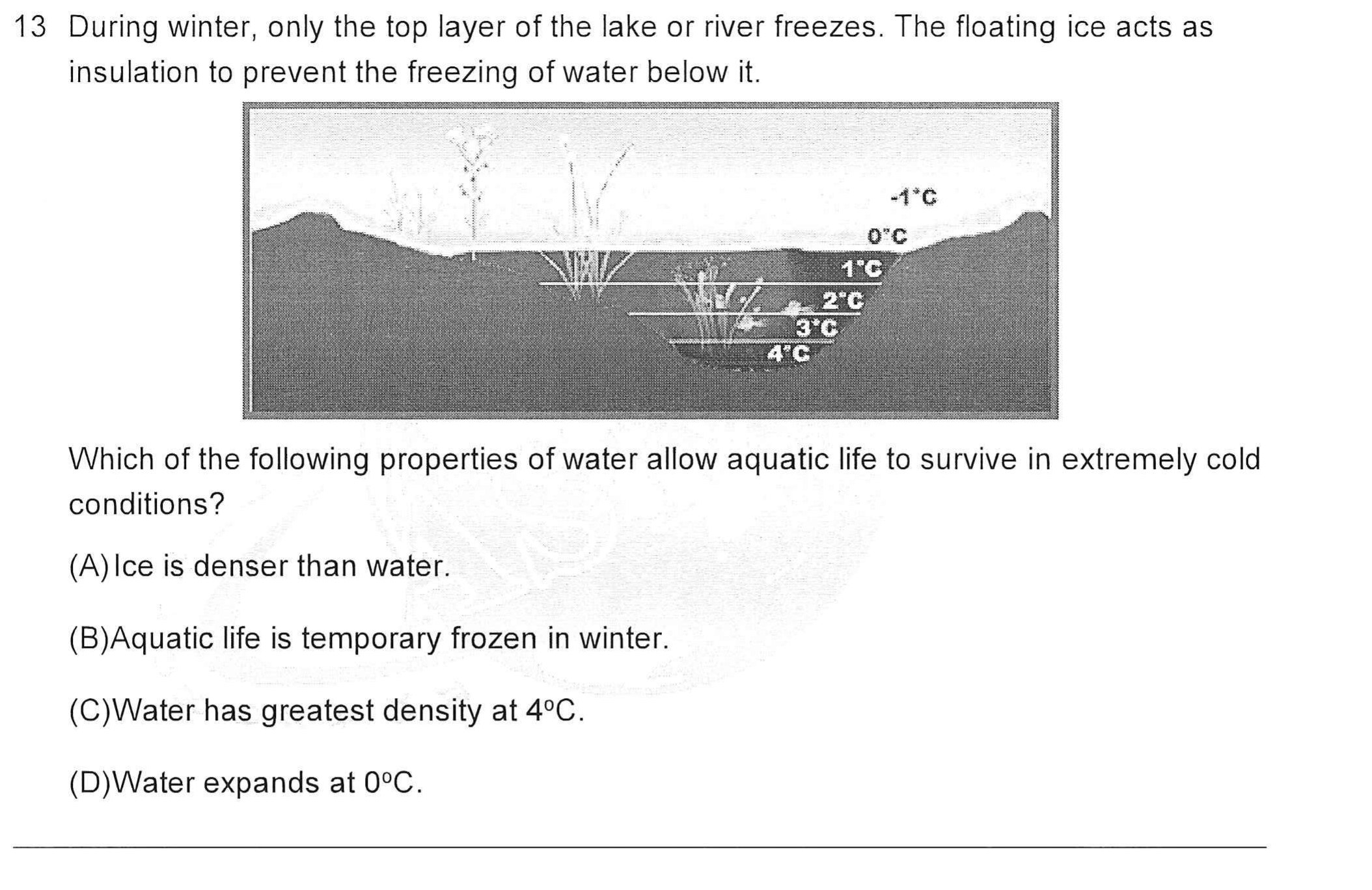
During winter, only the top layer of the lake or river freezes. The floating ice acts as insulation to prevent the freezing of water below it.

Which of the following properties of water allow aquatic life to survive in extremely cold conditions?

Question illustration
  1. Ice is denser than water.
  2. Aquatic life is temporarily frozen in winter.
  3. Water has greatest density at 4°C.
  4. Water expands at 0°C.

Question 14

Sound is a vibration that propagates as a mechanical wave of pressure and displacement, through some medium. Sometimes sound refers to only those vibrations with frequencies that are within the range of hearing for humans or for a particular animal.

Sound transmits fastest through

Question illustration
  1. Solid
  2. Liquid
  3. Air
  4. Vacuum

Question 15

Sound is a vibration that propagates as a mechanical wave of pressure and displacement, through some medium. Sometimes sound refers to only those vibrations with frequencies that are within the range of hearing for humans or for a particular animal.

Can sound travel in vacuum?

Question illustration
  1. Yes, it’s same as light waves which could travel in vacuum.
  2. Yes, as long as the sound energy is large enough.
  3. No, there are no particles in vacuum as medium to transmit sound.
  4. No, sound can only transmitted through the air.

Question 16

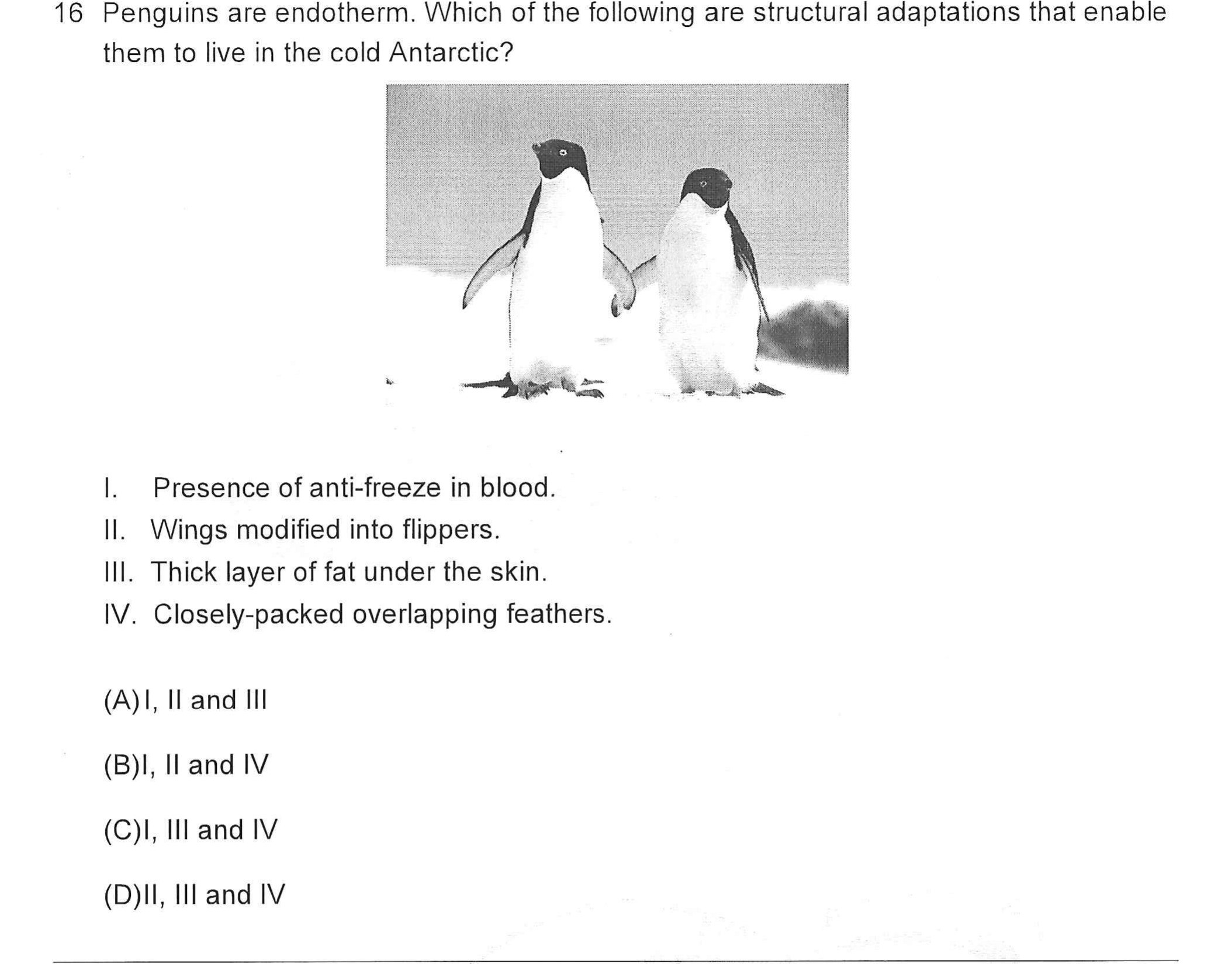
Penguins are endotherm. Which of the following are structural adaptations that enable them to live in the cold Antarctic?

I. Presence of anti-freeze in blood.
II. Wings modified into flippers.
III. Thick layer of fat under the skin.
IV. Closely-packed overlapping feathers.

Question illustration
  1. I, II and III
  2. I, II and IV
  3. I, III and IV
  4. II, III and IV

Question 17

The solar system is made up of the Sun, the planets that orbit the Sun, their satellites, dwarf planets and many, many small objects, like asteroids and comets. All of these objects move and we can see these movements.

The fact that the Moon always shows its same face to Earth is evidence that the Moon rotates about its axis about once per

Question illustration
  1. Day
  2. Month
  3. Year
  4. None of these, for the moon does not rotate about an axis.

Question 18

The solar system is made up of the Sun, the planets that orbit the Sun, their satellites, dwarf planets and many, many small objects, like asteroids and comets. All of these objects move and we can see these movements.

The Moon is most responsible for Earth’s tides. Which pulls more strongly on the Earth and its oceans?

Question illustration
  1. Moon
  2. Sun
  3. Both about equal.
  4. None of these.

Question 19

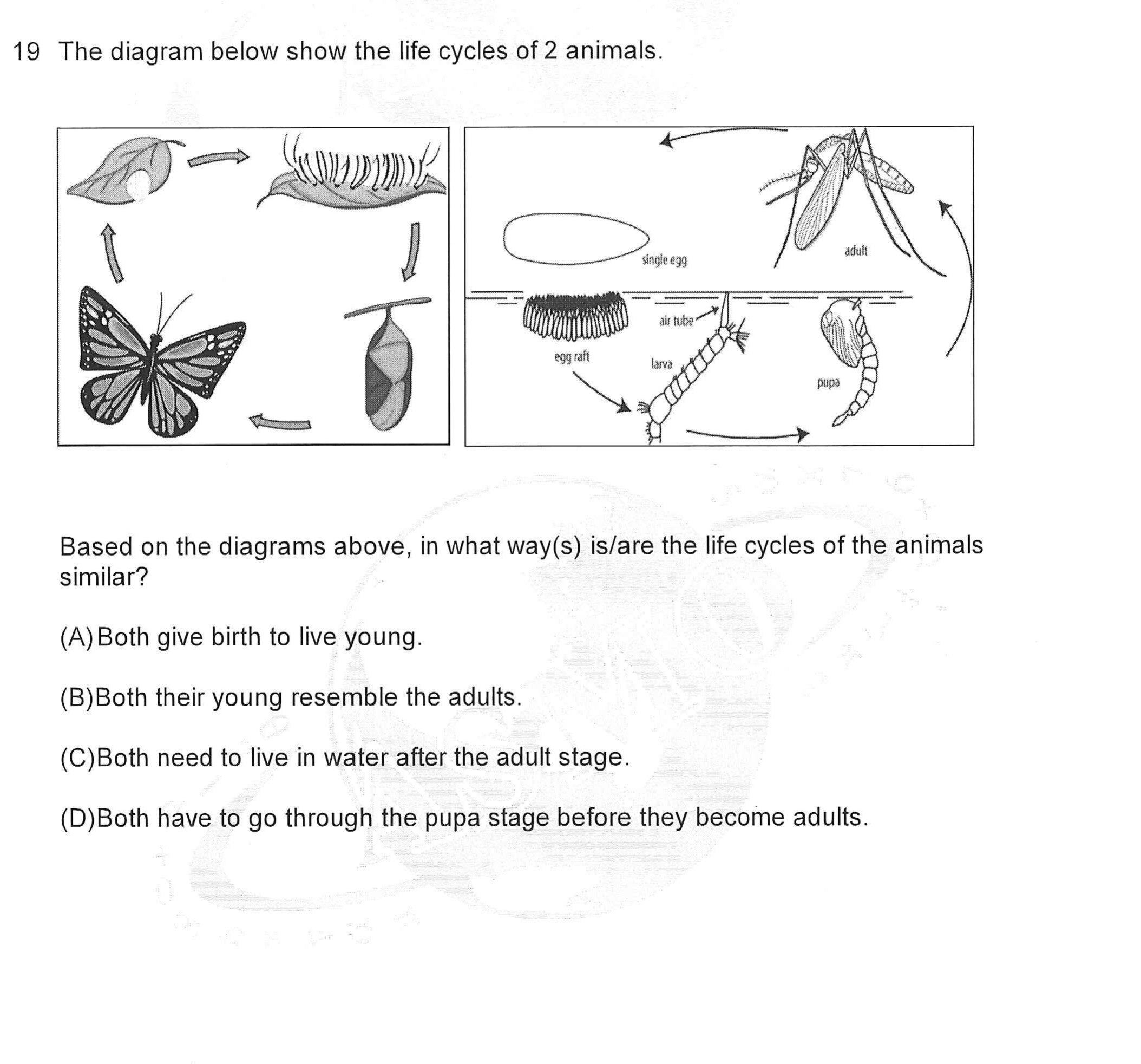
The diagram below show the life cycles of 2 animals.

Based on the diagrams above, in what way(s) is/are the life cycles of the animals similar?

Question illustration
  1. Both give birth to live young.
  2. Both their young resemble the adults.
  3. Both need to live in water after the adult stage.
  4. Both have to go through the pupa stage before they become adults.

Question 20

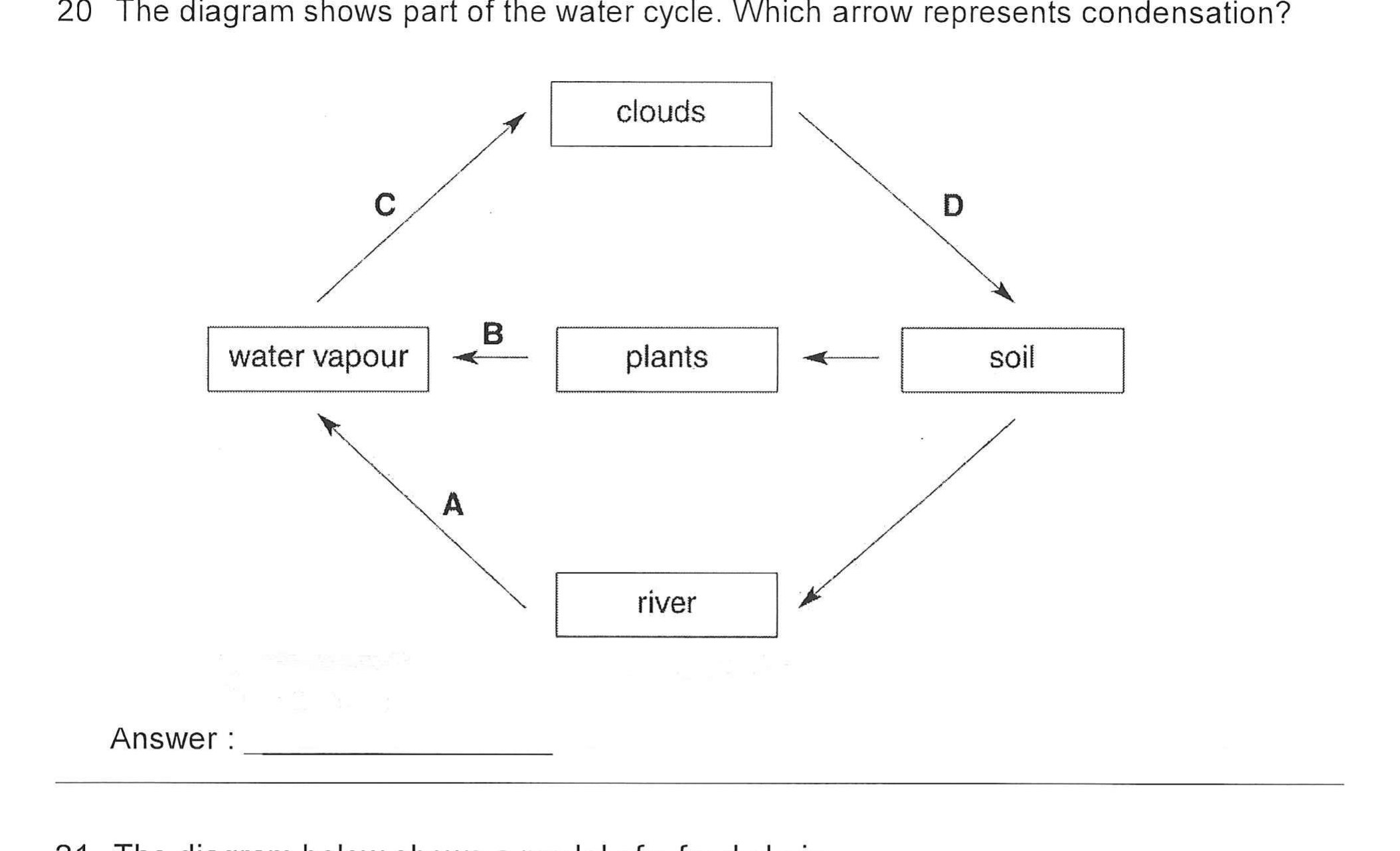
The diagram shows part of the water cycle. Which arrow represents condensation?

Question illustration