Skip to content / Đến nội dung
ThichHocToan.com

VTMO 2026 - Grade 5 - Final - SET 9 - Self-study

Question 1

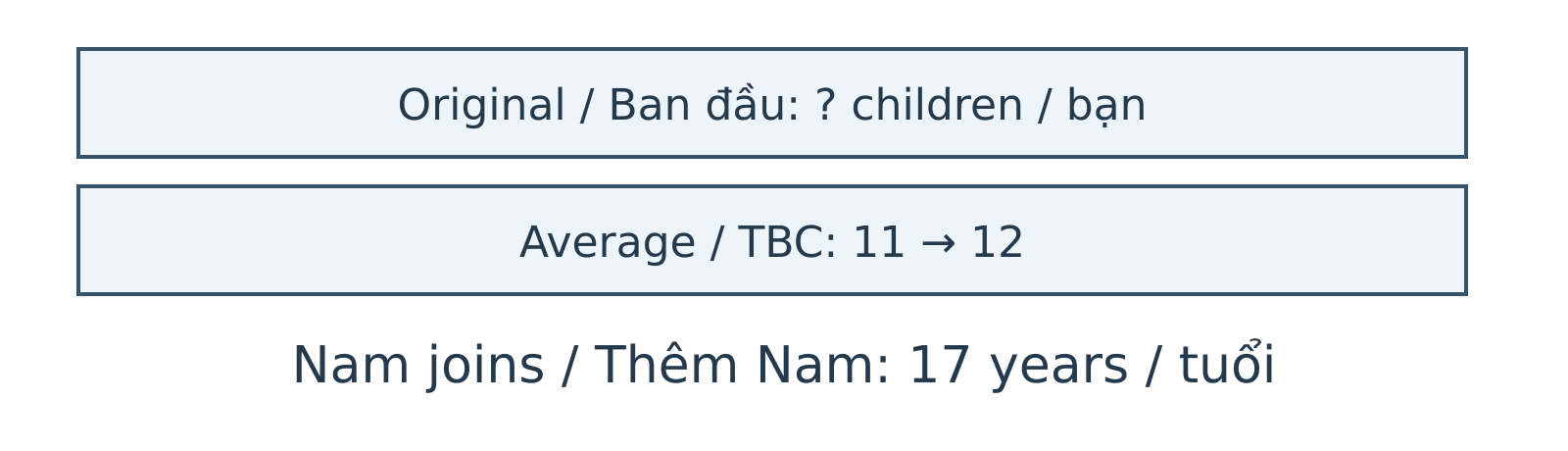
The average age of a group of children is 11 years. When 17-year-old Nam joins them, the average becomes 12 years. How many children were in the original group?

Question illustration

Question 2

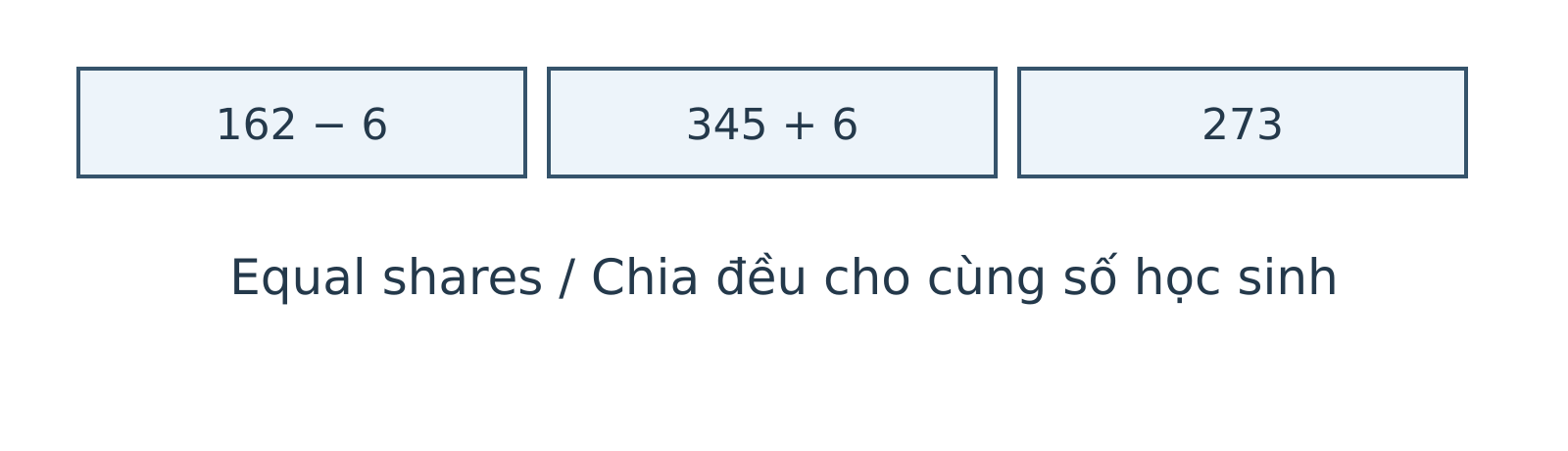
If 162 sweets are shared equally among the students of class 5A, 6 sweets remain. If 345 sweets are shared equally, 6 more sweets are needed to complete equal shares. If 273 sweets are shared equally, none remain. What is the greatest possible number of students in class 5A?

Question illustration

Question 3

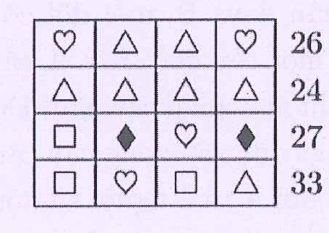
Each different symbol represents a different number. The total of each row is shown on its right. Find the values represented by the square and the heart. Give the square first and the heart second.

Question illustration

Question 4

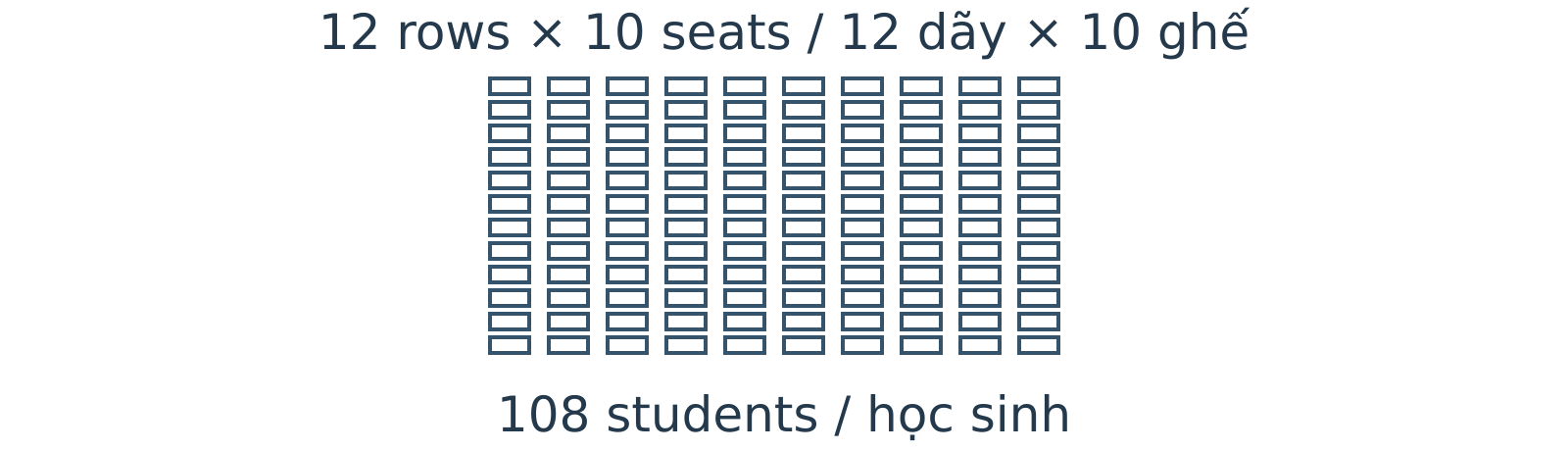
An auditorium has 12 rows of 10 seats each, and 108 students are seated. What is the greatest number of rows you can select such that the selected rows all have different numbers of students?

Question illustration

Question 5

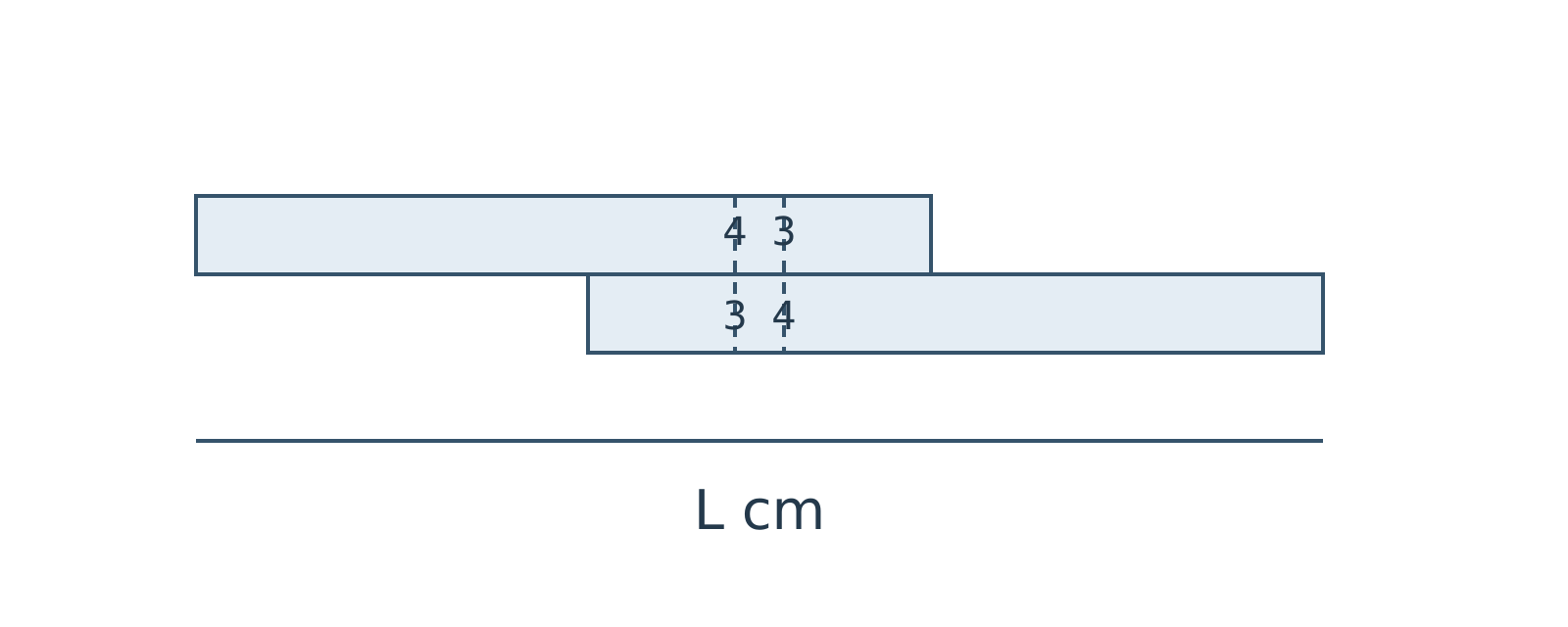
Two old rulers are each 15 cm long and were marked from 0 to 15 cm. All centimetre marks have faded except the 3 cm and 4 cm marks. They overlap in opposite directions as shown: the 3 cm mark of either ruler coincides with the 4 cm mark of the other. Find the total length $L$ in centimetres.

Question illustration

Question 6

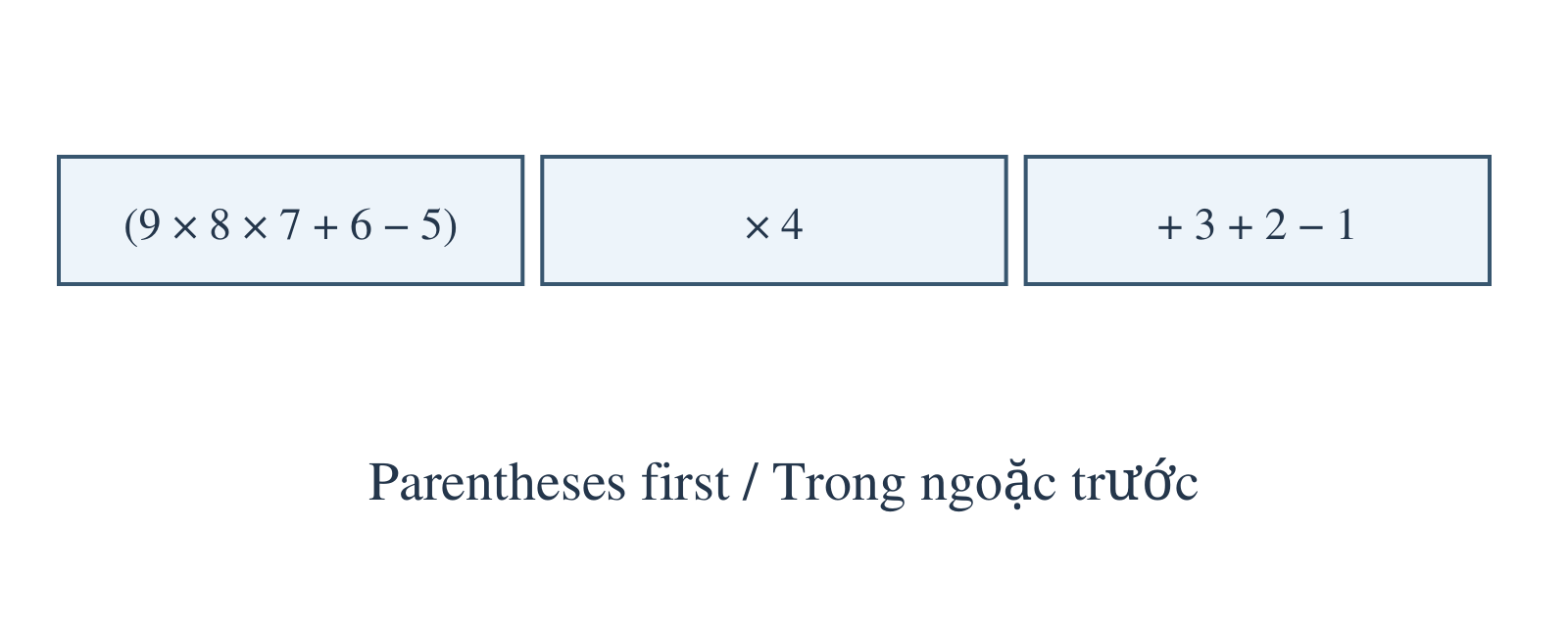
Calculate $(9\times8\times7+6-5)\times4+3+2-1$.

Question illustration

Question 7

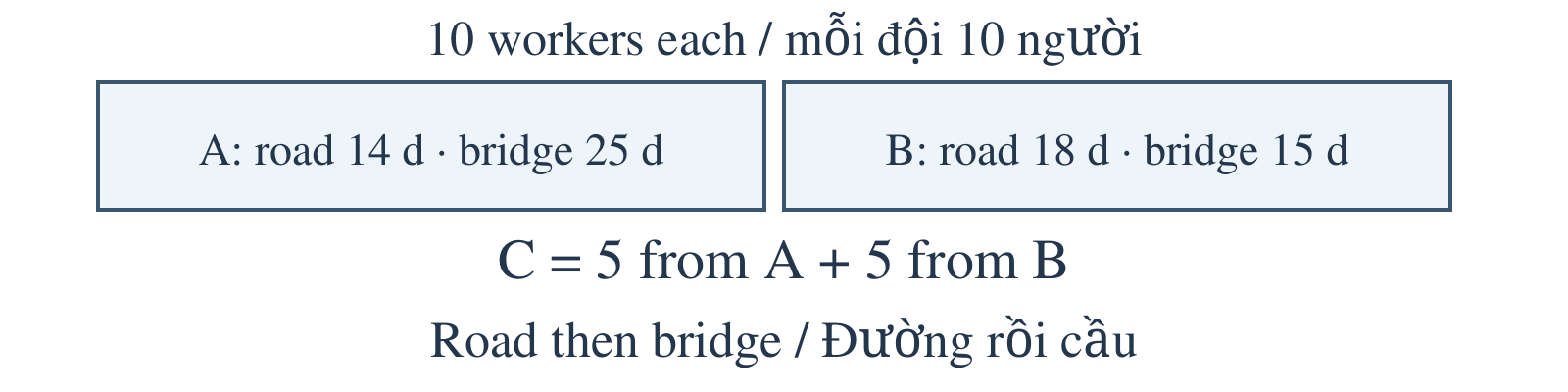
Teams A and B each have 10 workers. Working alone, A builds a road in 14 days and a bridge in 25 days; B builds the same road in 18 days and the same bridge in 15 days. Team C consists of 5 workers from A and 5 from B. It finishes the road and then builds the bridge. How many days does C need in total? Show your reasoning.

Practice clarification: for each job, workers within each original team have equal, constant productivity, and their work rates add. Workers from different teams need not have equal productivity.

Question illustration

Question 8

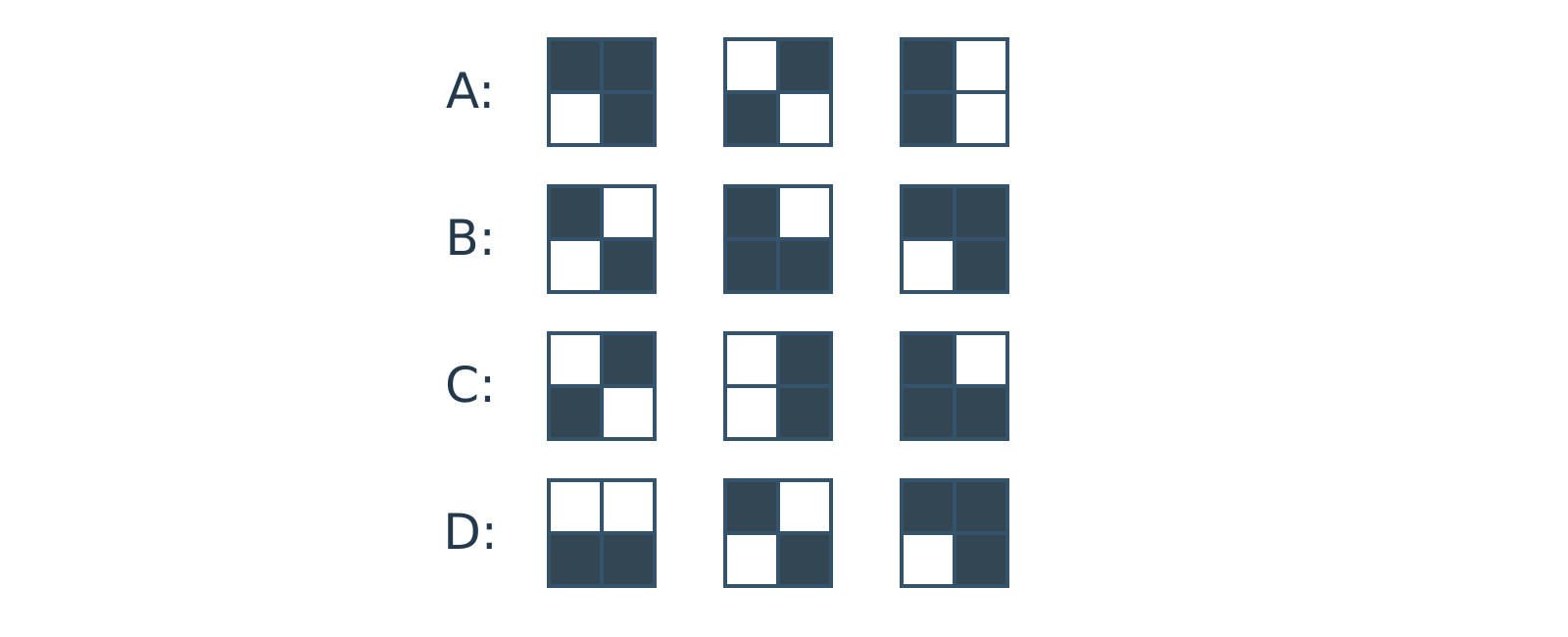
Each $2\times2$ square pattern represents a digit, and each row of three patterns represents a three-digit number. The four numbers are 913, 895, 628 and 238, in some order. Find the value of $B$.

Question illustration

Question 9

Nine balls are labelled 1 through 9. An, Bình, Châu and Dũng each take two balls, with no ball used twice. An’s labels sum to 10; Bình’s differ by 1; Châu’s multiply to 24; and the larger of Dũng’s labels divided by the smaller equals 3. Which label is left? Explain your reasoning.

Question illustration

Question 10

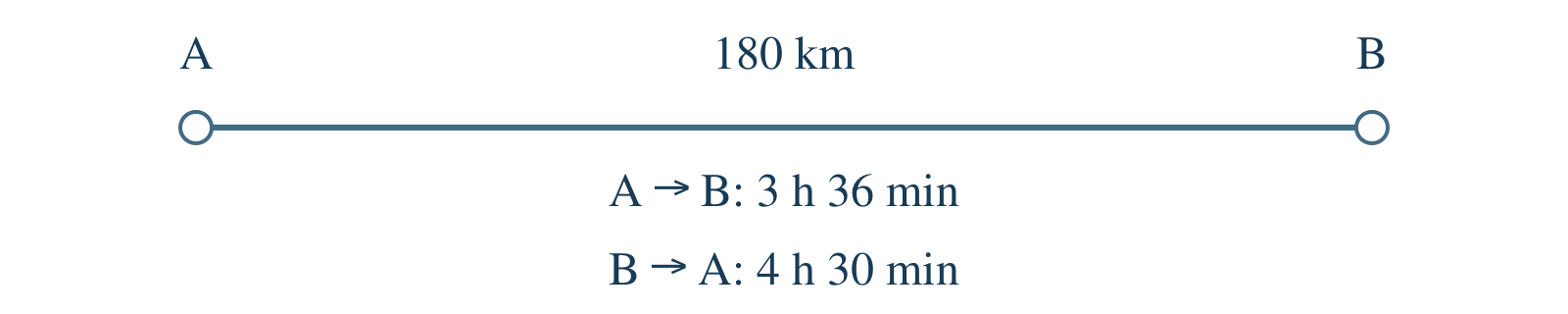
Towns A and B are $180$ km apart. One car travels from A to B in 3 hours 36 minutes and immediately returns towards A. Another car travels from B to A in 4 hours 30 minutes and immediately returns towards B. They start at the same time and meet for the second time at C. How far is C from A? Show your reasoning.

Practice convention: Each car travels at its own constant speed on the same route in both directions.

Question illustration

Question 11

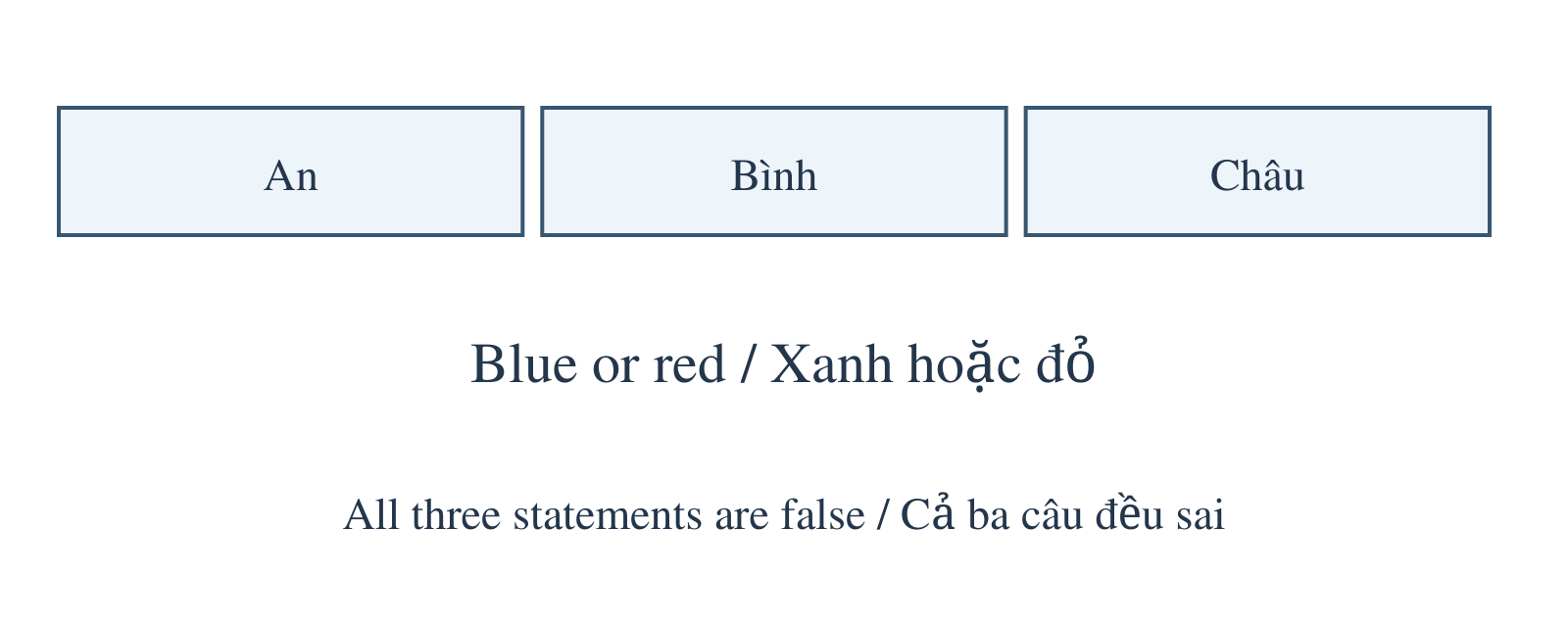
An, Bình and Châu always lie. Each owns one stone, either blue or red. An says, “My stone is the same colour as Bình’s.” Bình says, “My stone is the same colour as Châu’s.” Châu says, “Exactly two of us have red stones.” How many of these statements are true?

• An has a blue stone.

• Bình has a blue stone.

• Châu has a red stone.

• An and Châu have stones of different colours.

Question illustration

Question 12

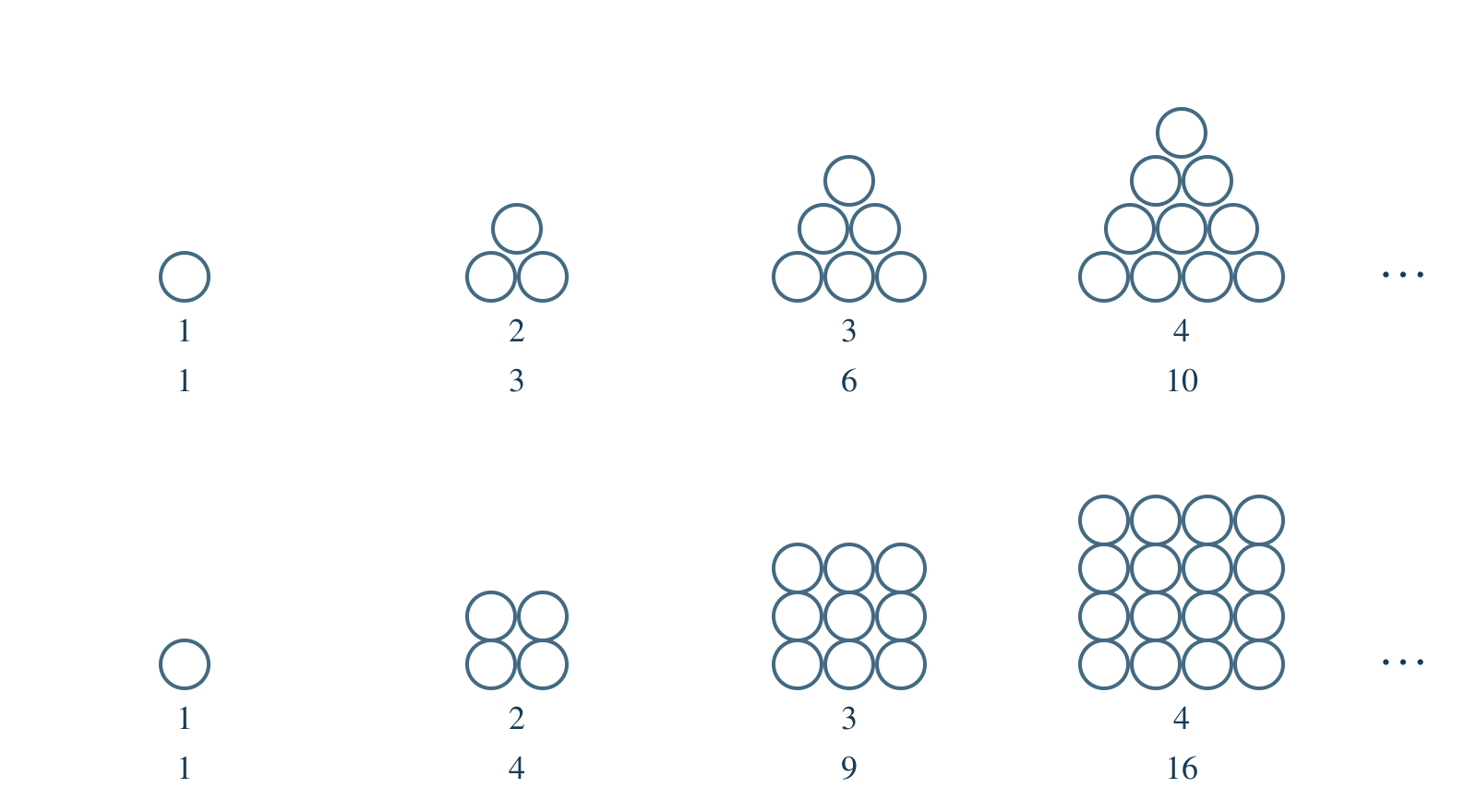
The two sequences of figures follow the patterns shown. The first four figures in the first sequence contain $1,3,6,10$ circles, and those in the second contain $1,4,9,16$ circles.
An has more than 800 but fewer than 1400 circles. Using every circle, An can make a figure in the first sequence. Using every circle again, An can also make a figure in the second sequence. How many circles does An have?
Question illustration

Question 13

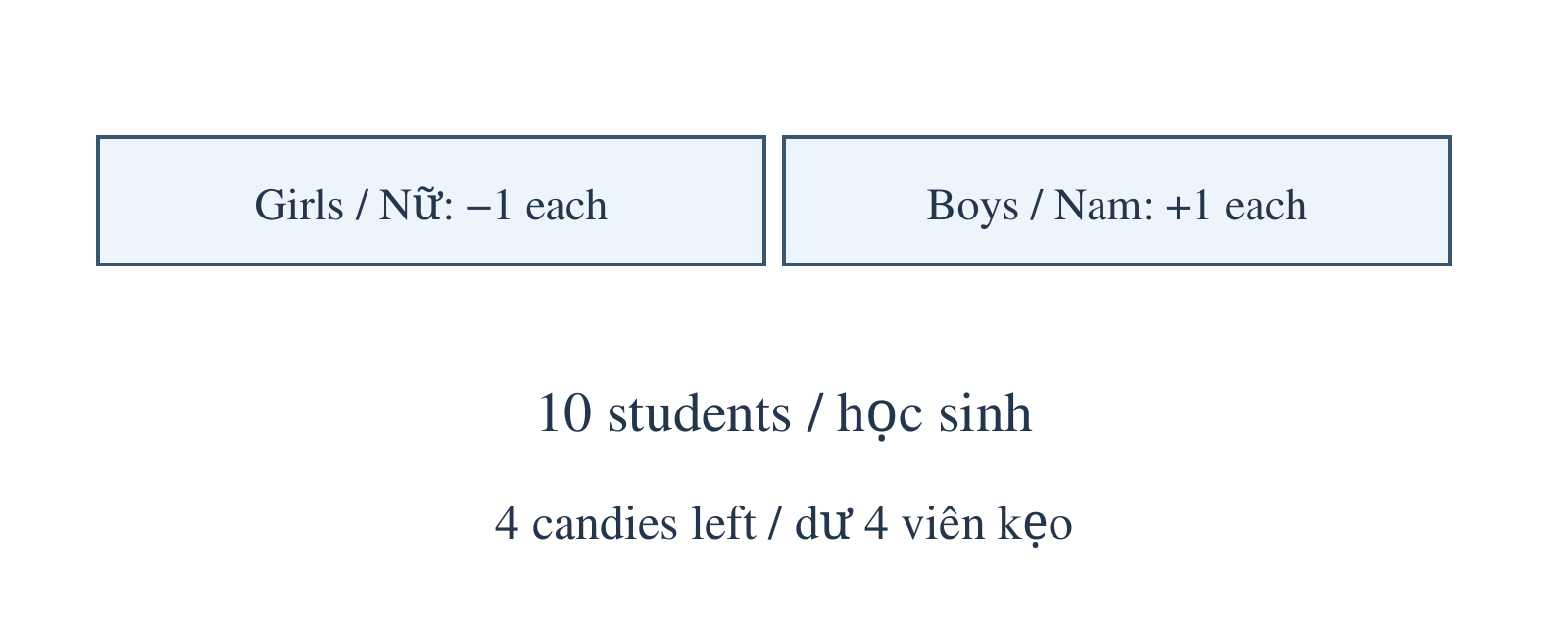
A teacher divides a bag of candies equally among the 10 students of class IQ5. If each girl gives back 1 candy and each boy receives 1 extra candy, 4 candies remain. If one girl is absent, the number of boys is unchanged, and that girl’s original share is divided equally among the other girls, each of those girls receives 1 extra candy. How many candies are in the bag?

Question illustration