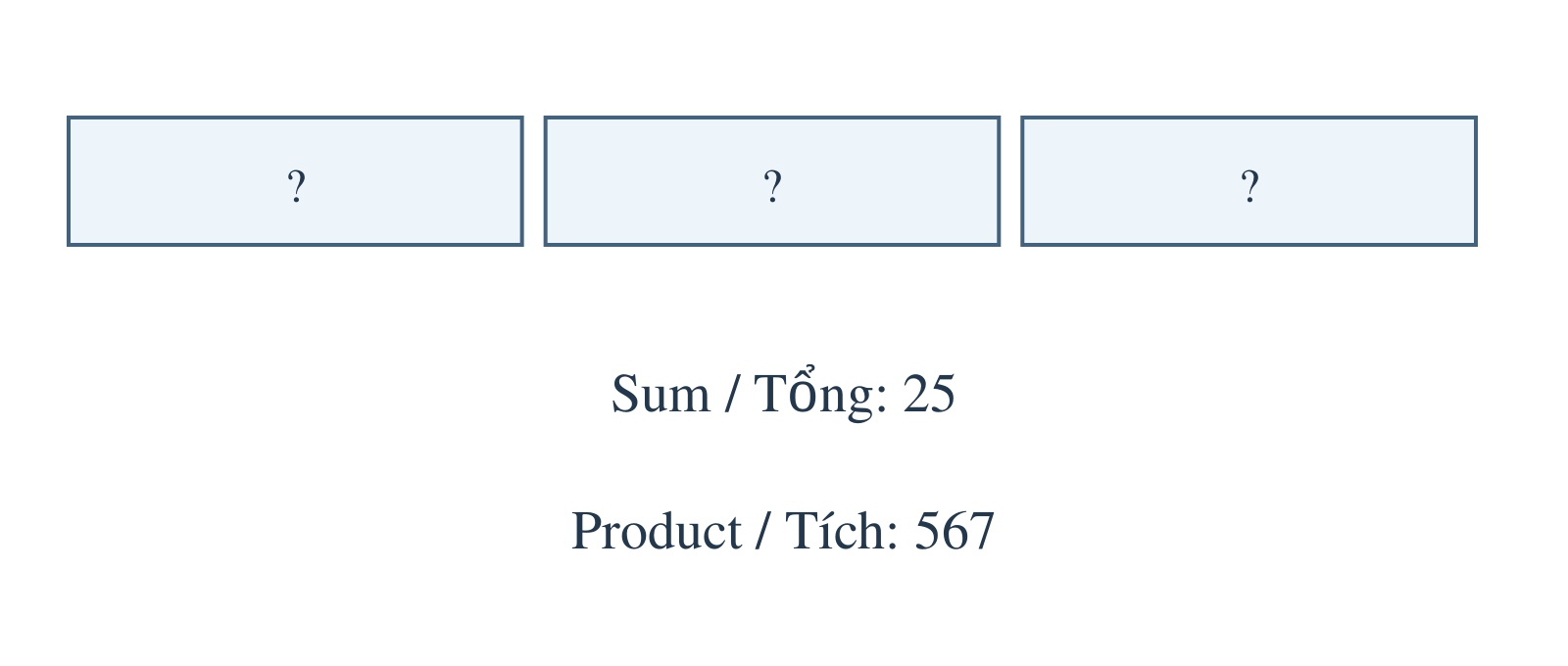
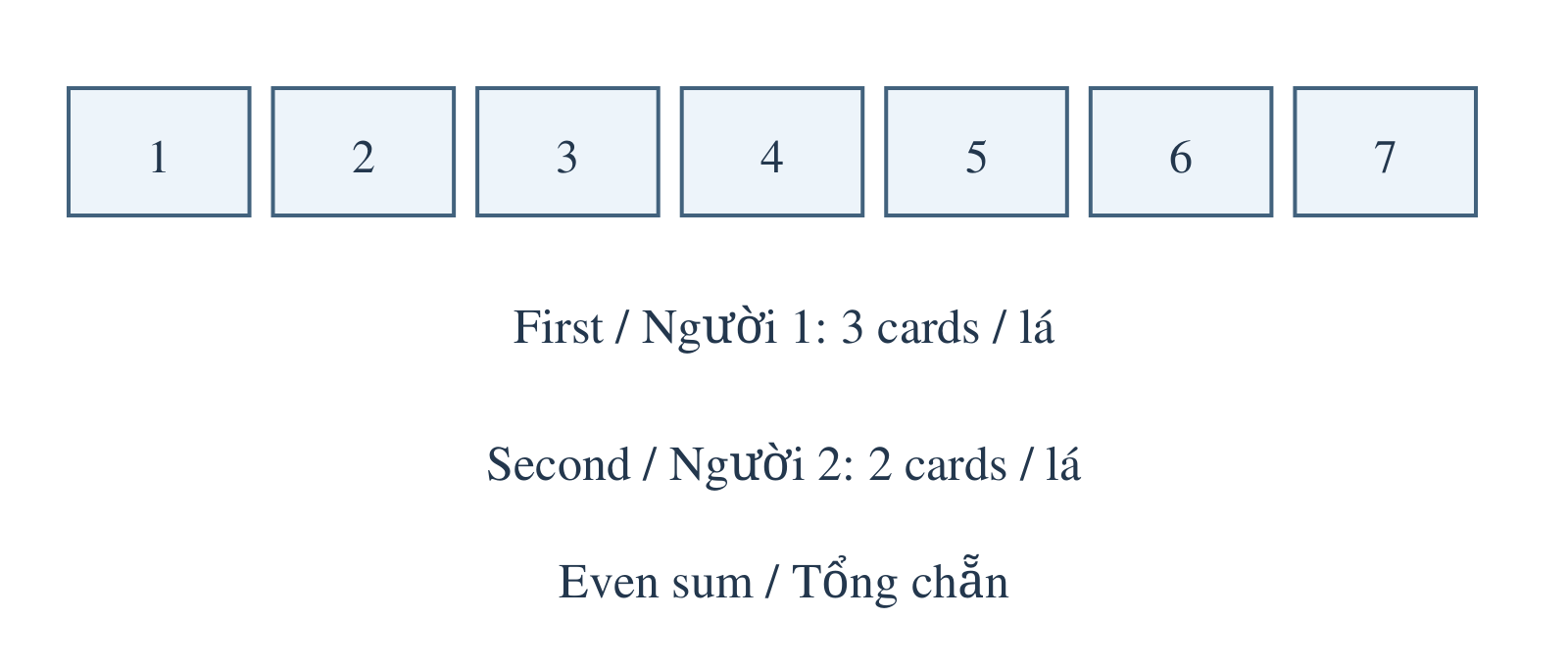
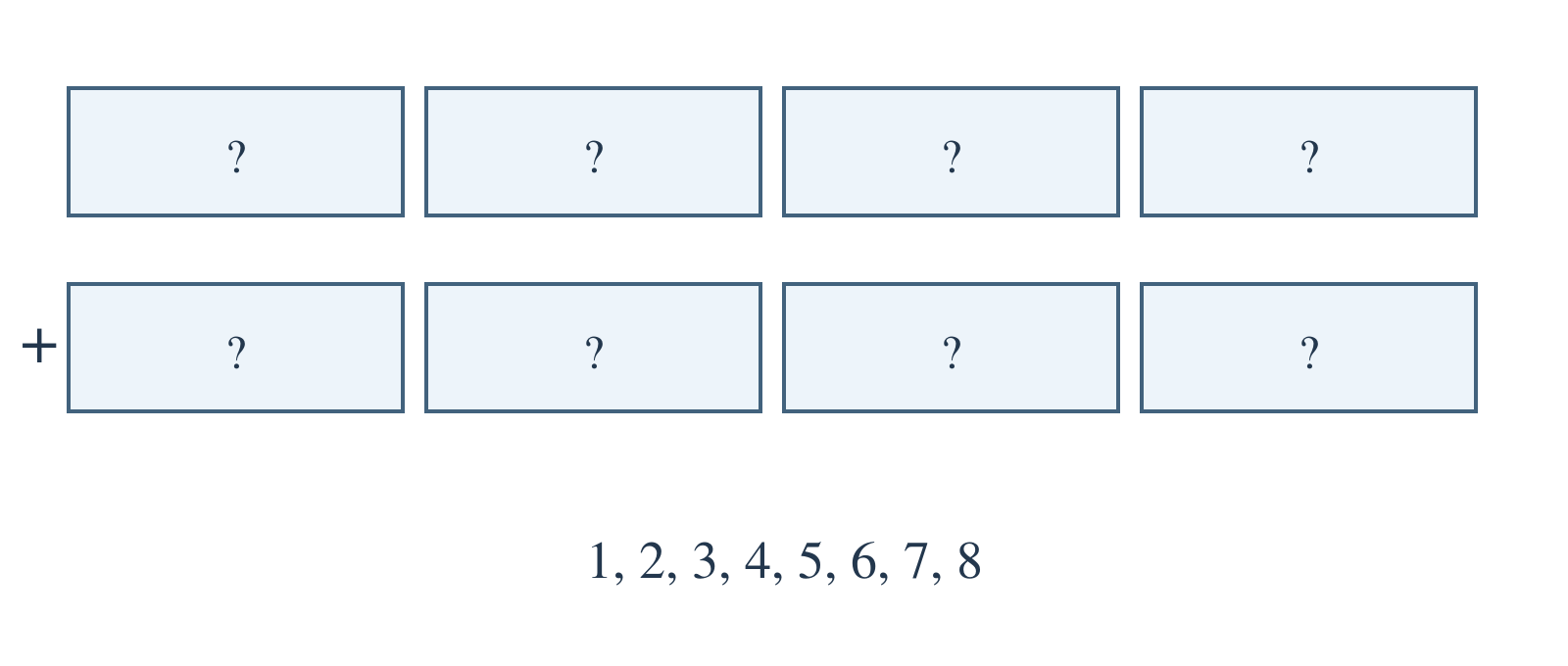
Seven cards numbered 1 to 7 are in a box. The first person shakes out three cards. The second person then shakes out two of the remaining cards. The first person says, “I know for certain that the sum of your two cards is even.” What is the sum of the first person’s three cards?
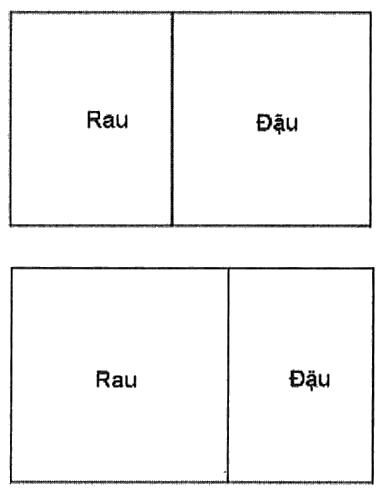
Bác Tư grows vegetables and beans on a fixed rectangular plot. This year he turns the rectangular vegetable patch into a square by extending one side by 3 m, as shown. The bean area decreases by 30 square metres. What was the vegetable area before the change? Show your reasoning. The upper diagram is before the change and the lower diagram is after it; “Rau” means vegetables and “Đậu” means beans.
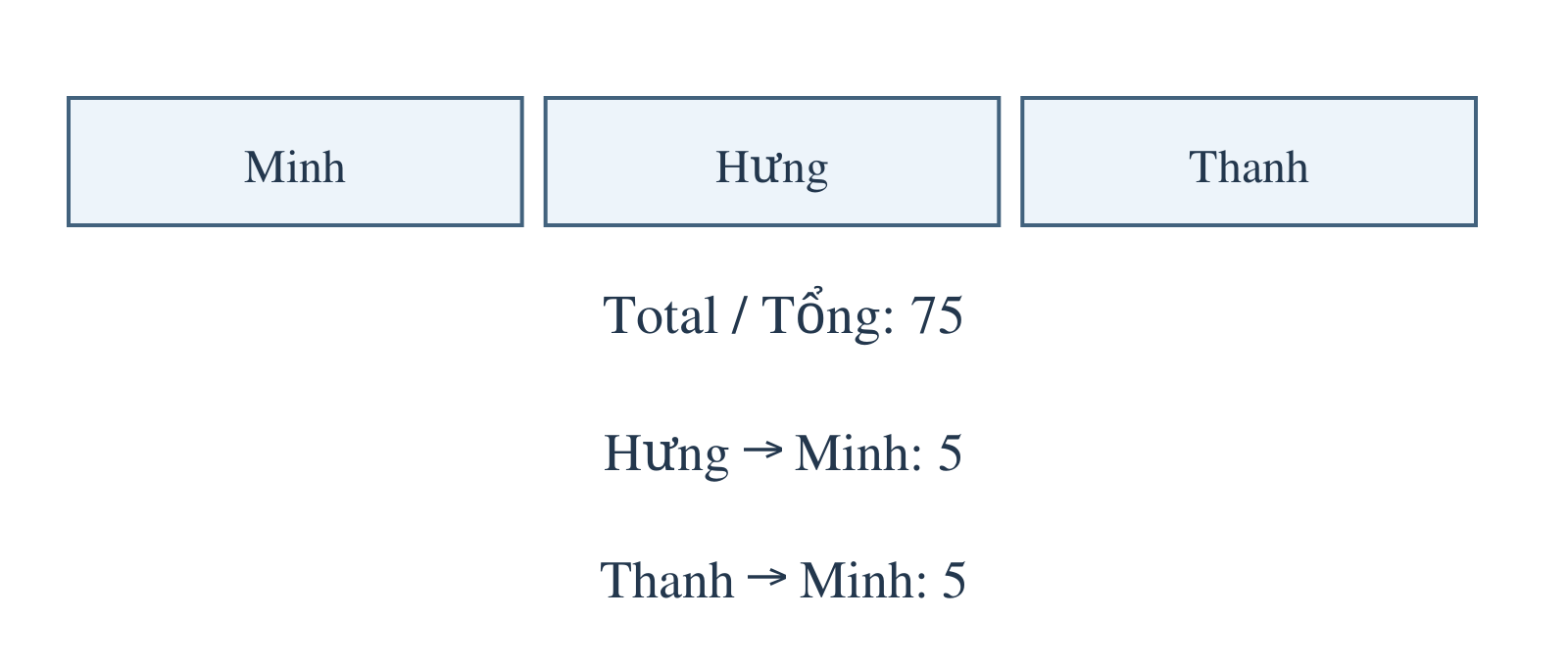
Minh, Hưng and Thanh have 75 marbles altogether. If Hưng gives Minh 5 marbles, they have equal numbers. If Thanh gives Minh 5 marbles, Minh and Hưng together have 15 more marbles than Thanh. How many did each have initially? Show your reasoning.
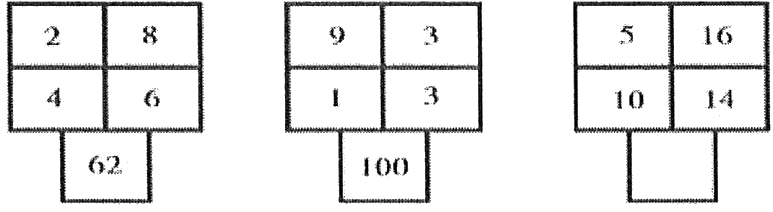
Practice rule: add the two left-column numbers, subtract the lower right number from the upper right number, then write the two results side by side in that order.
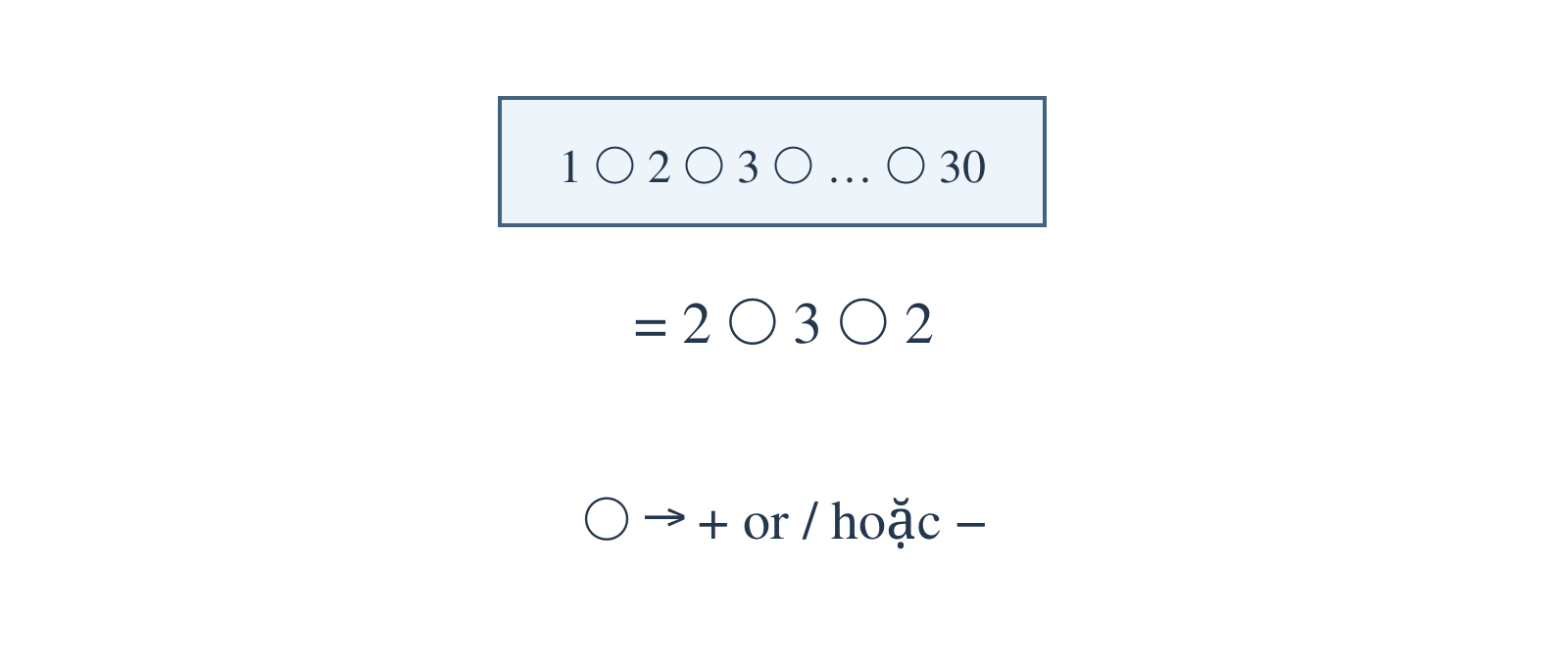
Replace every symbol $\odot$ in $1\odot2\odot3\odot4\odot\cdots\odot29\odot30=2\odot3\odot2$ with $+$ or $-$ to make a correct equality. What is the greatest number of plus signs, counting both sides? Calculate from left to right; a smaller number cannot have a larger number subtracted from it. Show your reasoning.
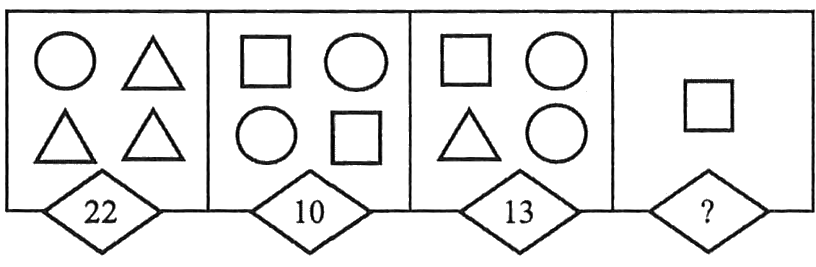
Find the number that replaces the question mark. Each shape has the same value wherever it appears; a number below a box is the sum of the shapes in that box.
The semifinal of the fifth TITAN Mathematical Olympiad has multiple-choice and fill-in-answer sections. In the multiple-choice section there are 10 questions: a correct answer earns 2 points, an incorrect answer loses 1 point, and a blank answer earns 0. Khang scores 12 points and remembers leaving exactly one question blank. How many multiple-choice questions did he answer correctly?
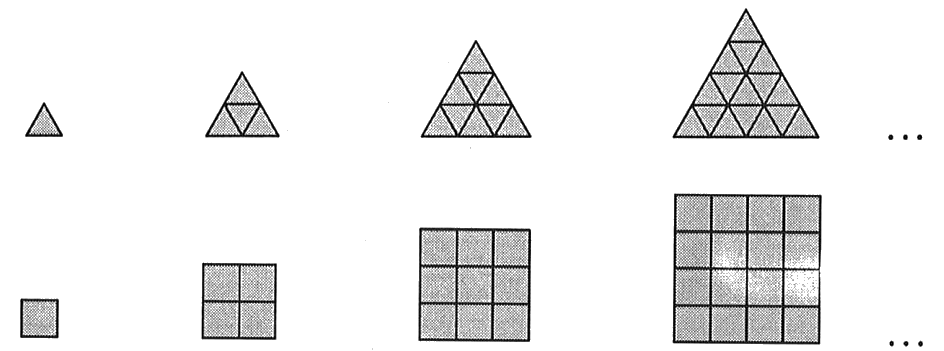
An uses small equilateral triangular cards of side 1 cm to make the first sequence. Bình uses small square cards of side 1 cm to make the second sequence. The first four figures in each sequence contain 1, 4, 9 and 16 cards, as shown. Each child chooses one figure from their own sequence. The sum of the two perimeters is 50 cm. What is the greatest possible number of cards in An’s figure?