Skip to content / Đến nội dung
ThichHocToan.com

SASMO 2015 Secondary 4 (Grade 10) Contest

Question 1

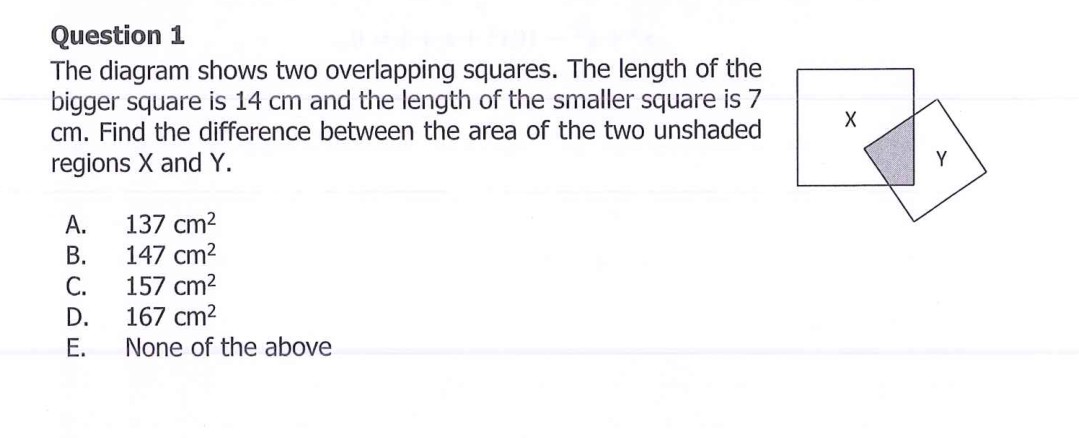
The diagram shows two overlapping squares. The length of the
bigger square is 14 cm and the length of the smaller square is 7
cm. Find the difference between the area of the two unshaded
regions X and Y.
Question illustration
  1. 137 cm?
  2. 147 cm?
  3. 157 cm?
  4. 167 cm?
  5. None of the above

Question 2

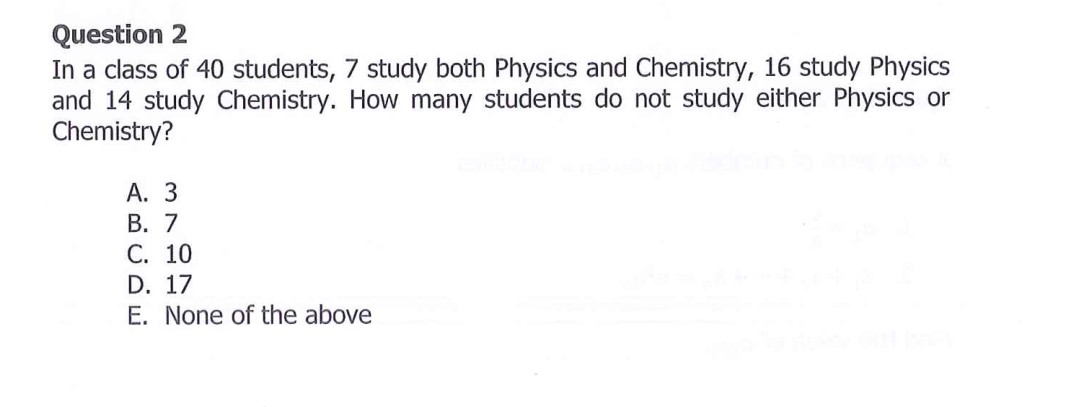
In a class of 40 students, 7 study both Physics and Chemistry, 16 study Physics
and 14 study Chemistry. How many students do not study either Physics or
Chemistry?

Question illustration
  1. 3 Bs Z
  2. 7
  3. See the source image for option C.
  4. i; 17
  5. None of the above

Question 3

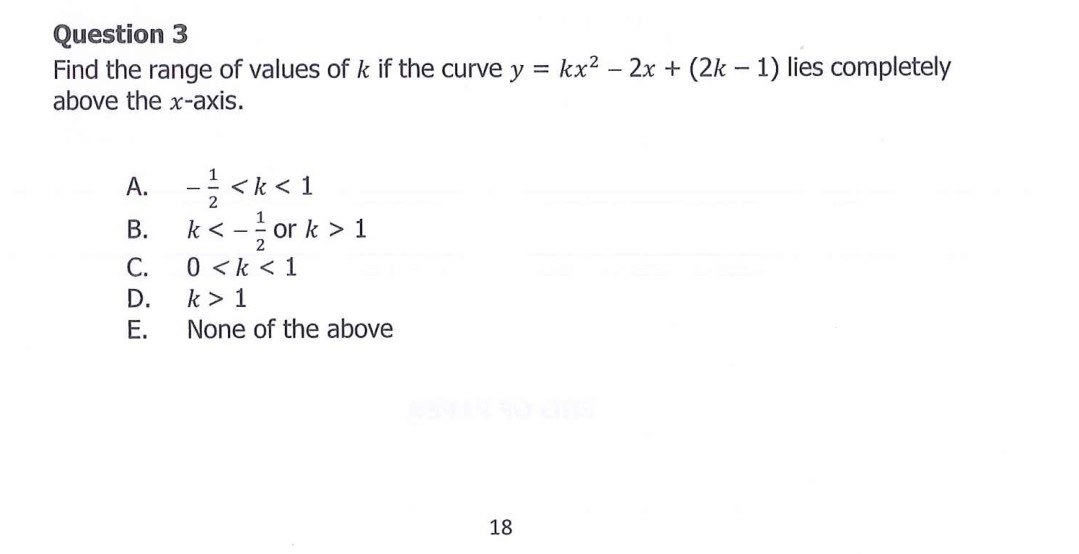
Find the range of values of k if the curve y = kx? - 2x + (2k — 1) lies completely
above the x-axis.
A -\$‹k‹1
B, k‹-Jork›4
Cc O‹k‹1

Question illustration
  1. -5<k<1
  2. See the source image for option B.
  3. See the source image for option C.
  4. k>i
  5. None of the above

Question 4

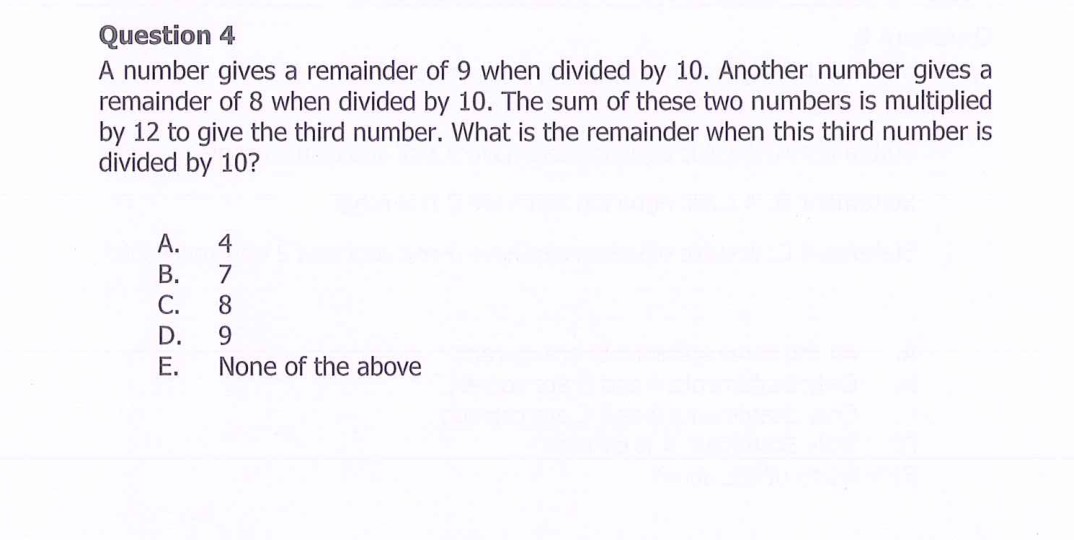
A number gives a remainder of 9 when divided by 10. Another number gives a
remainder of 8 when divided by 10. The sum of these two numbers is multiplied
i by 12 to give the third number. What is the remainder when this third number is
divided by 10?
A 4
Bee
Cc 8
D 9
E. None of the above

Question illustration
  1. 64 Be. 7,
  2. See the source image for option B.
  3. See the source image for option C.
  4. See the source image for option D.
  5. None of the above

Question 5

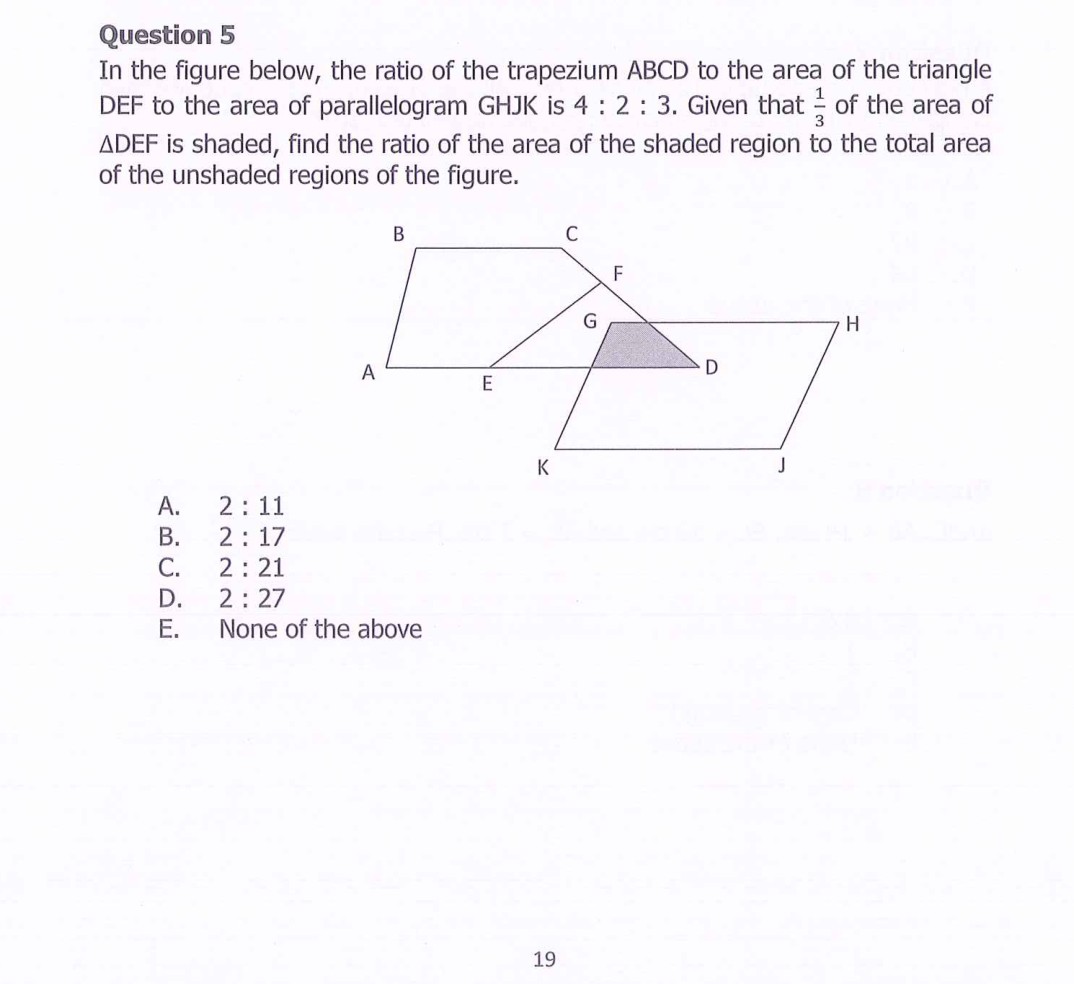
In the figure below, the ratio of the trapezium ABCD to the area of the triangle
DEF to the area of parallelogram GHJK is 4 : 2 : 3. Given that : of the area of
ADEF is shaded, find the ratio of the area of the shaded region to the total area
of the unshaded regions of the figure.
B G
F
Va ‘
, ee)
K J
A 2:11
Be 2217
Ce 32 221
De 227
/ E. None of the above
t
eee

Question illustration
  1. See the source image for option A.
  2. D D
  3. See the source image for option C.
  4. soi
  5. See the source image for option E.

Question 6

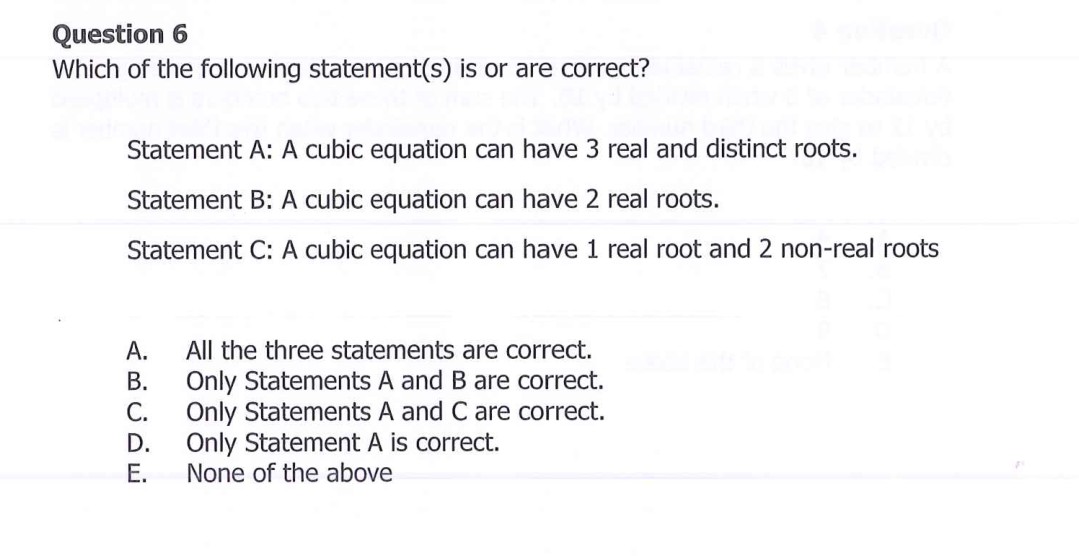
Which of the following statement(s) is or are correct?
Statement A: A cubic equation can have 3 real and distinct roots.
Statement B: A cubic equation can have 2 real roots.
Statement C: A cubic equation can have 1 real root and 2 non-real roots

Question illustration
  1. All the three statements are correct.
  2. Only Statements A and B are correct.
  3. Only Statements A and C are correct.
  4. Only Statement A is correct.
  5. None of the above

Question 7

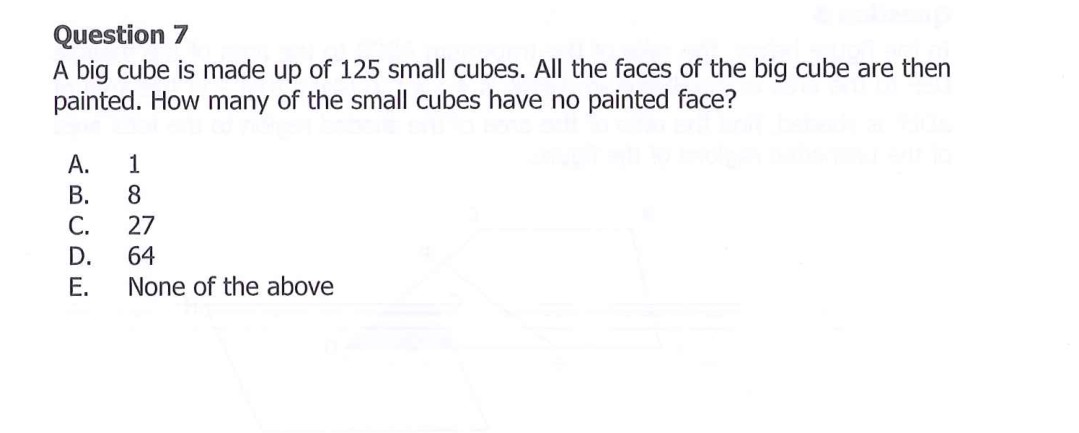
A big cube is made up of 125 small cubes. All the faces of the big cube are then
painted. How many of the small cubes have no painted face?
A 1

Question illustration
  1. 1
  2. 8
  3. 27
  4. 64
  5. None of the above

Question 8

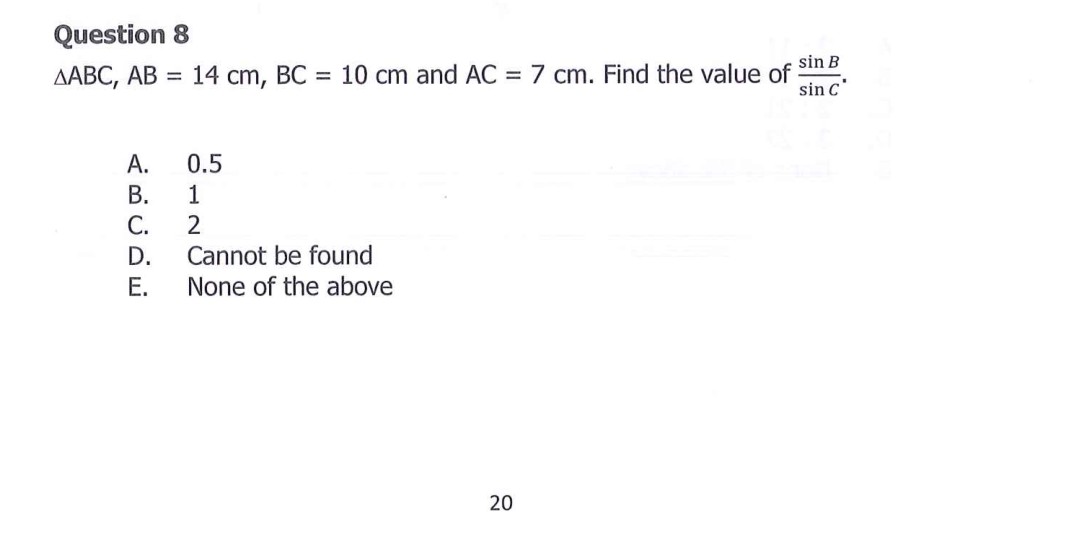
AABC, AB = 14 cm, BC = 10 cm and AC = 7 cm. Find the value of ~

Question illustration
  1. 0.5
  2. See the source image for option B.
  3. See the source image for option C.
  4. Cannot be found
  5. None of the above

Question 9

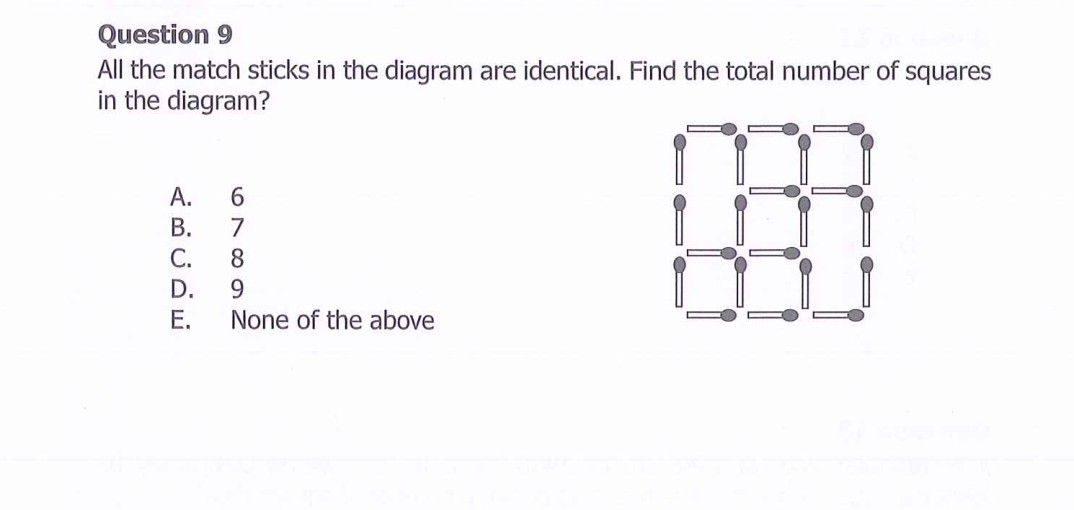
i All the match sticks in the diagram are identical. Find the total number of squares
in the diagram?
—2 —=2 —o,

_ mea
8? Ltt
Cc 8 mt

Question illustration
  1. 6 —38_—S
  2. 7 Litt
  3. See the source image for option C.
  4. 9 Ltt
  5. None of the above ee ee

Question 10

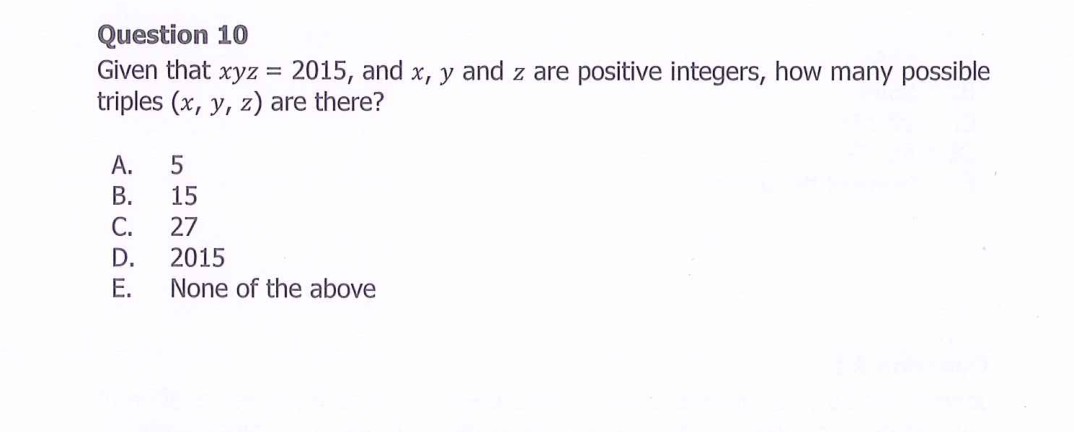
E Given that xyz = 2015, and x, y and z are positive integers, how many possible
BS] triples (x, y, z) are there?
E A 5
= B. 45
CG 27
= D. 2015
= E. None of the above

Question illustration
  1. 65 By 15
  2. See the source image for option B.
  3. 27
  4. 2015
  5. None of the above

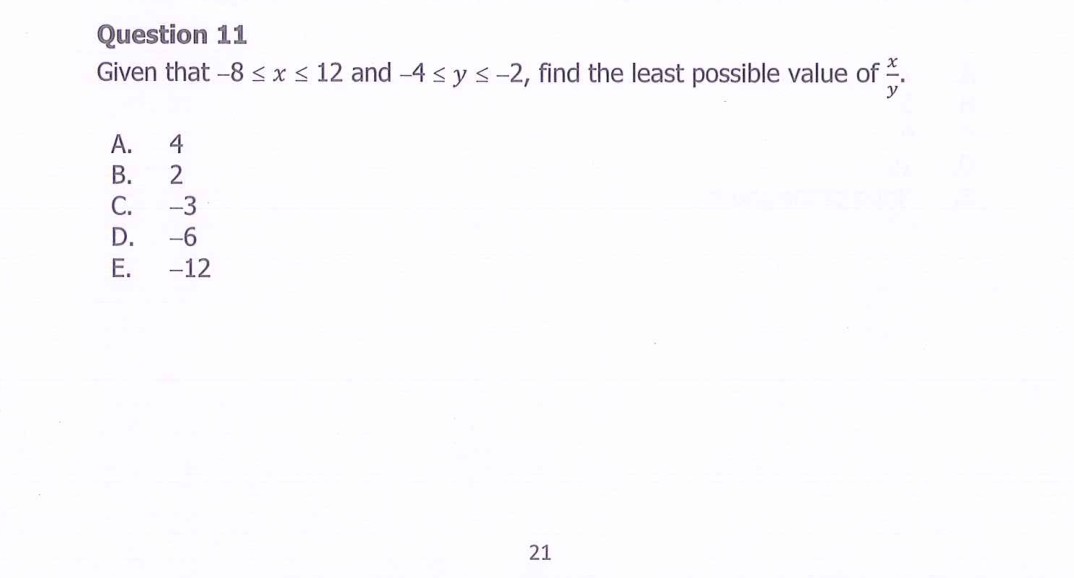
Question 11

Given that -8 ‹ x ‹ 12 and -4 ‹ y ‹ -2, find the least possible value of =
eat

Question illustration
  1. 64
  2. 2
  3. =33
  4. -6
  5. -12

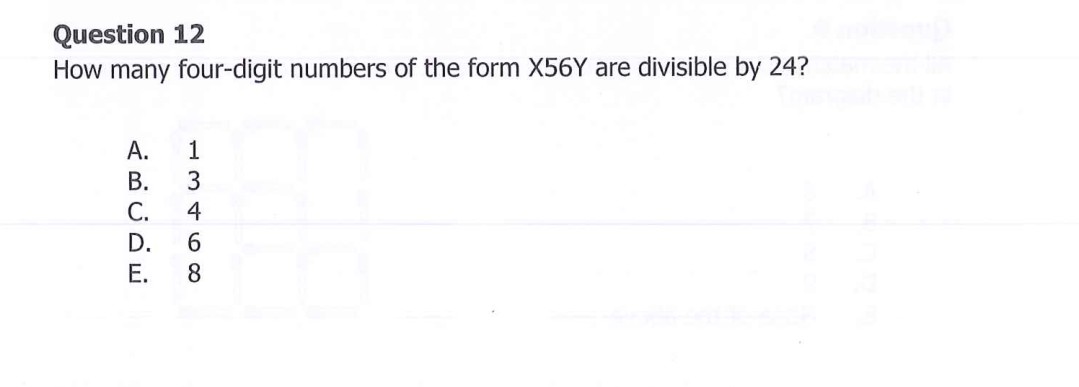
Question 12

How many four-digit numbers of the form X56Y are divisible by 24?
A 1

Question illustration
  1. See the source image for option A.
  2. 3
  3. _ = 4
  4. “6 Ea ae
  5. See the source image for option E.

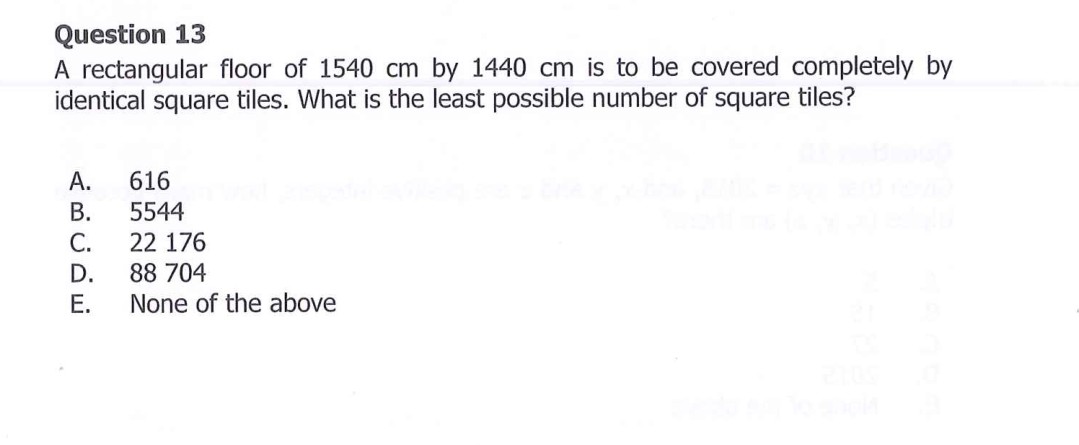
Question 13

A rectangular floor of 1540 cm by 1440 cm is to be covered completely by
identical square tiles. What is the least possible number of square tiles?

Question illustration
  1. 616
  2. 5544
  3. 22176
  4. 88 704
  5. None of the above

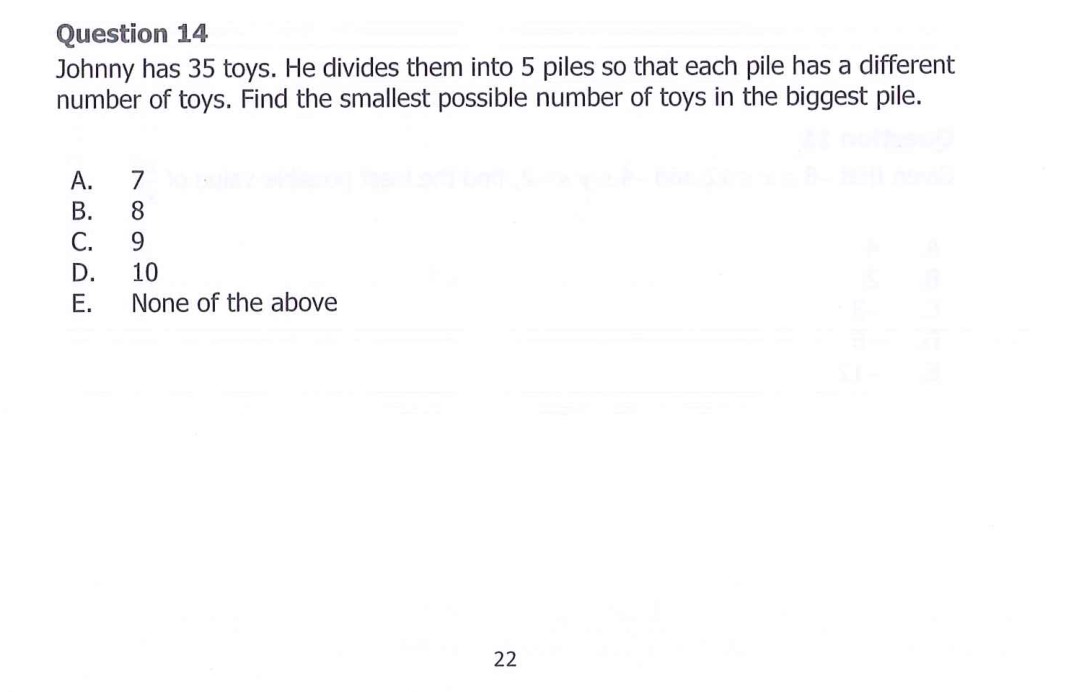
Question 14

Johnny has 35 toys. He divides them into 5 piles so that each pile has a different
number of toys. Find the smallest possible number of toys in the biggest pile.
A 7

Question illustration
  1. 7
  2. 8 G
  3. D. 10
  4. 10
  5. None of the above

Question 15

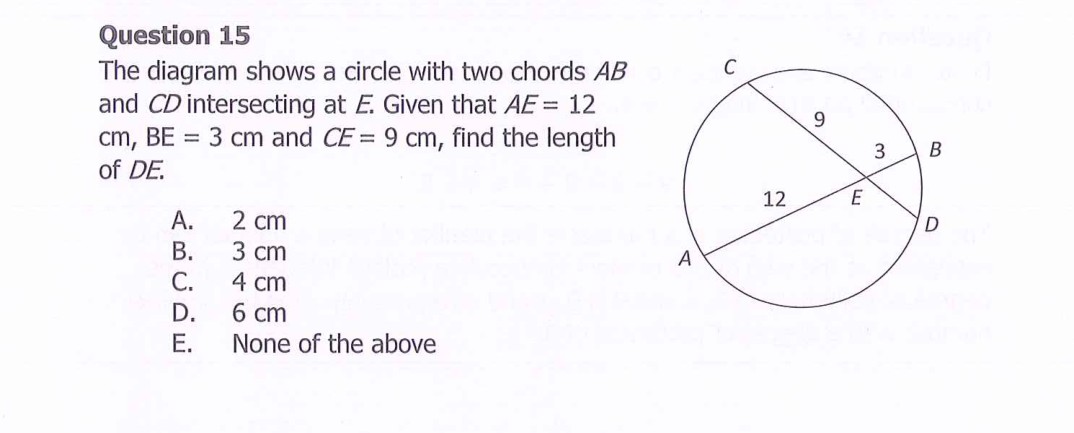
The diagram shows a circle with two chords AB c
and CD intersecting at £. Given that AF = 12
cm, BE = 3 cm and CE = 9 cm, find the length B
of DE. ‹J
‘| A. 2cm D
i B. 3cm A
GQ 4cm

Question illustration
  1. 2cm D
  2. 3cm A Fae
  3. 4cm
  4. 6cm
  5. None of the above

Question 16

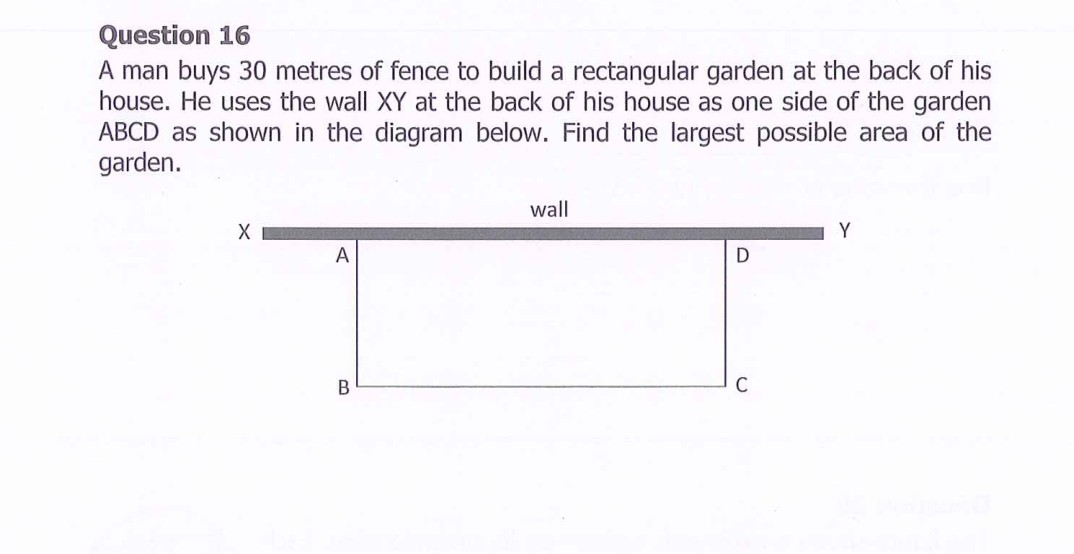
A man buys 30 metres of fence to build a rectangular garden at the back of his
house. He uses the wall XY at the back of his house as one side of the garden
ABCD as shown in the diagram below. Find the largest possible area of the
garden.
wall
x y
oie ere
B ¢c

Question illustration

Question 17

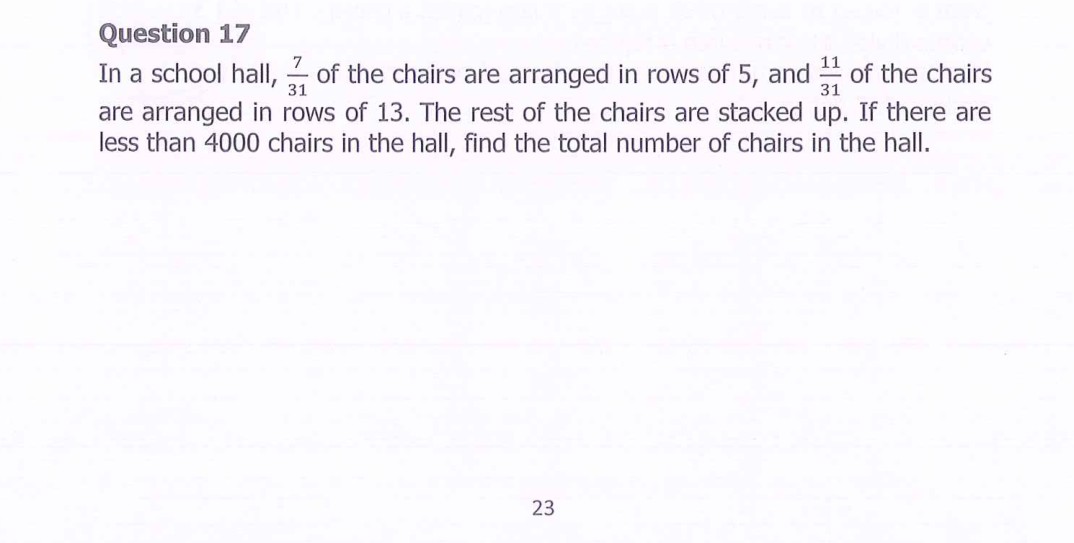
Ina school hall, z of the chairs are arranged in rows of 5, and = of the chairs
are arranged in rows of 13. The rest of the chairs are stacked up. If there are
less than 4000 chairs in the hall, find the total number of chairs in the hall.
Se SS eS ES SE

Question illustration

Question 18

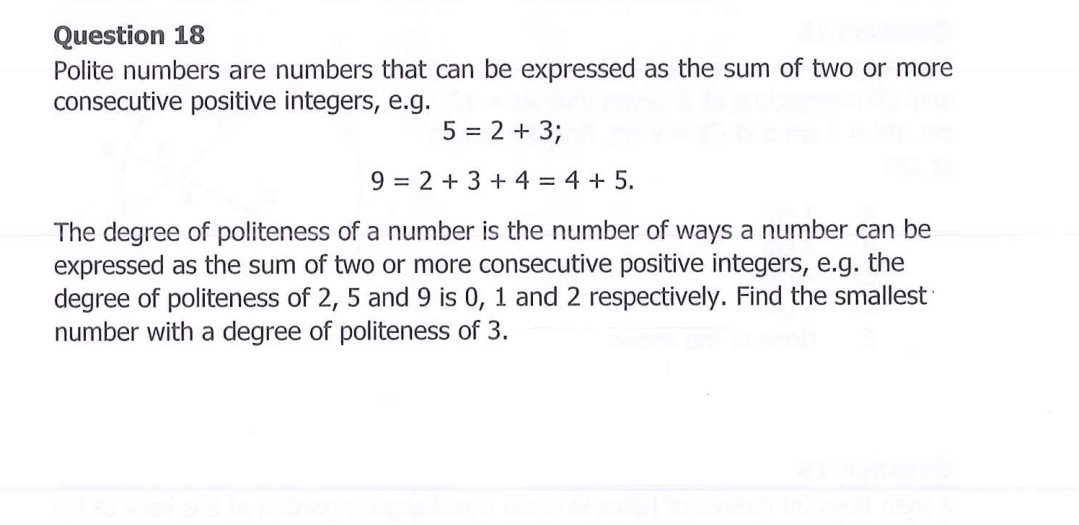
Polite numbers are numbers that can be expressed as the sum of two or more
consecutive positive integers, e.g.
Sa2 43}
9=24+34+4=4+45.
The degree of politeness of a number is the number of ways a number can be
expressed as the sum of two or more consecutive positive integers, e.g. the
degree of politeness of 2, 5 and 9 is 0, 1 and 2 respectively. Find the smallest
number with a degree of politeness of 3.

Question illustration

Question 20

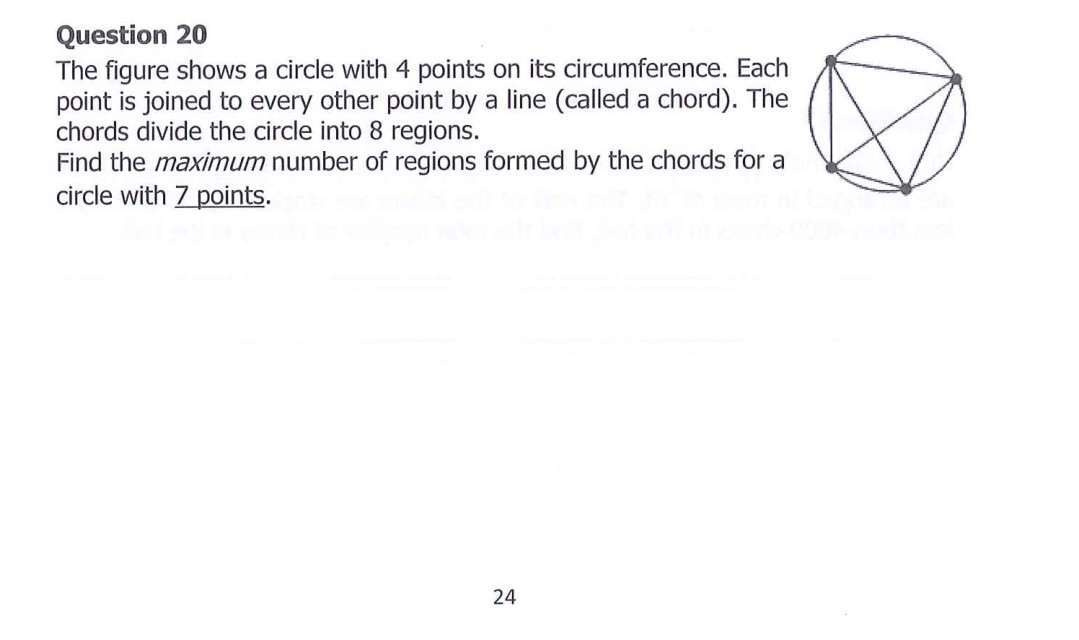
The figure shows a circle with 4 points on its circumference. Each
point is joined to every other point by a line (called a chord). The
chords divide the circle into 8 regions.
Find the maximum number of regions formed by the chords for a
circle with 7 points.
SSS) | Fonseca enone Ronettes) fSonchecocnmneee SS SSS
i

s 3

:

:
E
= =
\
= | | %
= ——————— eee
: |

Question illustration