Skip to content / Đến nội dung
ThichHocToan.com

SASMO 2015 Secondary 3 (Grade 9) Contest

Question 1

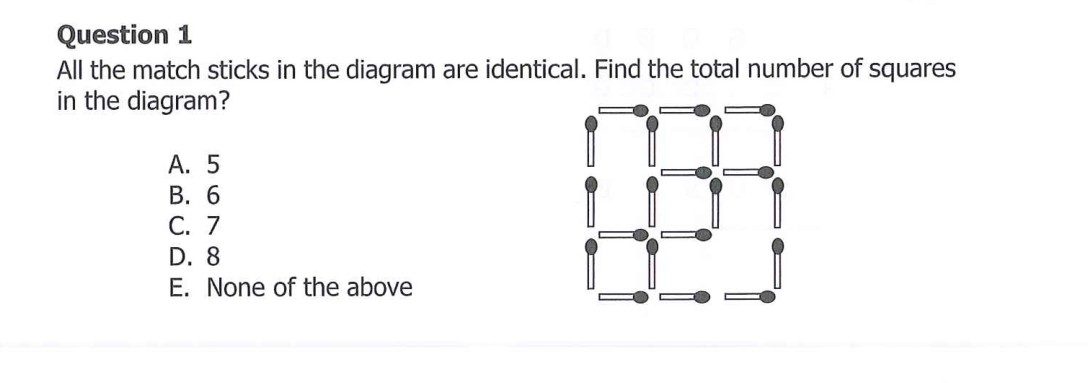
All the match sticks in the diagram are identical. Find the total number of squares
in the diagram? rr

AS = I

Question illustration
  1. See the source image for option A.
  2. 6 ef {ttt
  3. See the source image for option C.
  4. 8 rt
  5. None of the above —~7.—e.e =e

Question 2

Some people are standing equally spaced around a circle, and they were
numbered starting from the number 1 in an anticlockwise direction. If the person
numbered 17 is directly opposite the person numbered 45, how many people are
there?

Question illustration
  1. 52
  2. 54
  3. 56
  4. 58
  5. 60

Question 3

A big cube is made up of 64 small cubes. All the faces of the big cube are then
painted. How many of the small cubes have exactly two painted faces?

Question illustration
  1. 8
  2. 12
  3. 16
  4. 24
  5. None of the above

Question 4

A rectangular floor of 1584 cm by 1134 cm is to be covered completely by
identical square tiles. What is the greatest possible length of the square tiles?

Question illustration
  1. 3cm
  2. 9cm
  3. 18cm
  4. 36cm
  5. None of the above

Question 5

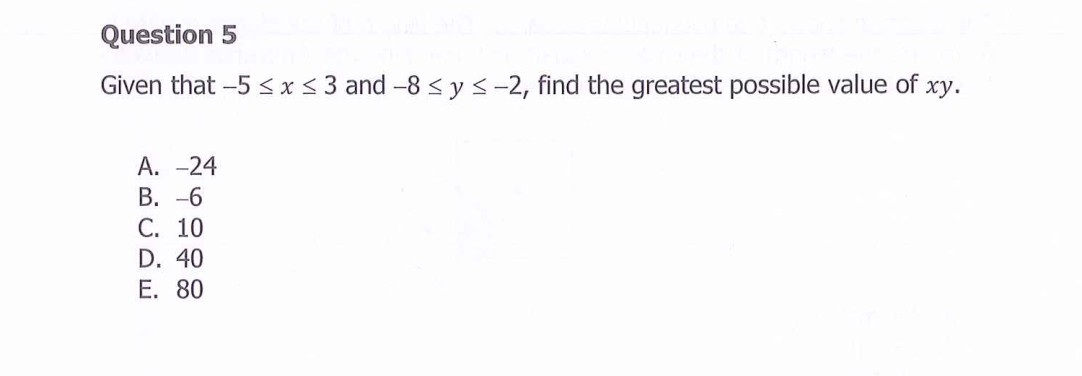
Given that —5 ‹ x ‹ 3 and -8 ‹ y ‹ -2, find the greatest possible value of xy.

Question illustration
  1. -24
  2. -6
  3. 10
  4. 40
  5. 80

Question 6

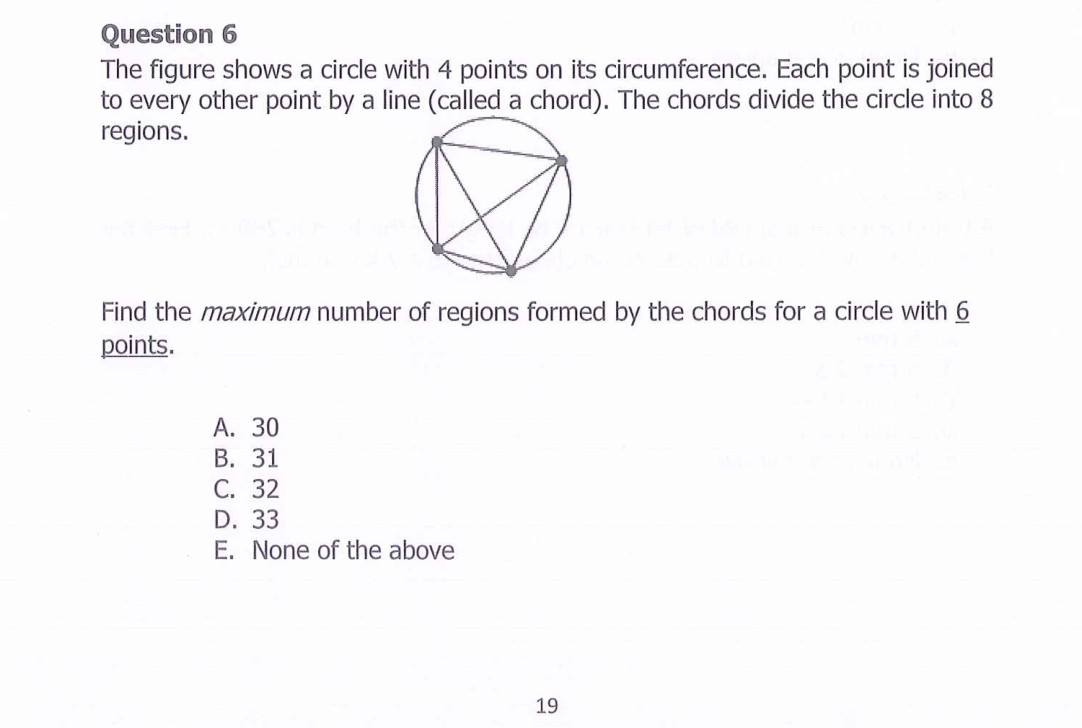
The figure shows a circle with 4 points on its circumference. Each point is joined
to every other point by a line (called a chord). The chords divide the circle into 8
regions. iy
Find the maximum number of regions formed by the chords for a circle with 6
points.
A. 30
iB. 31
G 32
; D. 33
: E. None of the above
ks
i

Question illustration
  1. 30
  2. 31
  3. 32
  4. 33
  5. None of the above

Question 7

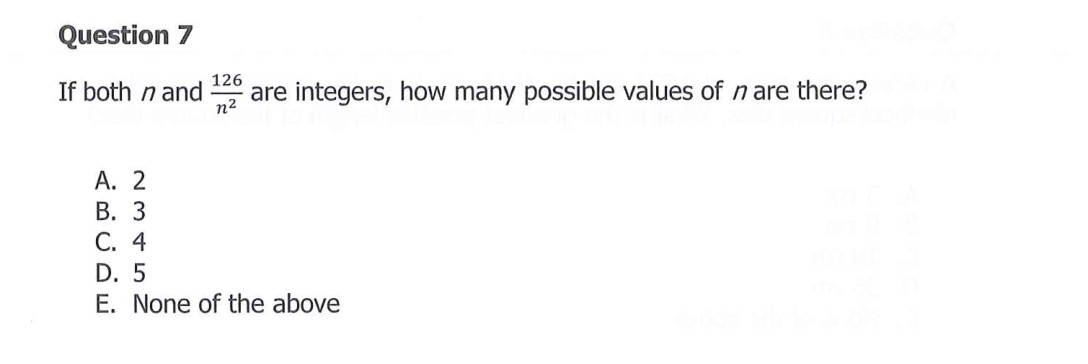
If both 7 and = are integers, how many possible values of are there?

Question illustration
  1. 2
  2. 3
  3. 4
  4. 5
  5. None of the above

Question 8

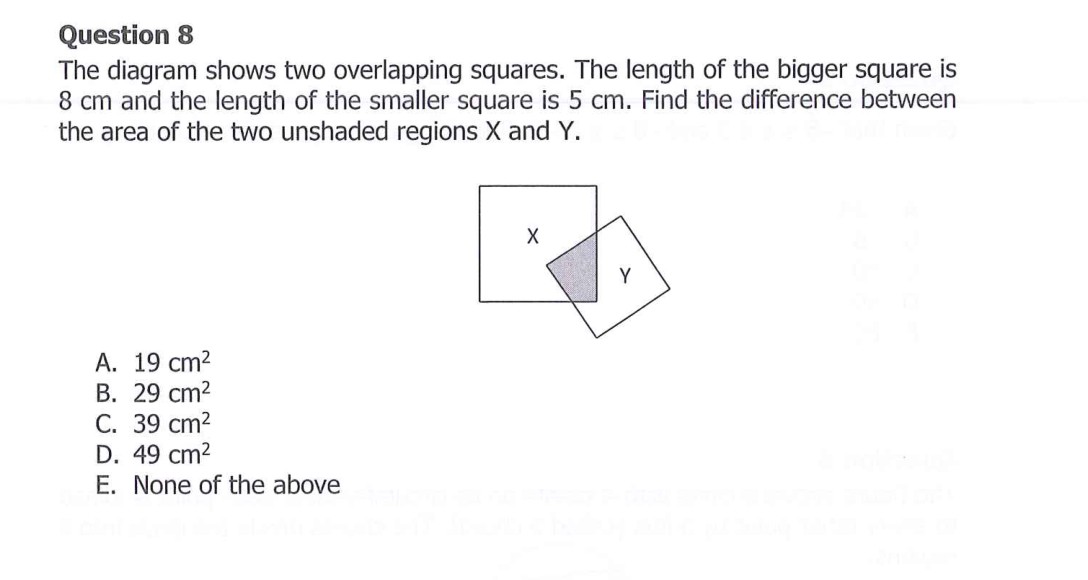
The diagram shows two overlapping squares. The length of the bigger square is
8 cm and the length of the smaller square is 5 cm. Find the difference between
the area of the two unshaded regions X and Y.

Question illustration
  1. 19 cm?
  2. 29 cm?
  3. 39 cm?
  4. 49 cm?
  5. None of the above

Question 9

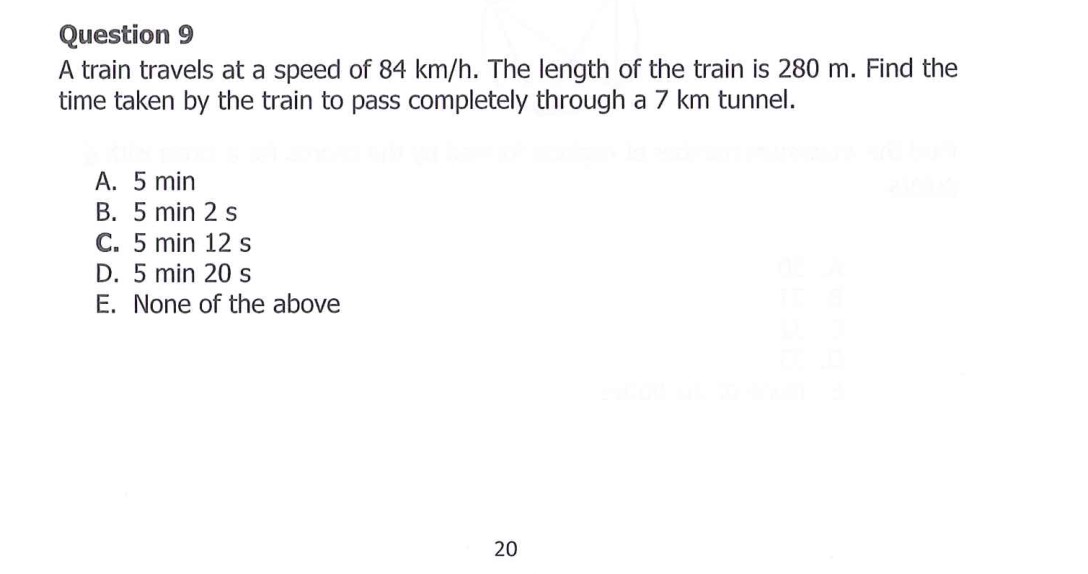
Atrain travels at a speed of 84 km/h. The length of the train is 280 m. Find the
time taken by the train to pass completely through a 7 km tunnel.

Question illustration
  1. 5 min
  2. 5min2s
  3. 5mini2s
  4. 5 min 20s
  5. None of the above

Question 10

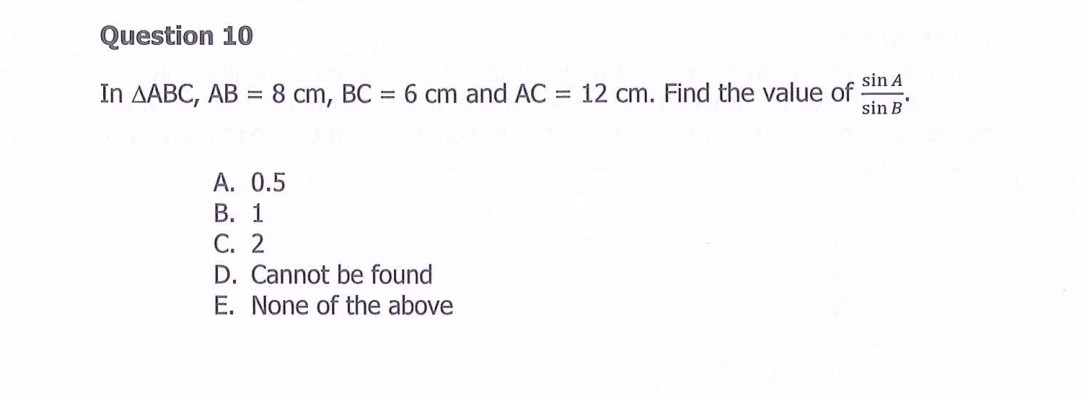
In AABC, AB = 8 cm, BC = 6 cm and AC = 12 cm. Find the value of a

Question illustration
  1. 0.5
  2. See the source image for option B.
  3. 2
  4. Cannot be found
  5. None of the above

Question 11

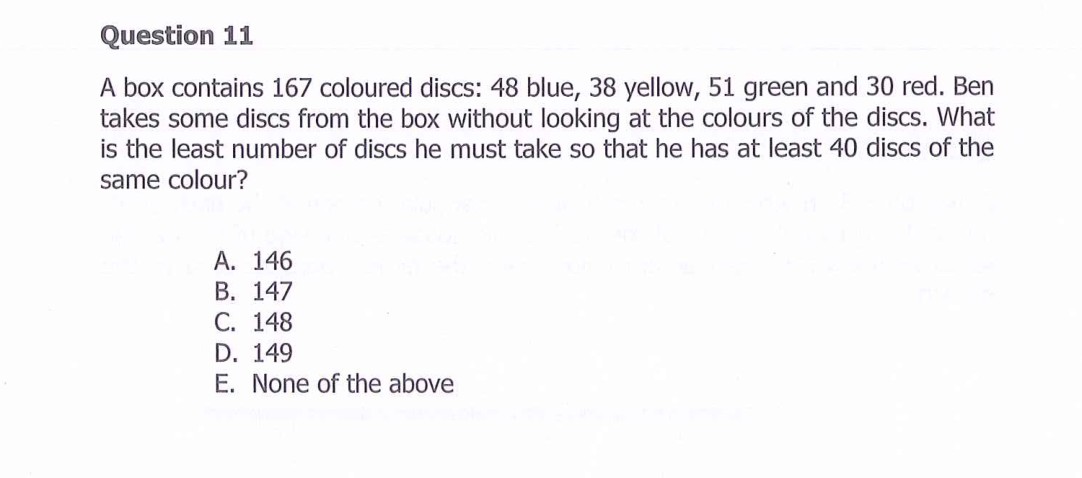
A box contains 167 coloured discs: 48 blue, 38 yellow, 51 green and 30 red. Ben
takes some discs from the box without looking at the colours of the discs. What
E | is the least number of discs he must take so that he has at least 40 discs of the
same colour?

Question illustration
  1. 146
  2. 147
  3. 148
  4. 149
  5. None of the above

Question 12

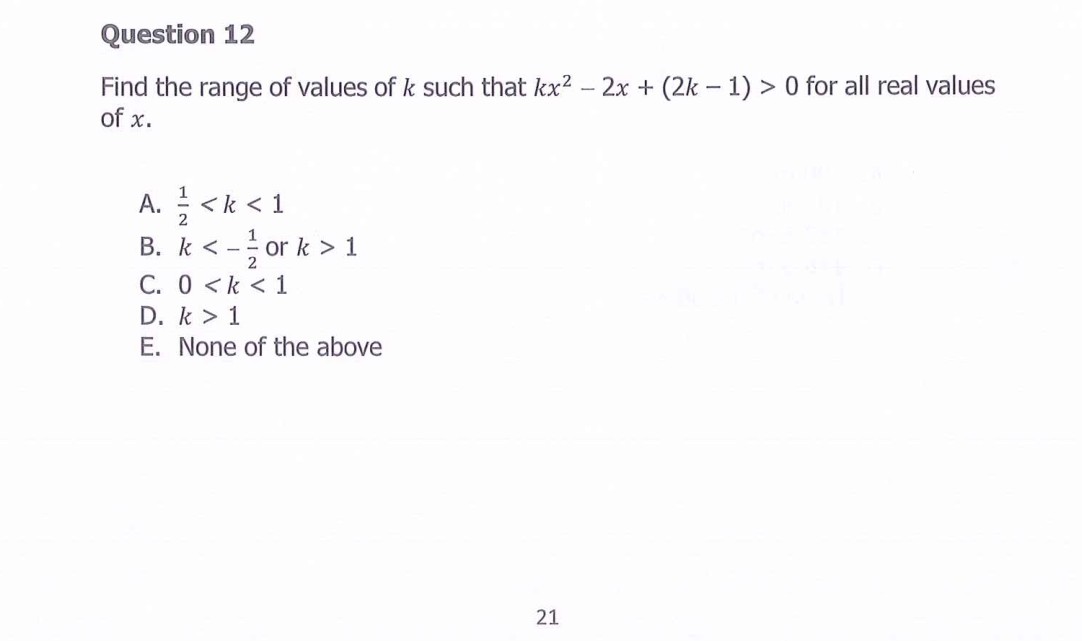
Find the range of values of k such that kx? — 2x + (2k - 1) › 0 for all real values
of x.
A E‹k‹1
BL k‹-Zork›1

Question illustration
  1. <k<1
  2. See the source image for option B.
  3. 0<sk<1
  4. ke
  5. None of the above

Question 13

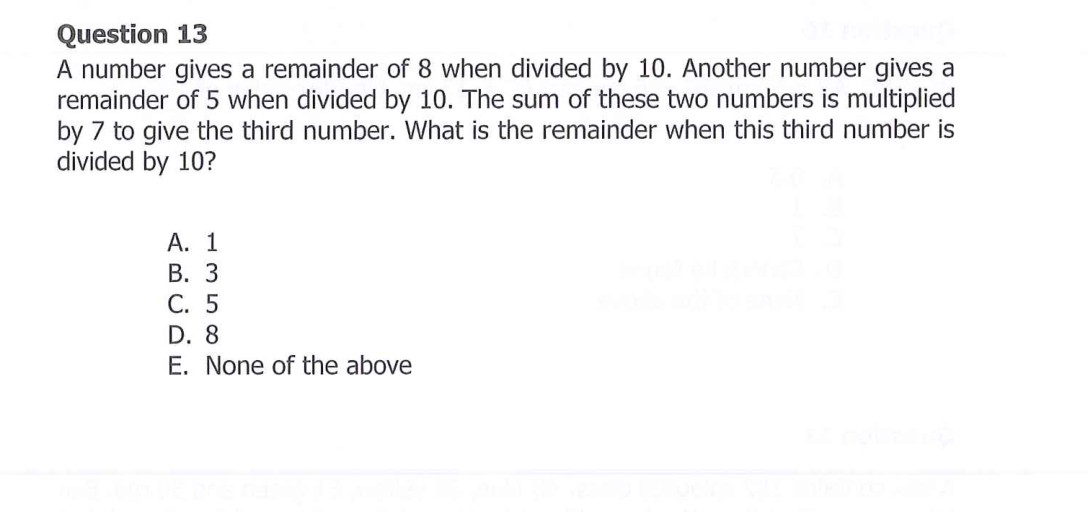
A number gives a remainder of 8 when divided by 10. Another number gives a
remainder of 5 when divided by 10. The sum of these two numbers is multiplied
by 7 to give the third number. What is the remainder when this third number is
divided by 10?

A1

Question illustration
  1. 1
  2. 3
  3. 5
  4. 8
  5. None of the above

Question 14

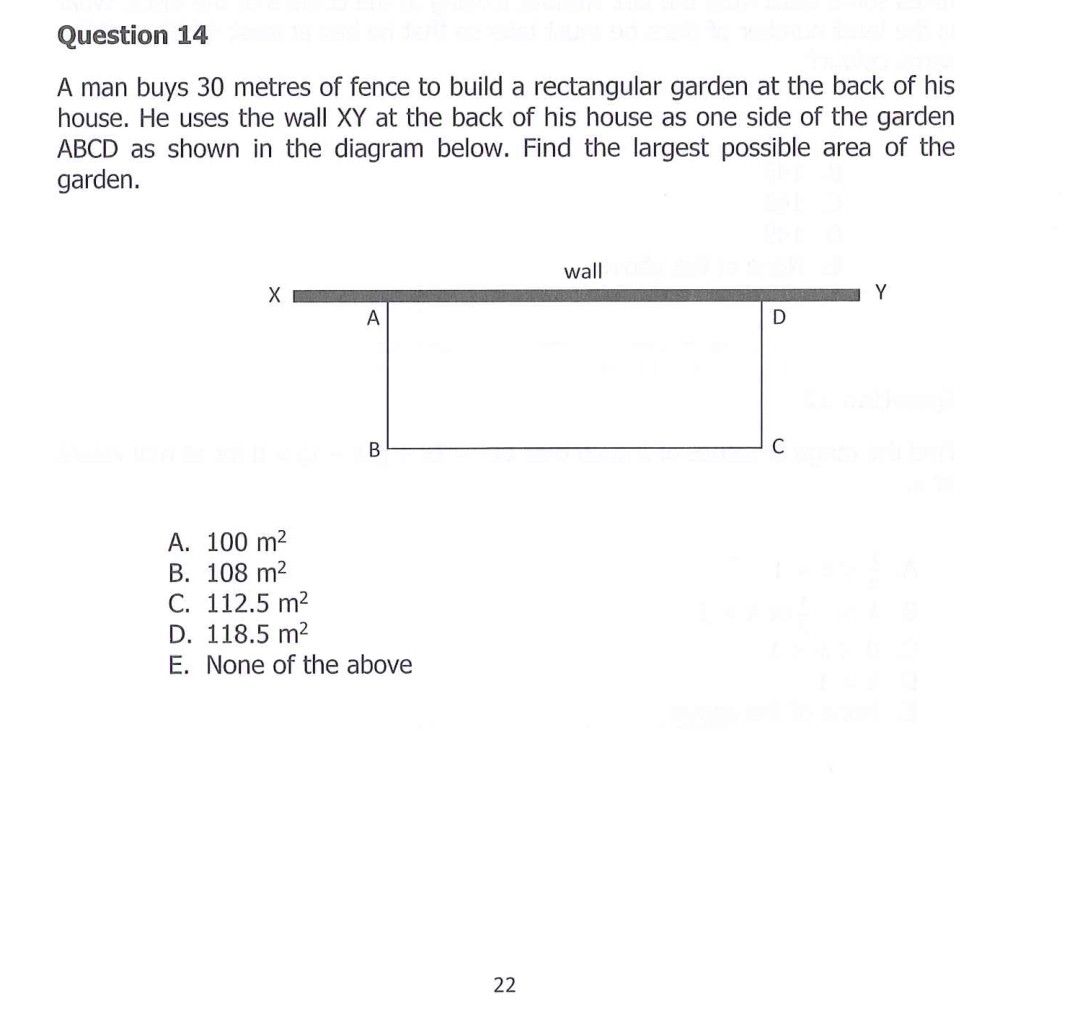
Aman buys 30 metres of fence to build a rectangular garden at the back of his
house. He uses the wall XY at the back of his house as one side of the garden
ABCD as shown in the diagram below. Find the largest possible area of the
garden.

wall
x ¥
TE
B c

Question illustration
  1. 100 m?
  2. 108 m?
  3. 112.5 m2
  4. 118.5 m2
  5. None of the above

Question 15

Given that 4! means 4 x 3 x 2 x 1 = 24, find the number of consecutive zeros
at the end of 27!

Question illustration
  1. 2
  2. 3
  3. 4
  4. . 5
  5. 6

Question 16

If the five-digit number X234Y is divisible by 72, find X.
{
i

Question illustration

Question 17

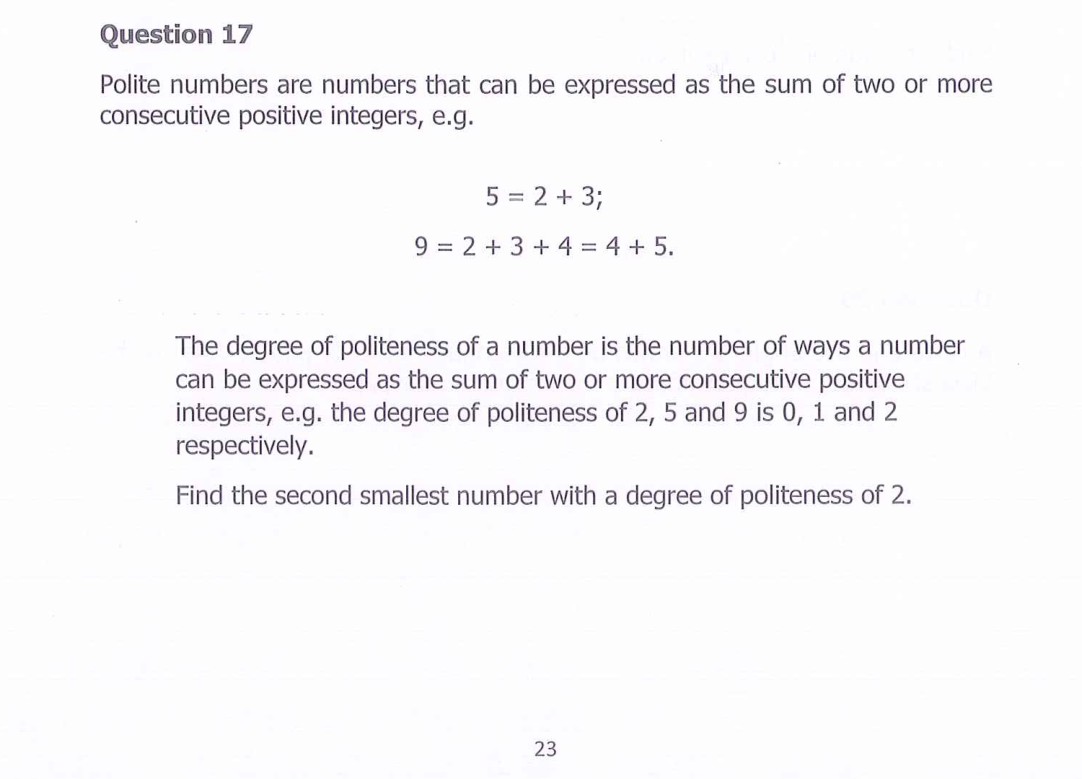
Polite numbers are numbers that can be expressed as the sum of two or more
consecutive positive integers, e.g.
5=2+3;
9=24344=445,
The degree of politeness of a number is the number of ways a number
can be expressed as the sum of two or more consecutive positive
integers, e.g. the degree of politeness of 2, 5 and 9 is 0, 1 and 2
respectively.
Find the second smallest number with a degree of politeness of 2.
A
bes
Se eS Se SS SSS
Question illustration

Question 18

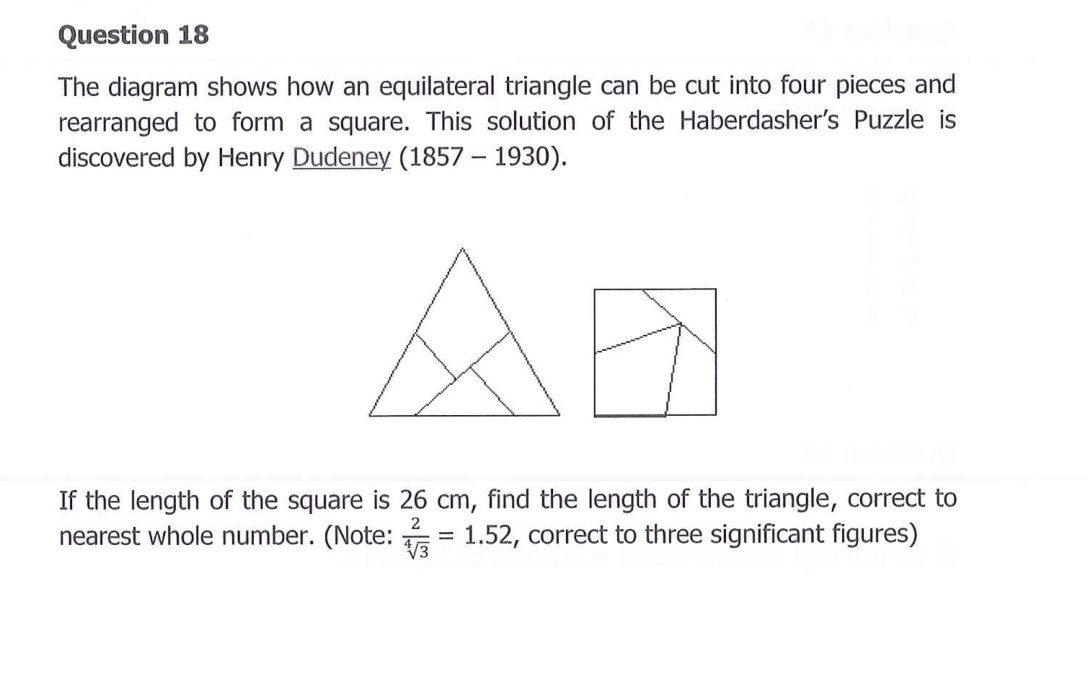
The diagram shows how an equilateral triangle can be cut into four pieces and
rearranged to form a square. This solution of the Haberdasher’s Puzzle is
discovered by Henry Dudeney (1857 — 1930).
If the length of the square is 26 cm, find the length of the triangle, correct to
nearest whole number. (Note: q = 1.52, correct to three significant figures)

Question illustration

Question 20

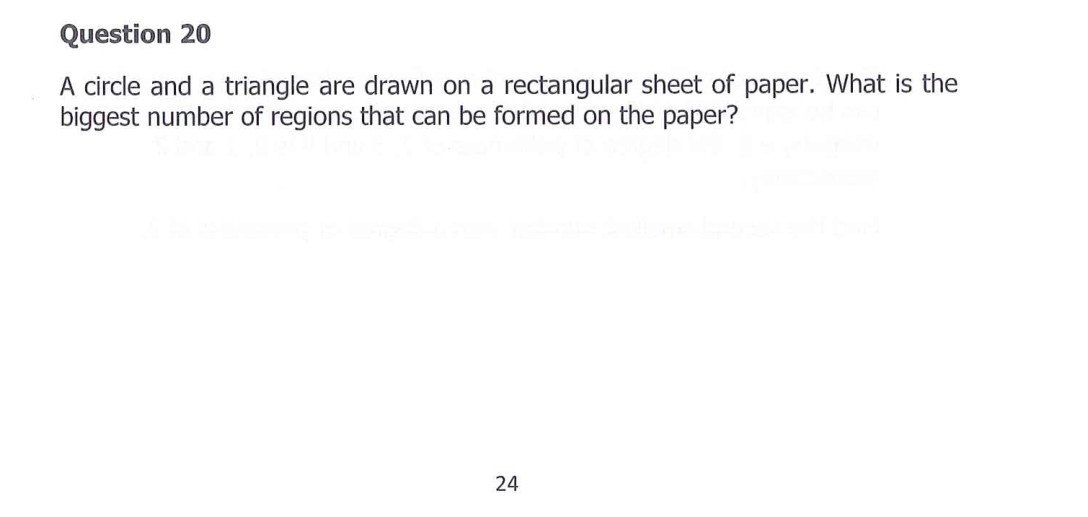
A circle and a triangle are drawn on a rectangular sheet of paper. What is the
biggest number of regions that can be formed on the paper?
Seas Eee) beer |) Sey Pees
j | i

= | | :
less
I
SS
=

Question illustration