Skip to content / Đến nội dung
ThichHocToan.com

SASMO 2015 Primary 6 (Grade 6) Contest

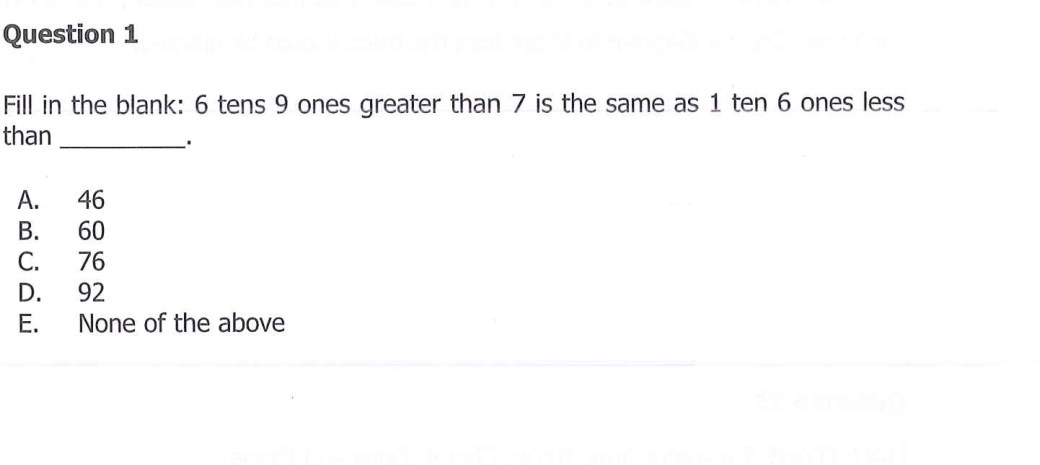
Question 1

Fill in the blank: 6 tens 9 ones greater than 7 is the same as 1 ten 6 ones less than ____.

Question illustration
  1. 46
  2. 60
  3. 76
  4. 92
  5. None of the above

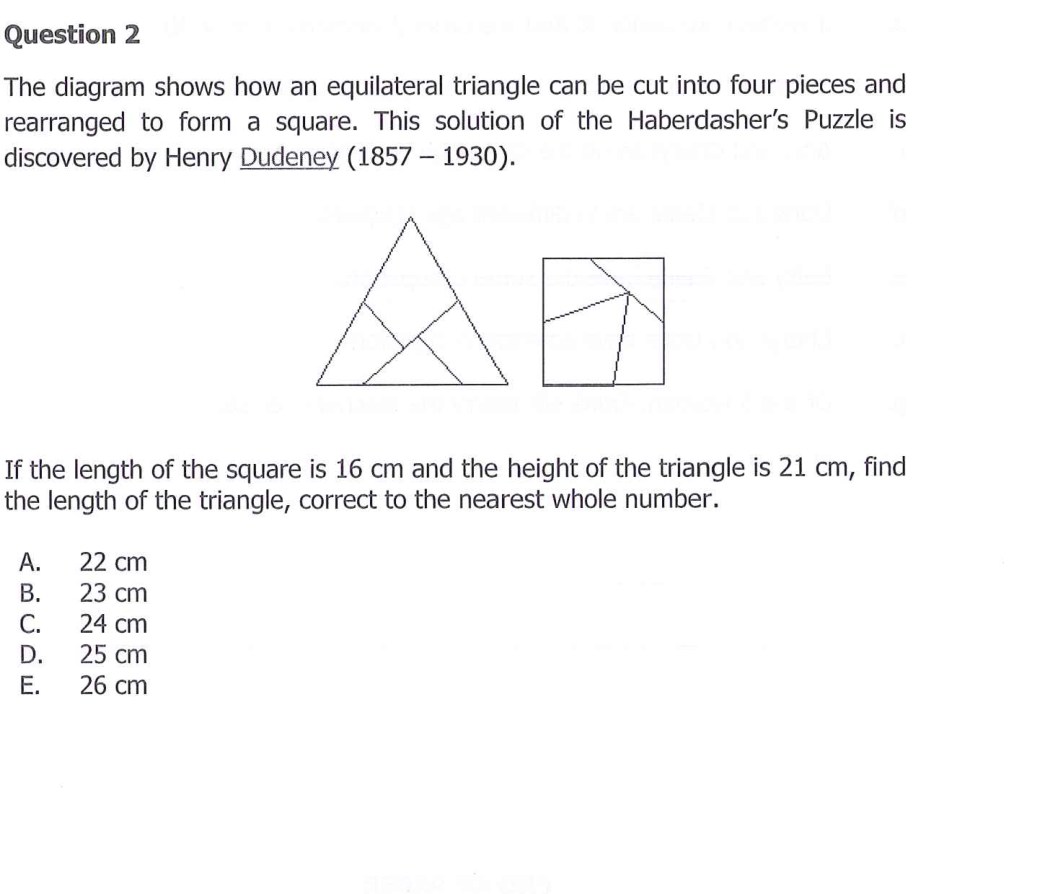
Question 2

The diagram shows how an equilateral triangle can be cut into four pieces and rearranged to form a square. If the side of the square is 16 cm and the height of the triangle is 21 cm, find the side length of the triangle, correct to the nearest whole number.

Question illustration
  1. 22 cm
  2. 23 cm
  3. 24 cm
  4. 25 cm
  5. 26 cm

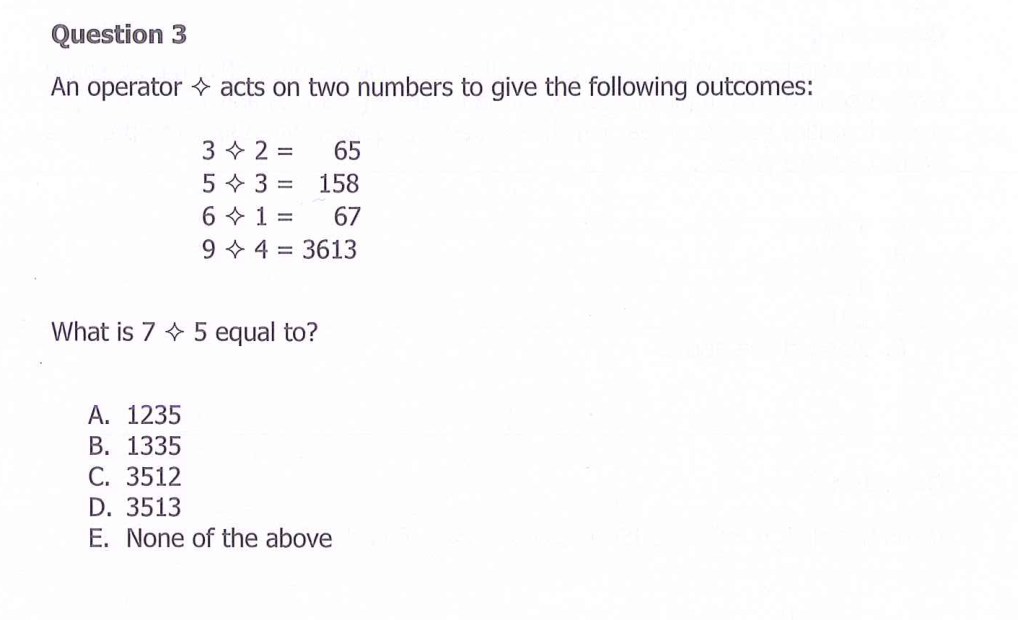
Question 3

An operator $\diamond$ acts on two numbers as shown: $3\diamond2=65$, $5\diamond3=158$, $6\diamond1=67$, $9\diamond4=3613$. What is $7\diamond5$?

Question illustration
  1. 1235
  2. 1335
  3. 3512
  4. 3513
  5. None of the above

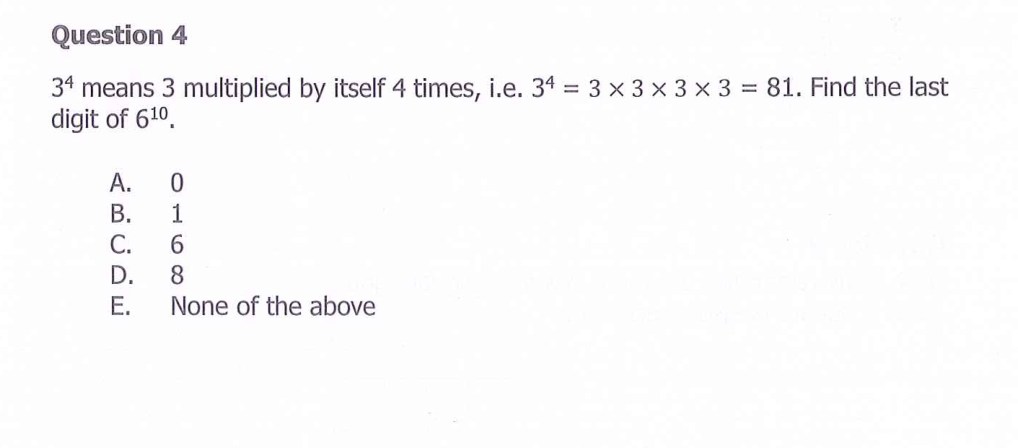
Question 4

$3^4$ means 3 multiplied by itself 4 times. Find the last digit of $6^{10}$.

Question illustration
  1. 0
  2. 1
  3. 6
  4. 8
  5. None of the above

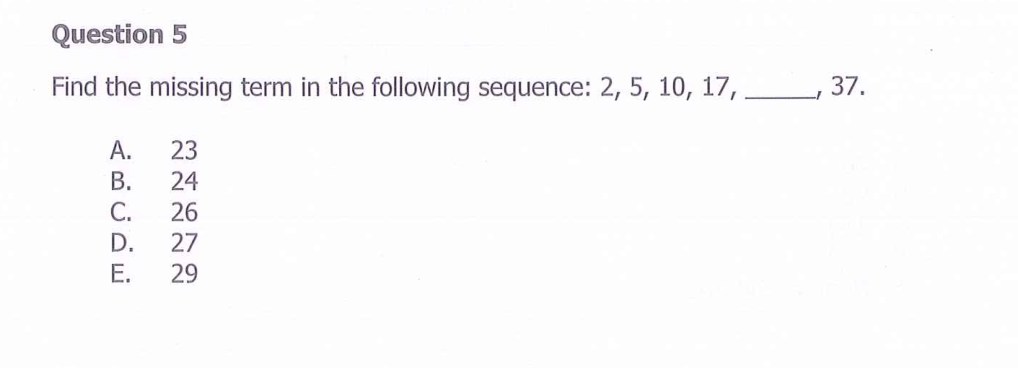
Question 5

Find the missing term in the sequence $2,5,10,17,\square,37$.

Question illustration
  1. 23
  2. 24
  3. 26
  4. 27
  5. 29

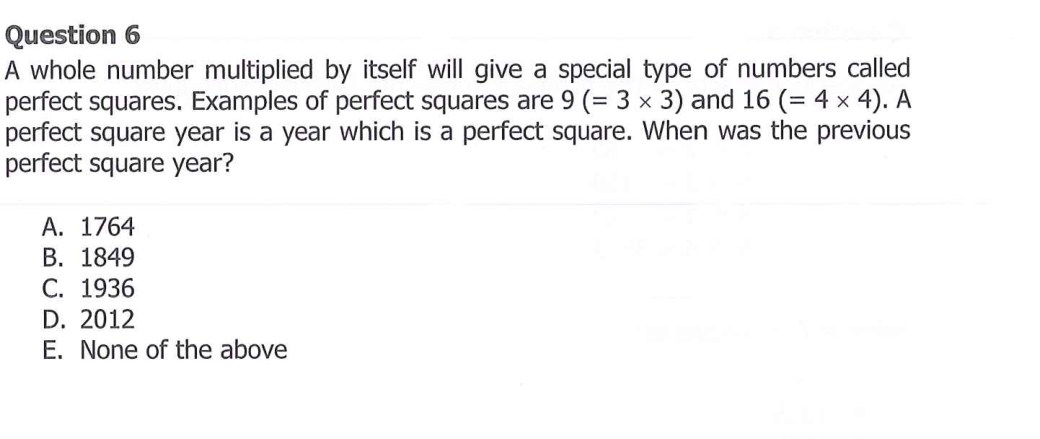
Question 6

A perfect square year is a year whose number is a perfect square. When was the previous perfect square year?

Question illustration
  1. 1764
  2. 1849
  3. 1936
  4. 2012
  5. None of the above

Question 7

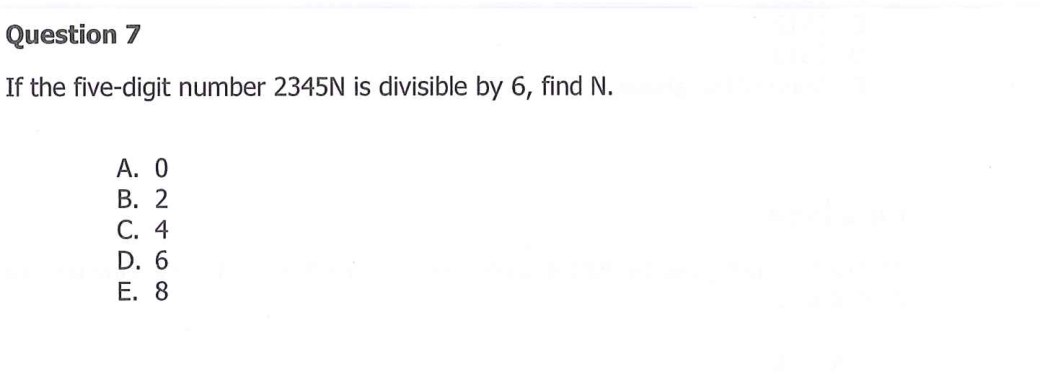
If the five-digit number $2345N$ is divisible by 6, find $N$.

Question illustration
  1. 0
  2. 2
  3. 4
  4. 6
  5. 8

Question 8

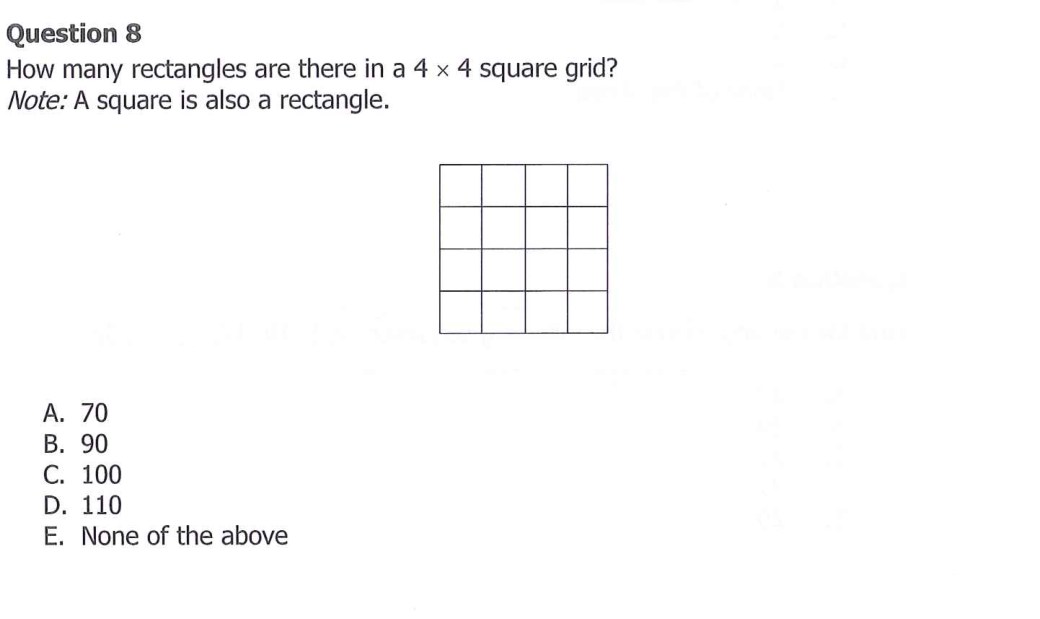
How many rectangles are there in a $4\times4$ square grid? Note: a square is also a rectangle.

Question illustration
  1. 70
  2. 90
  3. 100
  4. 110
  5. None of the above

Question 9

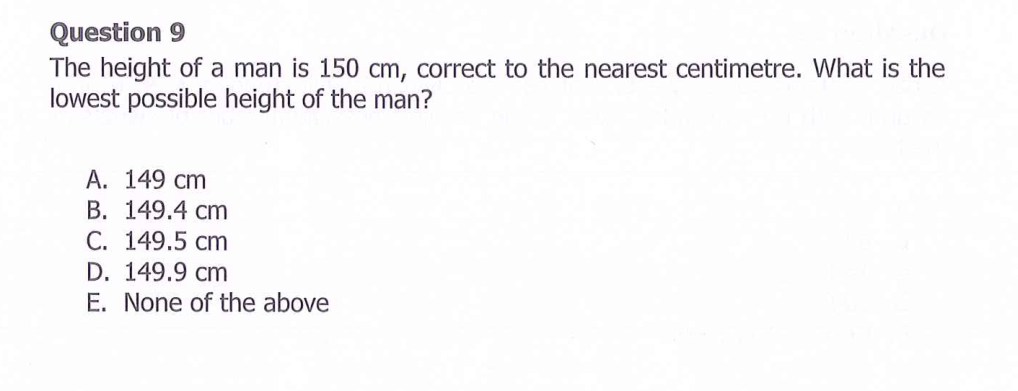
The height of a man is 150 cm, correct to the nearest centimetre. What is the lowest possible height of the man?

Question illustration
  1. 149 cm
  2. 149.4 cm
  3. 149.5 cm
  4. 149.9 cm
  5. None of the above

Question 10

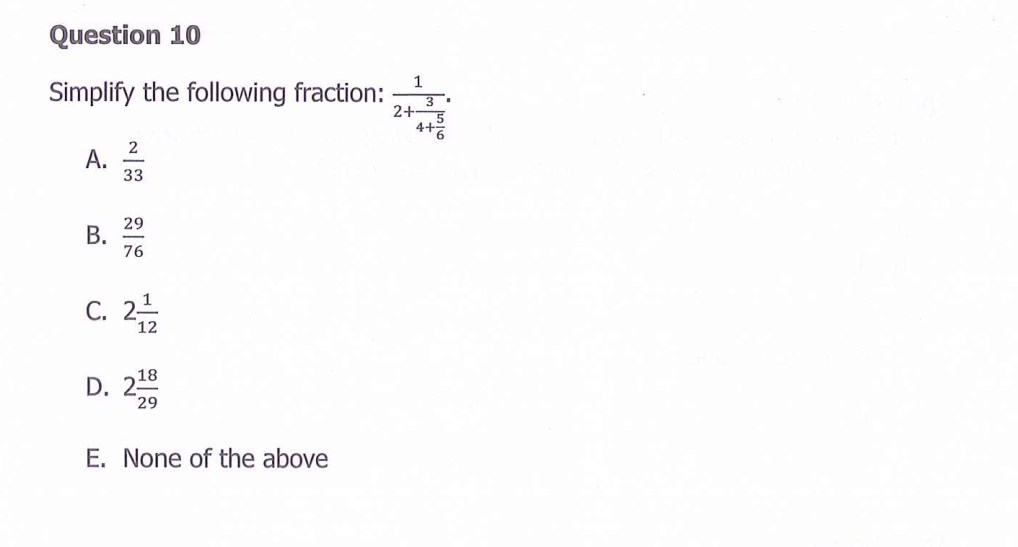
Simplify $\displaystyle\frac{1}{2+\frac{3}{4+\frac56}}$.

Question illustration
  1. $\frac{2}{33}$
  2. $\frac{29}{76}$
  3. $2\frac{1}{12}$
  4. $2\frac{18}{29}$
  5. None of the above

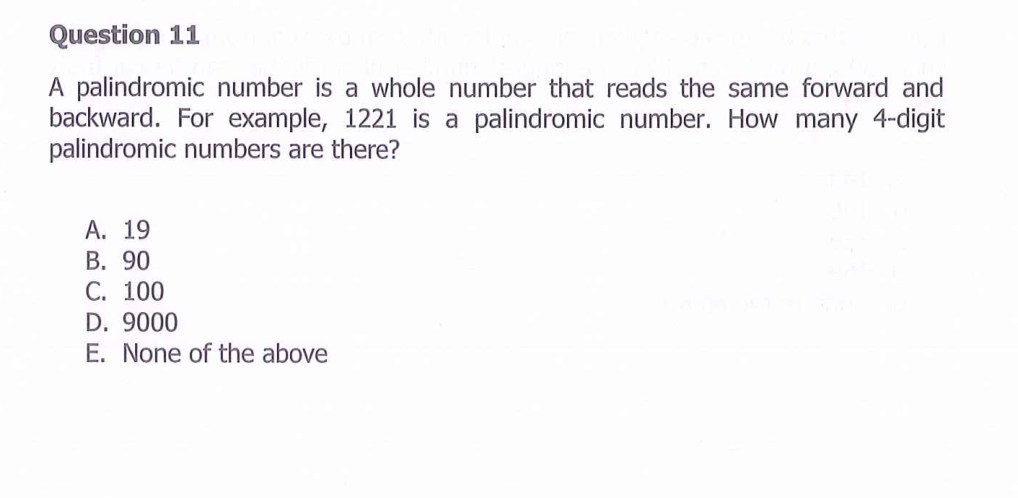
Question 11

A palindromic number is a whole number that reads the same forward and backward. How many four-digit palindromic numbers are there?

Question illustration
  1. 19
  2. 90
  3. 100
  4. 9000
  5. None of the above

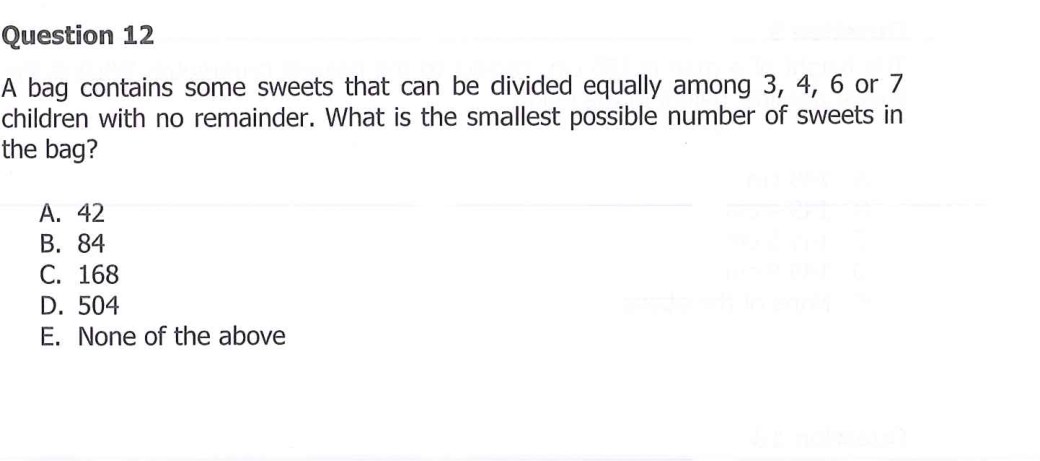
Question 12

A bag contains some sweets that can be divided equally among 3, 4, 6 or 7 children with no remainder. What is the smallest possible number of sweets?

Question illustration
  1. 42
  2. 84
  3. 168
  4. 504
  5. None of the above

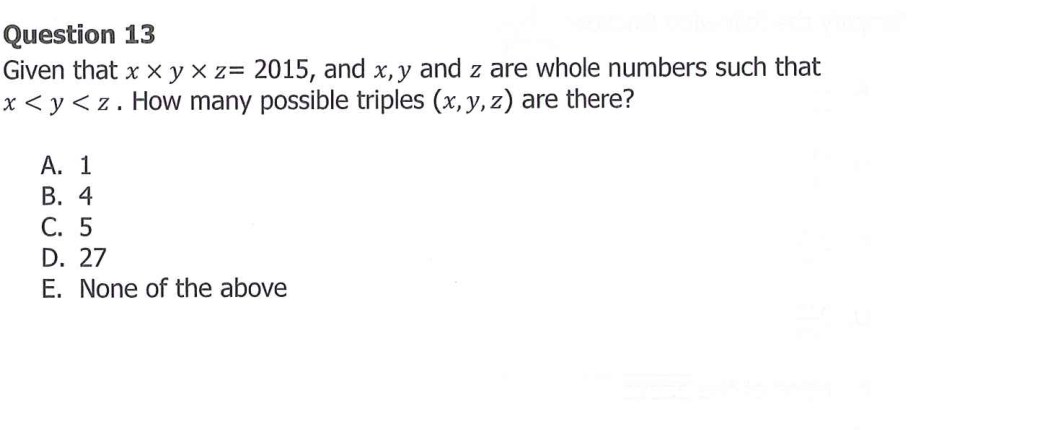
Question 13

Given that $xyz=2015$, where $x,y,z$ are whole numbers and $x<y<z$, how many possible triples $(x,y,z)$ are there?

Question illustration
  1. 1
  2. 4
  3. 5
  4. 27
  5. None of the above

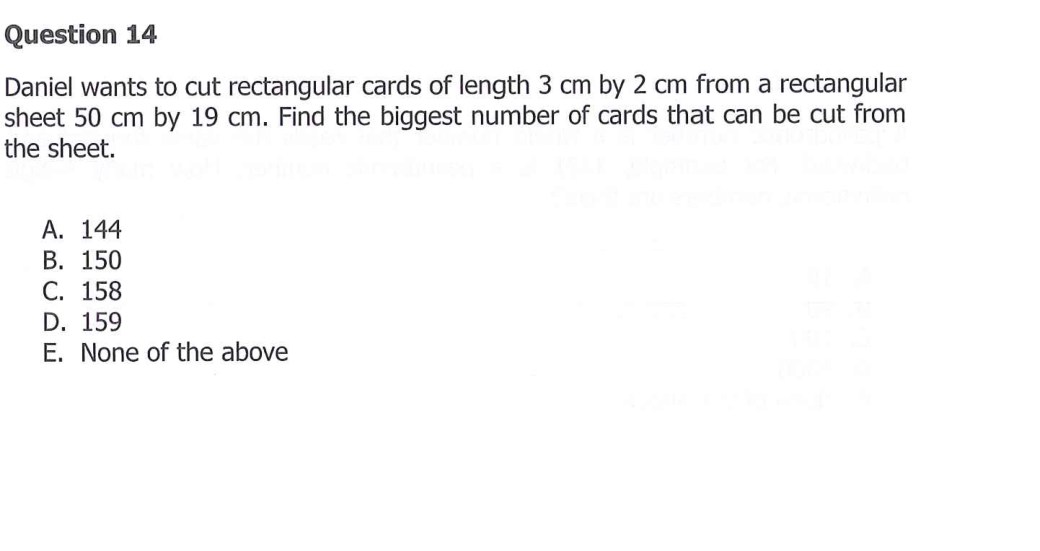
Question 14

Daniel wants to cut $3$ cm by $2$ cm rectangular cards from a $50$ cm by $19$ cm rectangular sheet. Find the greatest number of cards that can be cut.

Question illustration
  1. 144
  2. 150
  3. 158
  4. 159
  5. None of the above

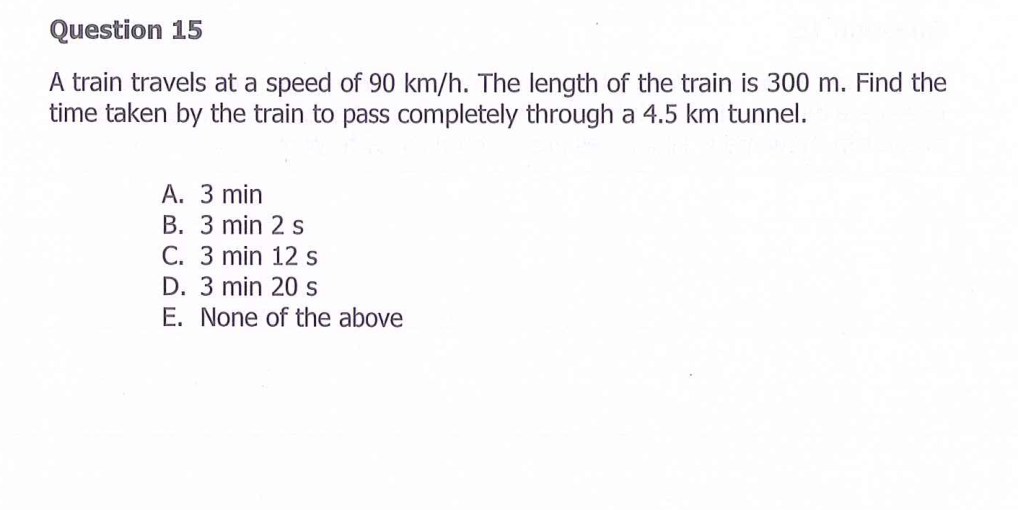
Question 15

A train travels at 90 km/h and is 300 m long. Find the time taken for the train to pass completely through a 4.5 km tunnel.

Question illustration
  1. 3 min
  2. 3 min 2 s
  3. 3 min 12 s
  4. 3 min 20 s
  5. None of the above

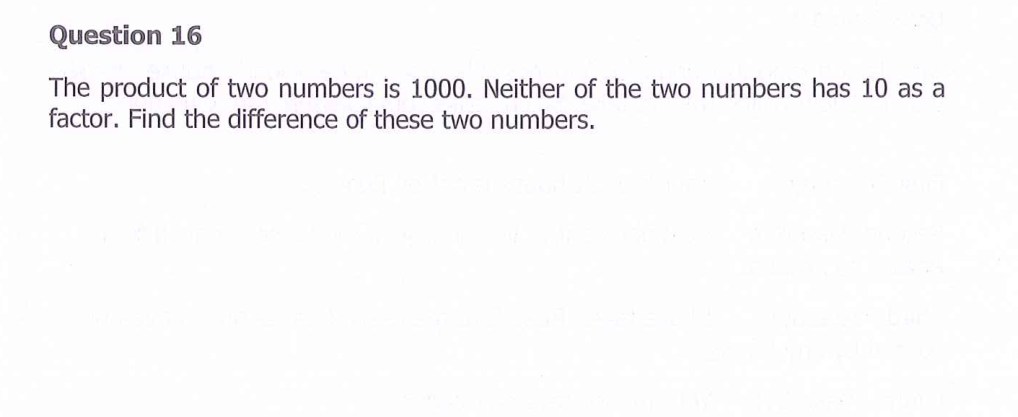
Question 16

The product of two numbers is 1000. Neither number has 10 as a factor. Find the difference between the two numbers.

Question illustration

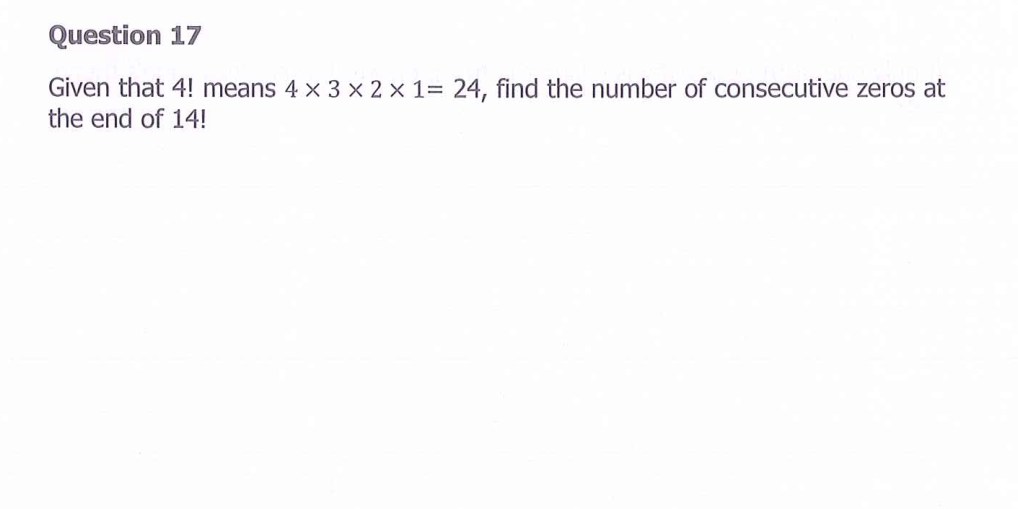
Question 17

Given that $4!=4\times3\times2\times1$, find the number of consecutive zeros at the end of $14!$.

Question illustration

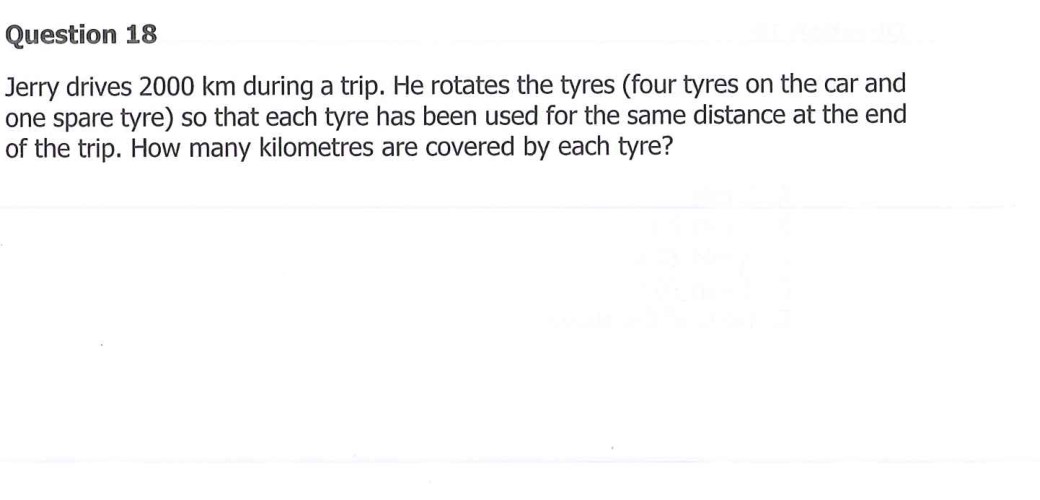
Question 18

Jerry drives 2000 km during a trip. He rotates the four tyres on the car and one spare so that each tyre is used for the same distance. How many kilometres are covered by each tyre?

Question illustration

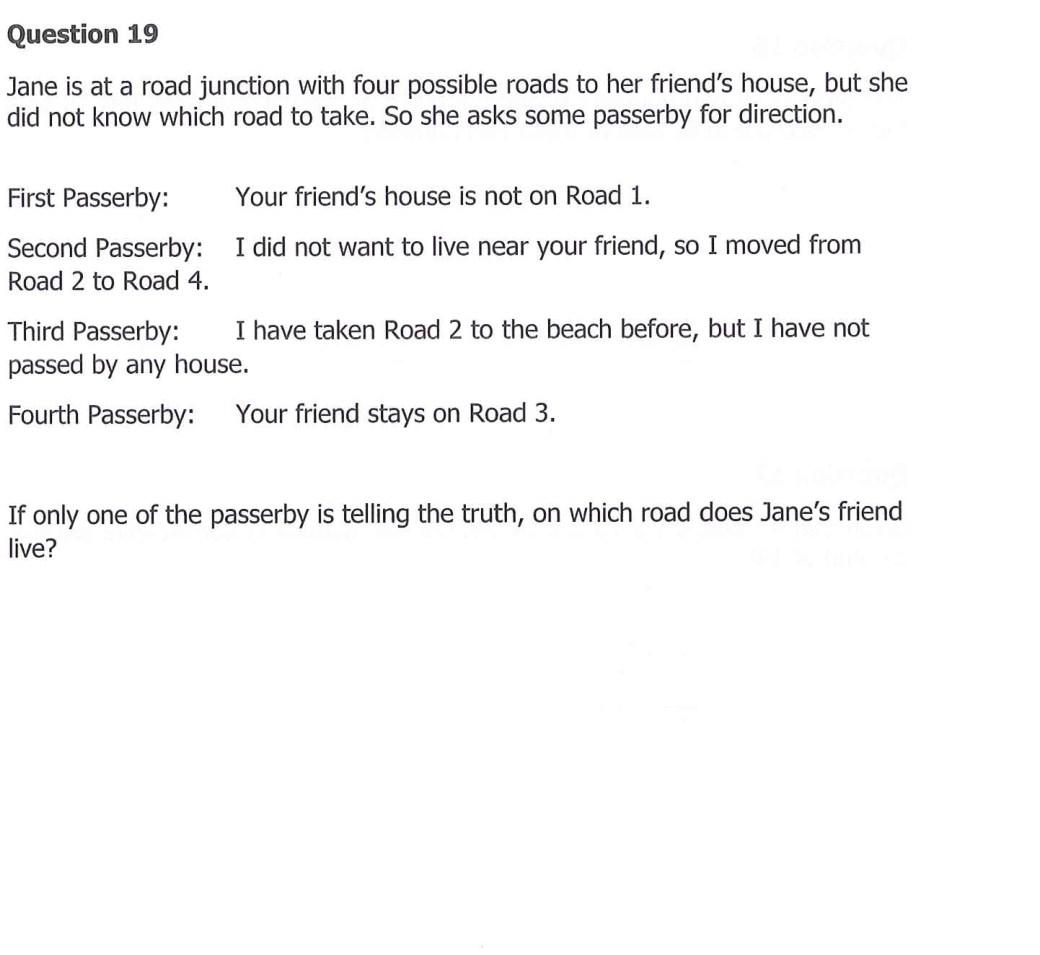
Question 19

Jane is at a junction with four roads to her friend's house. Four passersby make the statements shown in the source. If only one passerby tells the truth, on which road does Jane's friend live?

Question illustration

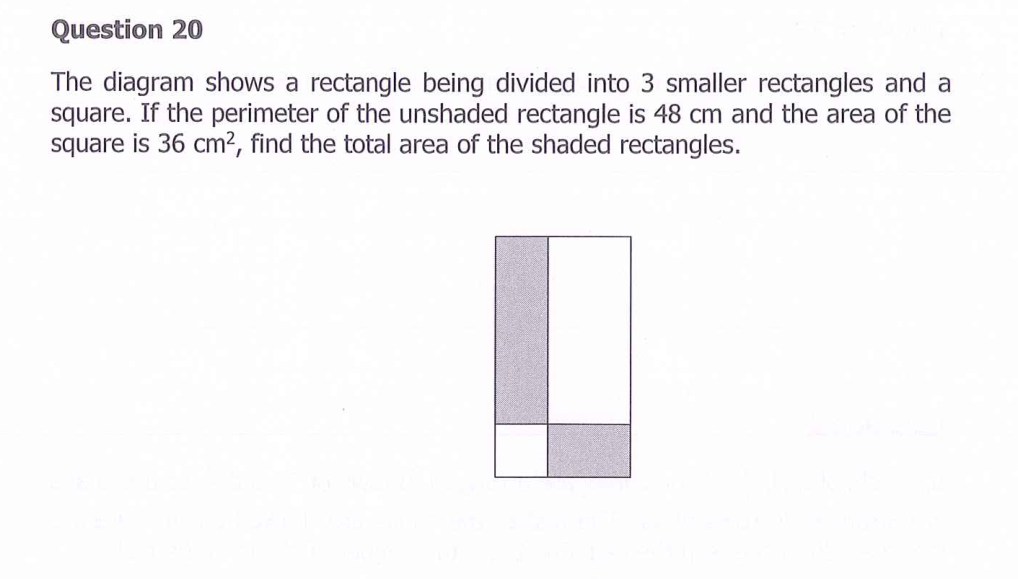
Question 20

The diagram shows a rectangle divided into three smaller rectangles and a square. If the perimeter of the unshaded rectangle is 48 cm and the square area is 36 cm², find the total area of the shaded rectangles.
Question illustration