SEAMO self-study edition 2027; not an official 2027 paper. Original source years are retained. 25 questions, 90 minutes; Q1–10: 3 points, Q11–20: 4 points, Q21–25: 6 points, total 100. Original response types and all subparts are preserved. Verified is an editorial convention; source defects, necessary assumptions and unresolved mathematical uncertainty are disclosed.
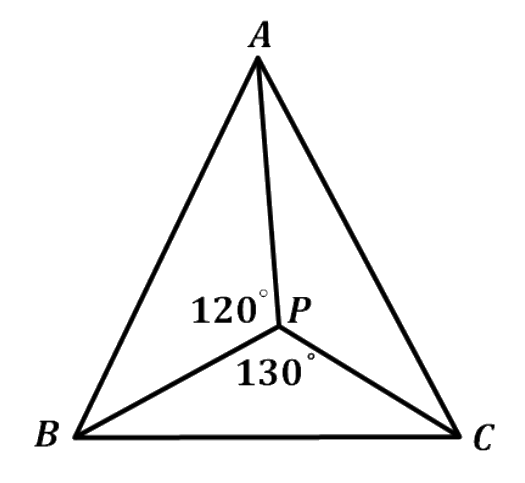
Point $P$ lies inside equilateral triangle $ABC$. Given $\angle APB=120^\circ$ and $\angle BPC=130^\circ$, if segments $AP,BP,CP$ form the sides of a new triangle, what is its largest angle?
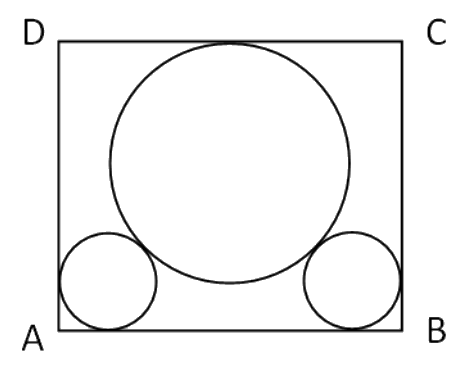
Two identical small circles of radius $5$ cm and a large circle of radius $8$ cm are placed inside rectangle $ABCD$ as shown. Each small circle touches the bottom side and its adjacent vertical side; the large circle touches the top side and both small circles. Given $AB=34$ cm, find the area of $ABCD$ in $\mathrm{cm}^2$.
At a round-table meeting, a CEO selects a team of three from 25 marketing specialists. The probability that at least two selected specialists sit next to each other is $m/n$, where $m,n$ are relatively prime positive integers. Find $m+n$.
Assume all 25 specialists occupy consecutive seats around the circle and every three-person subset is equally likely. Interpret the source phrase “2 ... sitting next to each other” as at least one adjacent pair, including teams of three consecutive people.
Twelve students are numbered 1 to 12. Each tosses a fair coin. A head gives a score equal to the student's number, and a tail gives 0. What is the probability that the total score is divisible by 3?
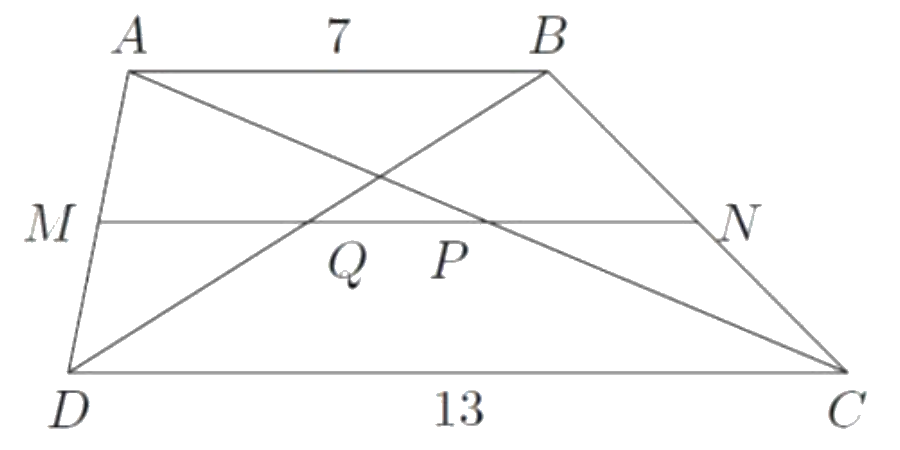
In trapezoid $ABCD$, $AB\parallel CD$. Points $M,N$ are the midpoints of legs $AD,BC$. Segment $MN$ meets $AC$ at $P$ and $BD$ at $Q$. If $AB=7$ and $CD=13$, find $PQ$.
In square $ABCD$, $AB=2$. Four segments, each of length 2 and each starting at a different vertex of the square, have a common endpoint $P$ outside the plane of the square. Find $\angle APB$ in degrees.
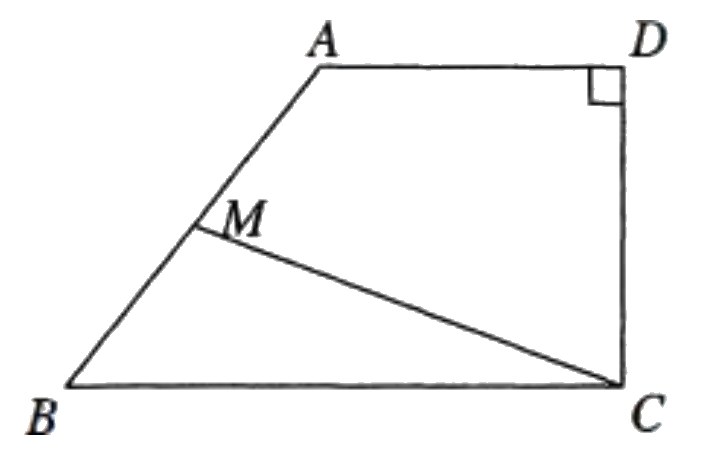
In trapezium $ABCD$, $AD\parallel BC$ and $\angle ADC=90^\circ$. Point $M$ is the midpoint of $AB$, $CM=13/2$ cm, and $BC+CD+DA=17$ cm. Find the area of $ABCD$ in $\mathrm{cm}^2$.
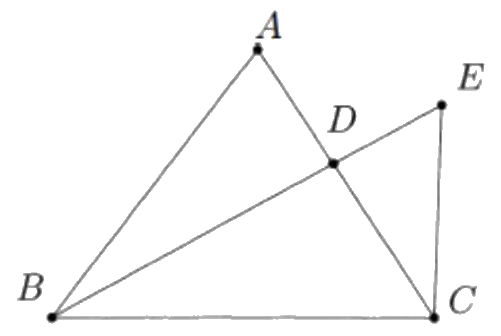
In triangle $ABC$, $AB=AC$ and $\angle ABC=40^\circ$. Point $D$ lies on $AC$ and $BD$ bisects $\angle ABC$. Extend $BD$ beyond $D$ to $E$ so that $DE=AD$. Find $\angle ECA$.
Barrel $A$ initially contains 11 litres of alcohol and barrel $B$ contains 15 litres of water. Some alcohol is poured from $A$ to $B$, and then some mixture is poured back from $B$ to $A$. The final alcohol concentrations in $A,B$ are $62.5\%$ and $25\%$, respectively. How many litres were poured back from $B$ to $A$?
Use the standard mixture model: the initial alcohol is pure, each mixture is stirred uniformly before transferring, there is no loss, and liquid volumes add.