SEAMO self-study edition 2027; not an official 2027 paper. Original source years are retained. 25 questions, 90 minutes; Q1–10: 3 points, Q11–20: 4 points, Q21–25: 6 points, total 100. Original response types and all subparts are preserved. Verified is an editorial convention; source defects, necessary assumptions and unresolved mathematical uncertainty are disclosed.
Find the positive integers $x,y\lt 10$ for which $2^x9^y=\overline{2x9y}$, where the bar denotes a four-digit number. Find $x+y$.
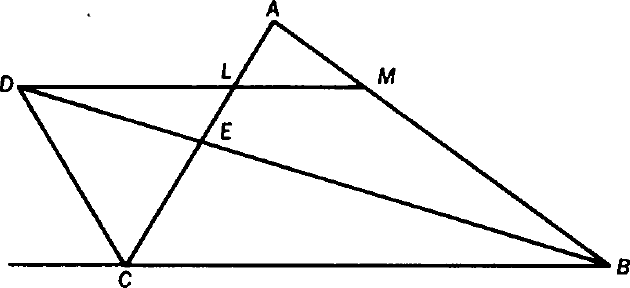
The interior bisector of $\angle B$ and the exterior bisector of $\angle C$ of triangle $ABC$ meet at $D$. Through $D$, a line parallel to $CB$ meets $AC$ at $L$ and $AB$ at $M$, as shown. If legs $LC$ and $MB$ of trapezoid $CLMB$ have lengths 5 and 7 respectively, find $LM$.
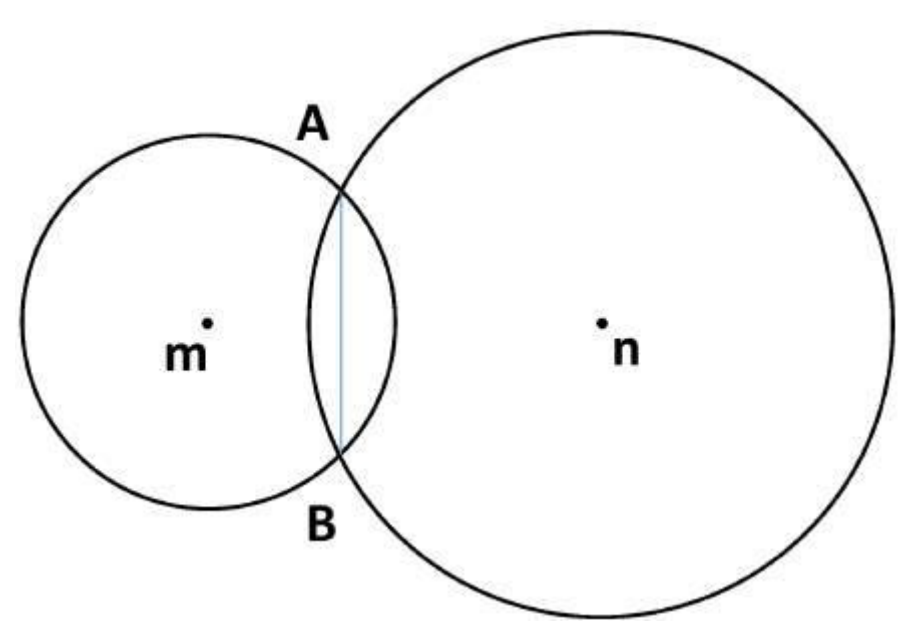
The chord $AB$, common to the circles with centres $m$ and $n$, has length $2\sqrt3$. It is one side of an equilateral triangle inscribed in circle $m$ and one side of a regular hexagon inscribed in circle $n$. Find the ratio of the areas of circle $m$ to circle $n$.
Source wording: “right hexagon” is not a standard description here. In this practice question, interpret it as a regular hexagon inscribed in the circle.
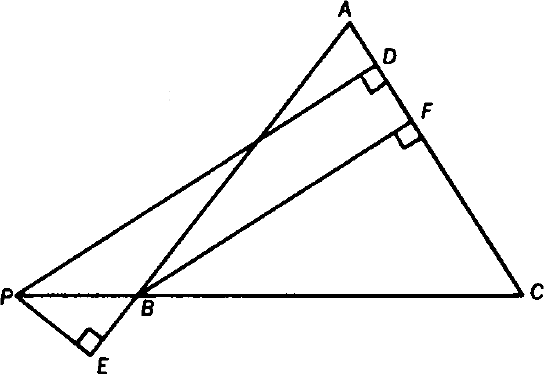
In isosceles triangle $ABC$ with $AB=AC$, extend $CB$ through $B$ to $P$. A line through $P$, parallel to altitude $BF$, meets $AC$ at $D$, where $D$ lies between $A$ and $F$. From $P$, draw a perpendicular to the extension of $AB$ at $E$, with $B$ between $E$ and $A$. Express $BF$ in terms of $PD$ and $PE$.
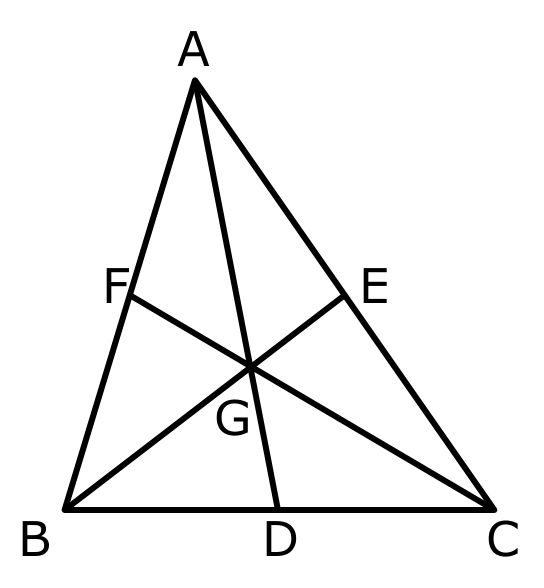
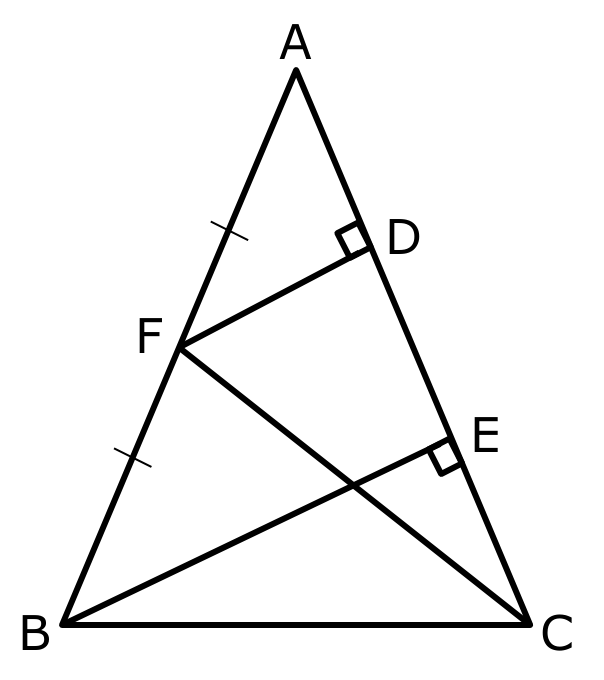
Let $ABC$ be an acute triangle. $BE$ and $CF$ are an altitude and a median respectively. Suppose $BC=5$ and $BE=CF=4$. Find the area of triangle $ABC$.
The equation $x^2+(2a-1)x+a^2=0$ has two real positive roots, where $a$ is an integer. If $x_1,x_2$ are the roots, find $\left|\sqrt{x_1}-\sqrt{x_2}\right|$.
If the radius of a sphere increases by 5%, what is the corresponding percentage increase in its volume, rounded to 1 decimal place? Use $V=\frac43\pi r^3$.
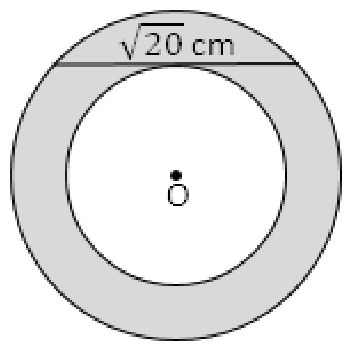
A chord of length $\sqrt{20}$ cm of the larger circle is tangent to the smaller concentric circle, as shown. Find the area of the shaded region, in $\mathrm{cm}^2$.