SEAMO self-study edition 2027; not an official 2027 paper. Original source years are retained. 25 questions, 90 minutes; Q1–10: 3 points, Q11–20: 4 points, Q21–25: 6 points, total 100. Original response types and all subparts are preserved. Verified is an editorial convention; source defects, necessary assumptions and unresolved mathematical uncertainty are disclosed.
Mr Tan drove from Town A to Town B at a constant speed of 40 km/h. He returned from B to A at 70 km/h. The whole journey took $5\frac12$ hours. Find the distance between the towns in km.
60% of the students at North Shore School were boys. 44% of all students took part in the sports meet, of whom 52% were boys. What percentage of the North Shore girls did not participate?
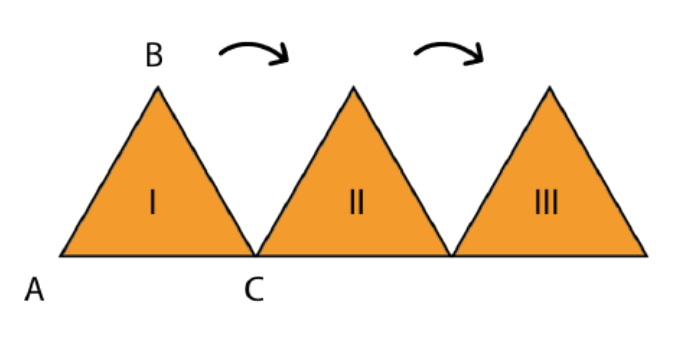
An equilateral triangle of side length 1 is rotated about $C$ from position I to II. It is then rotated about the new position of $B$ from II to III, as shown. Find the total distance travelled by the original point $A$.
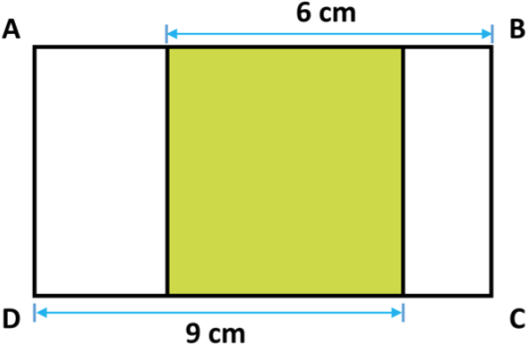
$ABCD$ is a rectangle and its shaded middle region is a square. The marked upper length from the square’s left edge to $B$ is 6 cm; the marked lower length from $D$ to the square’s right edge is 9 cm. Find the perimeter of $ABCD$ in cm.
The two-digit numbers $\overline{ab}$ and $\overline{ba}$ both leave remainder 1 on division by 7. Find $\overline{ab}\times\overline{ba}$. Original choices: (A) 2156; (B) 2234; (C) 2668; (D) 3132; (E) 3505.
Source wording does not say that the two digits are different. Preserve that wording: explain whether the product is uniquely determined, and discuss the original choices. This item is assessed manually.
Benjamin told his friends, “The product of my score, my age and my rank in the Math Competition is 2910.” He ranked among the top 5 students. Find his score.
The source gives no permitted range for Benjamin’s age or score. Explain what can and cannot be determined from the printed information; do not silently add a maximum score. Manual assessment is used.
Given $\frac1{1\times5}+\frac1{5\times9}+\frac1{9\times13}+\frac1{13\times17}+\frac1{17\times21}+\frac1{21\times25}=\frac mn$, where $m,n>0$ are relatively prime integers, find $m+n$.
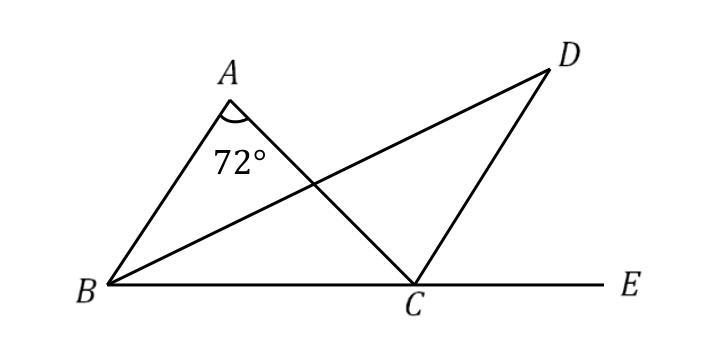
In the figure, $\angle A=72^\circ$. The bisectors of $\angle ABC$ and the exterior angle $\angle ACE$ meet at $D$, with $B,C,E$ collinear. Find $\angle BDC$.
The sum of the ages of a group of people is 4476. The eldest is at most 79 years old and the youngest is at least 30. No more than 3 people have the same age. What is the minimum number of people aged at least 60?
Use ages measured in completed whole years, as intended by this discrete counting problem.
A car travels from A to B at a constant speed of $V$ km/h. Increasing its speed by 20% throughout would get it to B one hour earlier. If, after travelling the first 120 km at $V$ km/h, it increases its speed by [missing in source], it arrives 40 minutes earlier. Find the distance from A to B.
The printed second speed increase is missing after the words “increases its speed by”. That omission is retained. Explain the missing information and what can be deduced; this is a manually assessed item.
At a party, three kinds of bottled drinks are served. One bottle of mineral water is shared by 2 people, one bottle of cola by 3 people, and one bottle of fresh orange juice by 4 people. Each person consumes their own share of every kind. In total, 91 bottles are consumed. How many people attend?
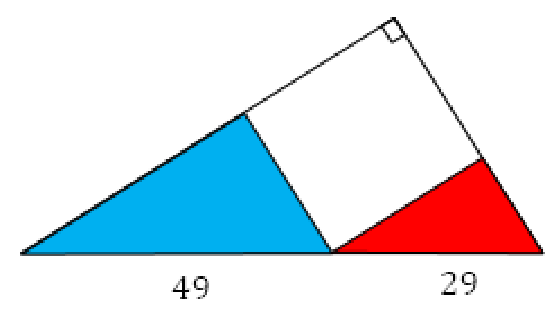
A square is embedded in a right-angled triangle as shown. Its bottom vertex divides the hypotenuse into lengths 49 cm and 29 cm. Find the total area of the two shaded regions in cm².