SEAMO self-study edition 2027; not an official 2027 paper. Original source years are retained. 25 questions, 90 minutes; Q1–10: 3 points, Q11–20: 4 points, Q21–25: 6 points, total 100. Original response types and all subparts are preserved. Verified is an editorial convention; source defects, necessary assumptions and unresolved mathematical uncertainty are disclosed.
What whole number is represented by $\otimes$? $[(\otimes+2)\times3]\div11-8=1$.
Mr. Chan is filling his fish tank. If he uses a 5-litre pail, 4 litres of water will overflow. If he uses a 3-litre pail, he needs another 4 pails of water. How many litres of water are needed to fill the fish tank?
Use the intended shared-count assumption: starting from an empty tank, compare the same initial number of full pails in both cases; the four extra pails are 3-litre pails. This shared initial count is not explicit in the printed source.
Evaluate, carrying out the divisions successively from left to right:
$10\div(10\div9)\div(9\div8)\div(8\div7)\div(7\div6)\div(6\div5)\div(5\div4)\div(4\div3)\div(3\div2)$.
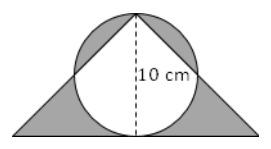
The figure consists of a circle of radius 5 cm and a right-angled isosceles triangle. Find the total area of the shaded regions, in square centimetres.
Use the incidences shown: the triangle’s right-angle vertex is the top of the circle, its altitude is the circle’s vertical diameter (10 cm), and its base is tangent at the bottom. The shaded parts lie in exactly one of the two shapes.
Sally took part in a “Know Your Neighbourhood” questionnaire. She had to answer 50 questions. Two marks were awarded for each correct answer and one mark was deducted for each wrong answer. If she scored 61 marks, how many questions did she answer correctly?
Sally answers all 50 questions; each answer is either correct or wrong.
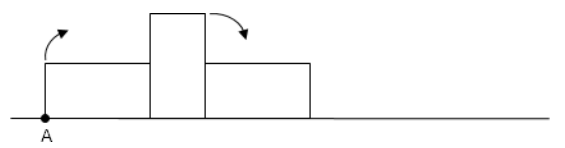
A $5\times12$ cm rectangle is rotated without slipping through the positions shown. The distance travelled by point A is $\frac mn\pi$ cm, where $m,n$ are relatively prime positive integers. Find $m+n$.
Count the two clockwise quarter-turns shown, beginning with the 12 cm side on the ground. Stop at the third position; do not continue rolling.
A prime number is a whole number with exactly two positive factors, 1 and itself. Examples are 2, 3, 5, 7, 11, 13, … . The sum of two prime numbers is 34. Find their smallest possible product.