SEAMO self-study edition 2027; not an official 2027 paper. Original source years are retained. 25 questions, 90 minutes; Q1–10: 3 points, Q11–20: 4 points, Q21–25: 6 points, total 100. Original response types and all subparts are preserved. Verified is an editorial convention; source defects, necessary assumptions and unresolved mathematical uncertainty are disclosed.
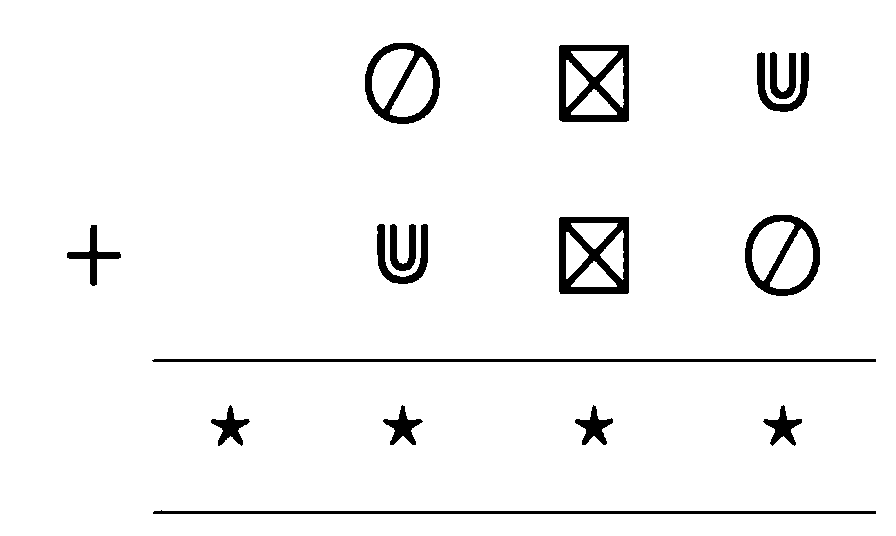
Each different symbol in the addition stands for a different number. Given that the U-shaped symbol is greater than the slashed-circle symbol, what is the largest possible value of U-shaped symbol minus slashed-circle symbol?
Each symbol represents one decimal digit; the same symbol always has the same digit, different symbols have different digits, and leading digits are nonzero. The four stars represent the same digit.
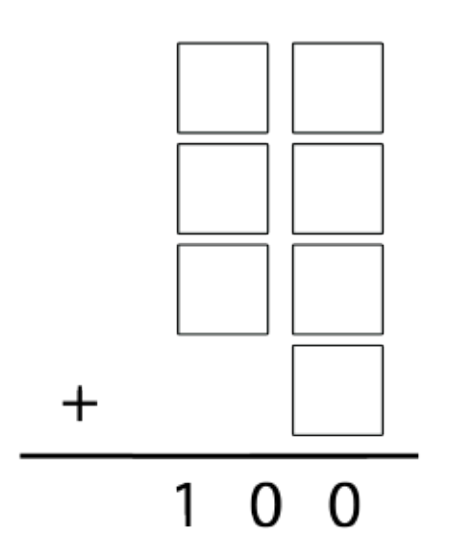
Mark fills the seven boxes with numbers from 1 to 7 so that the sum is 100. Find the largest two-digit number in the addition.
Interpretation used for self-study: use each digit 1 through 7 exactly once, and find the greatest possible two-digit addend over all valid fillings. The source does not state these conditions explicitly.
On the first day, Marcus spent 5 dollars more than half the amount in his wallet. On the second day, he spent 10 dollars more than half the remaining amount. He then had 8 dollars left. How much did he spend on the first day? Give your answer in dollars.
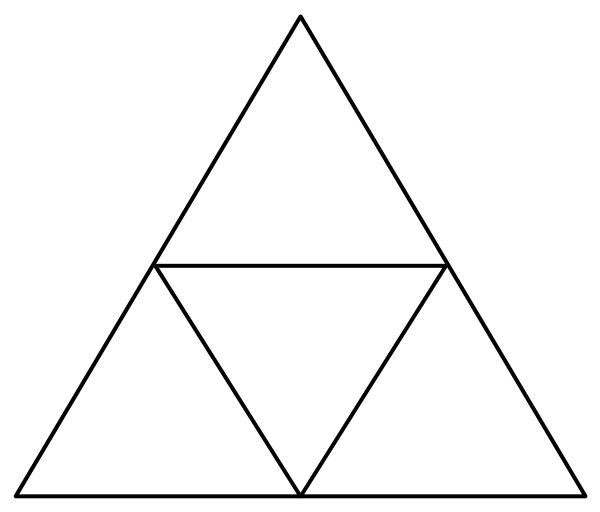
Four triangles are formed using nine line segments of equal length, as shown. Four beads are placed along each segment at equal intervals. How many beads are there altogether?
Place a bead at both endpoints of each segment as well as at its two interior division points. A shared endpoint has only one bead.
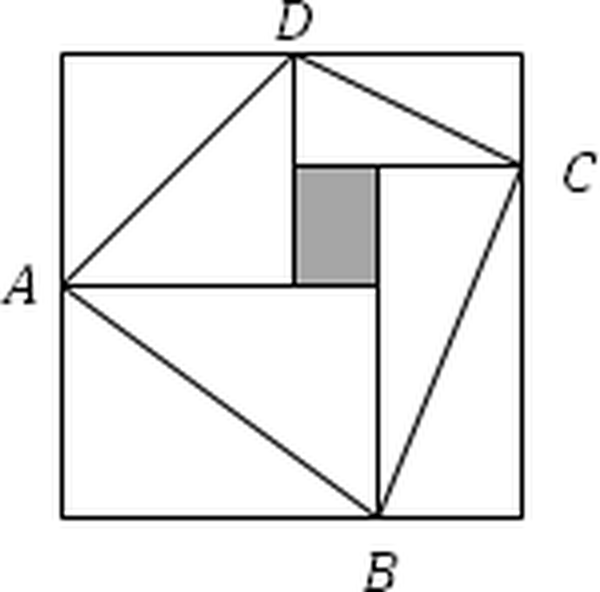
In the figure, the sides of the shaded rectangle are parallel to the sides of the outer square. The square has side length 10 cm, and the shaded rectangle has area $6\text{ cm}^2$. Find the area of quadrilateral ABCD, in square centimetres.
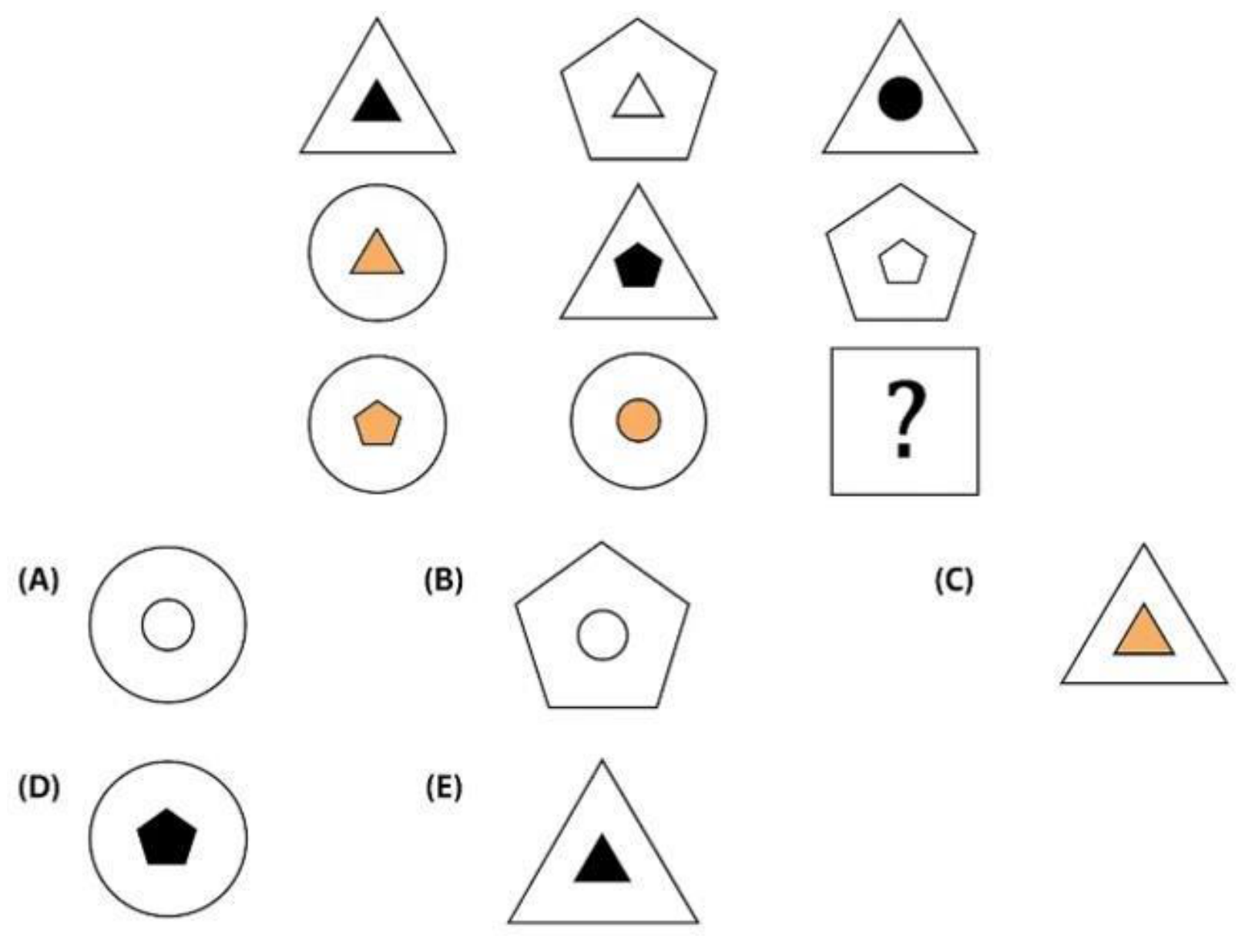
Find the missing diagram in the geometric puzzle. Select one of the five pictured options.
Use the intended systematic completion of the pictured collection. As in other finite visual-pattern puzzles, other rules can be invented; choose the option that completes the natural pattern.
Ms Wang spent 148 dollars on a dress and $\frac{2}{7}$ of the remainder on a bag. She was left with 60% of her money. How many dollars did she have left?
The final 60% refers to her original amount of money, before either purchase.
Shawn walks to school every morning. At 50 metres per minute he is 3 minutes late. At 60 metres per minute he arrives 2 minutes before the assembly bell. How many kilometres is the school from his home?
Compare trips along the same route with the same departure time and assembly-bell time, at constant speeds.
Enter kilometres, using a decimal point if needed.
A teacher distributes 100 apples as fairly as possible among children at a nursery. At least one child receives 3 apples. What is the greatest possible number of children?
Distribute all 100 whole apples. “As fairly as possible” means that any two children receive numbers differing by at most one.
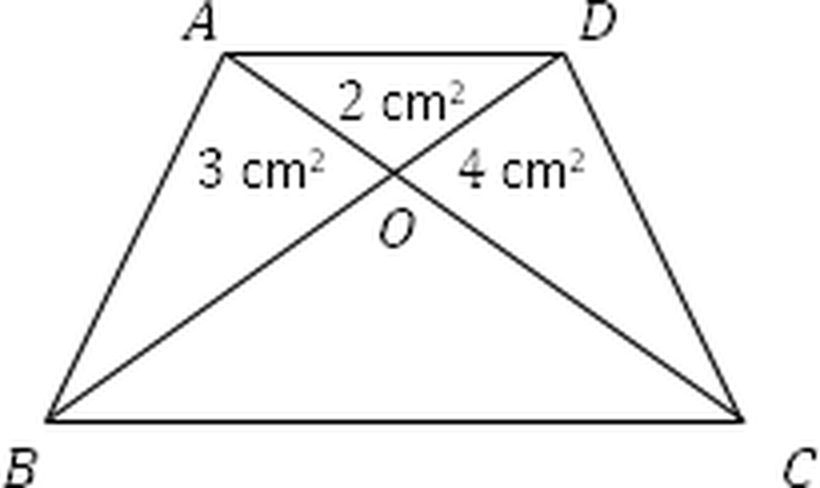
Diagonals AC and BD divide quadrilateral ABCD into four triangles, meeting at O. The areas of triangles ADO, CDO and ABO are respectively 2, 4 and $3\text{ cm}^2$. Find the area of ABCD, in square centimetres.
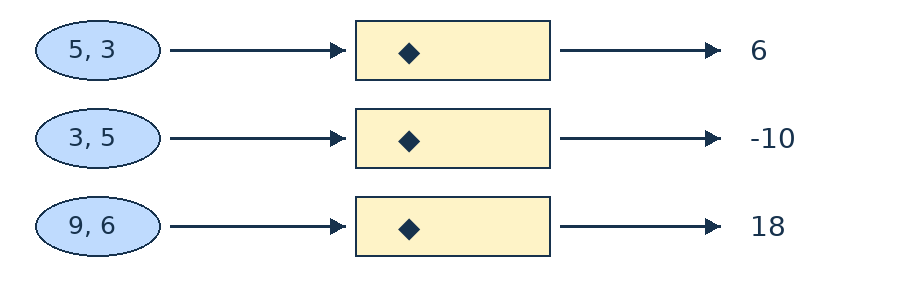
Given $5\diamond3=6$, $3\diamond5=-10$ and $9\diamond6=18$, find the value of $7\diamond4$.
The source supplies examples but no definition of the operation. A unique value is not guaranteed. State a rule, verify all three examples and evaluate the requested expression under that rule; explain whether the value is uniquely determined. This response requires manual review. The diamond denotes the same operation symbol as in the source.
In mathematics, $A>B$ means A is greater than B, and $A<B$ means A is less than B. Given $A=98765\times87654$ and $B=98756\times87663$, which statement is true?