SEAMO self-study edition 2027; not an official 2027 paper. Original source years are retained. 25 questions, 90 minutes; Q1–10: 3 points, Q11–20: 4 points, Q21–25: 6 points, total 100. Original response types and all subparts are preserved. Verified is an editorial convention; source defects, necessary assumptions and unresolved mathematical uncertainty are disclosed.
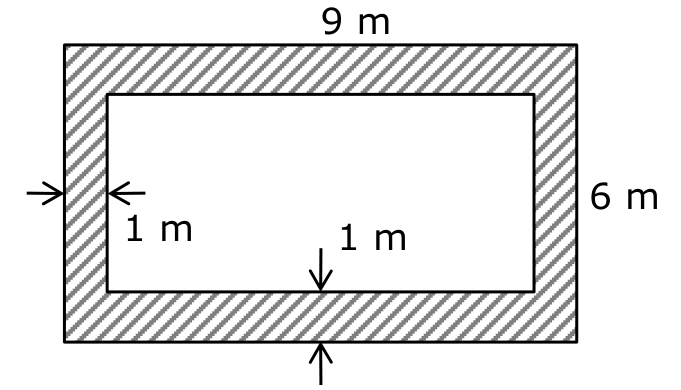
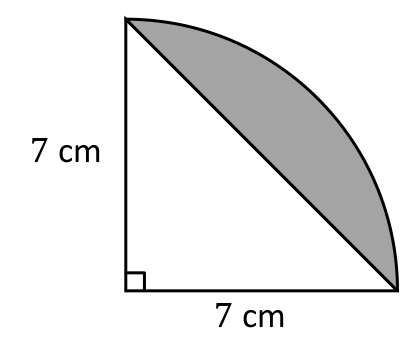
Find the area of the shaded region, in m².
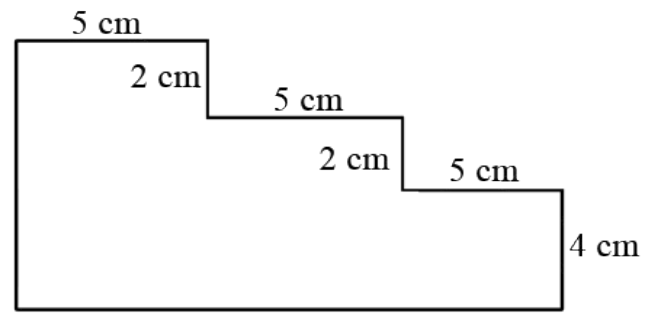
Interpret the pictured frame as having a uniform width of 1 m on all four sides. Only the left and bottom widths are explicitly labelled in the source.
A mathematics test has 15 questions. Each correct answer earns 8 marks; each wrong answer loses 4 marks. John scores 72 marks. How many questions did he answer wrongly?
Assume John answered all 15 questions; the source does not specify how unanswered questions are treated.
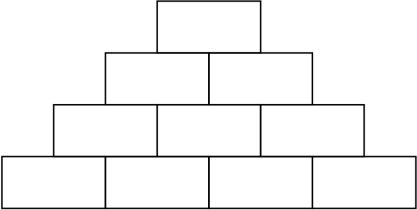
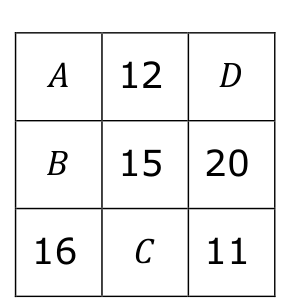
Meredith has the diagram below. Each box above two adjacent boxes contains their sum. What is the maximum number of odd numbers she can write in the boxes?
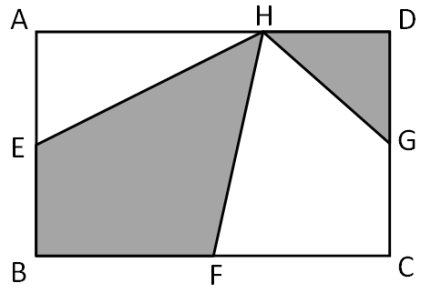
ABCD is a rectangle. H lies on AD, and E, F and G are the midpoints of AB, BC and CD respectively. The area of ABCD is 40 cm². Find the total area of the shaded regions, in cm².
A bag contains 5 red, 4 yellow and 3 black balls. Blindfolded, you draw one ball at a time without replacement. What is the minimum number of draws that guarantees at least 3 balls of the same colour?
A double-decker bus has 66 seats. At the first stop 1 commuter boards, at the second 2 board, at the third 3 board, and so on. At which stop will all seats be taken?
Assume the bus initially has no passengers, nobody gets off, and each commuter takes one seat.
Children are divided into two groups. Group A has 20 more boys than girls. Group B has 12 more girls than boys. Girls make up 45% of all the children. How many boys are there altogether?