The next term of a sequence is obtained by adding the same constant to the previous term. The 1st term is 12 and the 7th term is 66. What is the 50th term of this sequence?
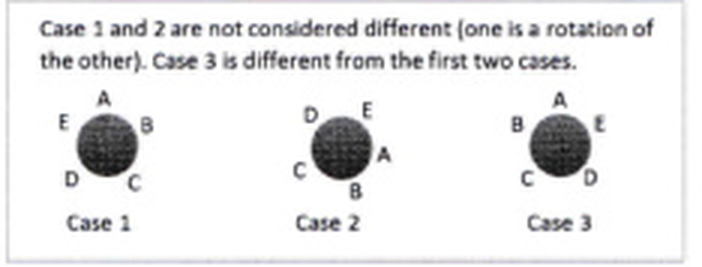
Mr and Mrs Hansen and their three children sit at a circular table. In how many different ways can they sit if the parents are adjacent? The five people are distinct. Rotations count as the same arrangement; reflections count as different. In the original example below, Cases 1 and 2 are rotations of each other, while Case 3 differs.
I have a set of four numbers $P,Q,R,S$ in ascending order. The average of $P,Q,R$ is 22, and the average of $Q,R,S$ is 24. The largest number is 27. Then the smallest number in this set:
Define $n!=n\times(n-1)\times\cdots\times2\times1$. For example, $4!=4\times3\times2\times1=24$ and $3!=3\times2\times1=6$. Simplify
$$\frac{29!\times29!}{28!\times28!}.$$
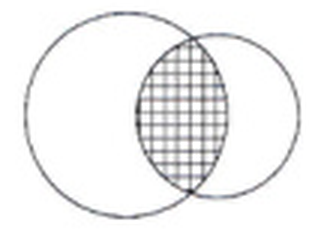
A circle of radius 14 cm and a circle of radius 21 cm overlap in the crosshatched region shown. The overlap has area $580\text{ cm}^2$. What is half the total area, in $\text{cm}^2$, of the two regions without crosshatching? Use $\pi=\frac{22}{7}$.
A number has 2021 digits. Let P be the sum of its digits, Q the sum of the digits of P, and R the sum of the digits of Q. Each operation is one ordinary sum of digits, not a repeated digital-root calculation. Find the largest possible Q.
How many three-digit natural numbers $n$ satisfy all three conditions: $n-14$ is divisible by 7; $n-24$ is divisible by 8; and $n-36$ is divisible by 9?