A child gets 10 dollars in pocket money each day. He saves 1 dollar on the first day, 2 dollars on the second, 3 dollars on the third, 4 dollars on the fourth, and so on. On which day will he first have enough saved to buy his sister a 50-dollar school bag?
Four sisters paint at the same constant rate and take turns, with no overlap or gaps. Alice finishes $1/4$ of the job; then Beth finishes $2/3$ of what is left; then Cathy finishes $3/4$ of the new remainder. Dee completes the last part in 20 minutes. How many minutes does the entire job take?
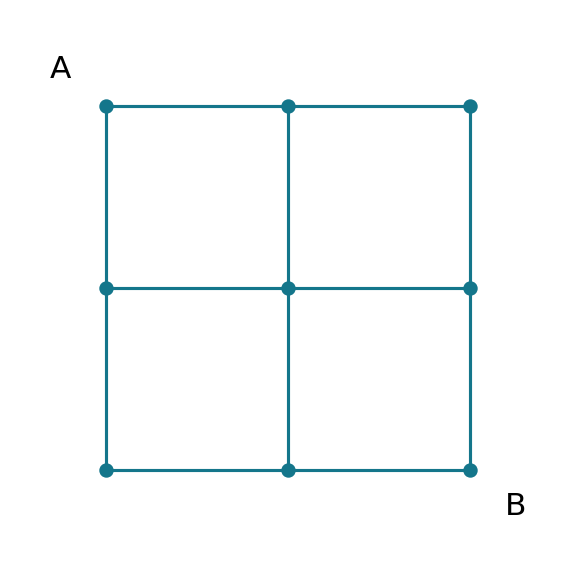
How many shortest paths along a 3 × 3 grid lead from one corner to the diagonally opposite corner?
Editorial clarification: use 3 rows and 3 columns of vertices, joined horizontally and vertically, as illustrated. This is a grid of 2 × 2 square cells. Travel from A to B along the drawn segments.
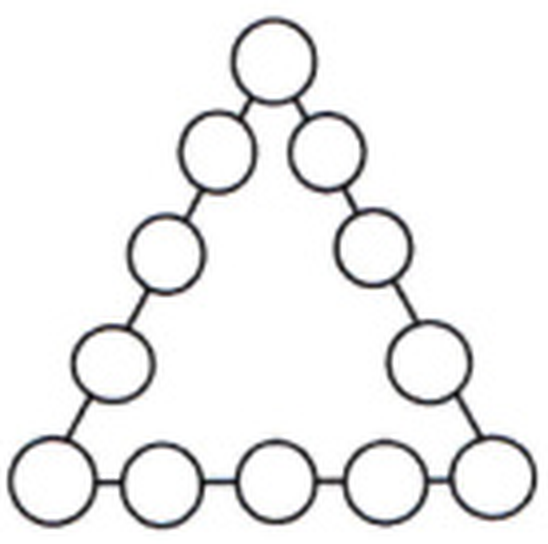
The numbers 1 through 12 are placed in the diagram, one in each circle, so that the sum of the numbers along each side of the triangle is the same. What is the largest possible value of this sum per side?
Original printed options: A. $14$; B. $0.71$; C. $0.071$; D. $17$; E. $\dfrac1{17}$.
**Input:** For this self-study version, enter the exact value as a fraction a/b, without units, rather than an option letter or a rounded decimal. The original options are retained above for comparison.
Assume all sections within each shape have equal area. Consider only the flower, circle or other shape itself, excluding its surroundings. Which shape has the smallest fraction shaded? Use the grey-filled regions in the original illustration.
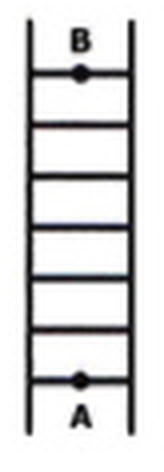
A ladder has 7 rungs. An ant climbs from A, the middle of the bottom rung, to B, the middle of the top rung, without retracing any part of its path. How many different paths are possible? Count routes along the rungs and side rails only, ignoring pauses; no segment may be traversed twice.
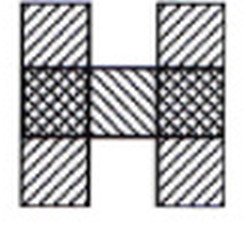
The figure is formed by overlapping three rectangles measuring 2 cm by 6 cm. An ant completes one trip around its perimeter, moving at 1 cm/s on horizontal segments and 2 cm/s on vertical segments. How many seconds does the trip take?
Each of the whole numbers 1 through 9 is written on a separate card. Three cards are given to each of three players. How many ways can the cards be given so that Player One’s cards sum to 8 and Player Two’s cards sum to 15? Cards within a player’s hand are unordered.