One-fifth of all apples in a basket are red. Three-fourths are yellow. The remaining apples are green. There are 200 apples in the basket. How many are green?
In the multiplication $\overline{AB}\times\overline{BA}=\overline{A45B}$, A and B are different digits, AB and BA are two-digit numbers, and A45B is a four-digit number. If AB is less than BA, what is AB?
Read carefully: dividing two positive whole numbers by their GCD (HCF) leaves two co-prime numbers. For example, 50 and 70 have GCD 10; their underlying co-primes are 5 and 7, obtained by dividing both numbers by 10.
Now use this idea. Two numbers add to 1085 and have GCD 35. What is the average of their underlying co-prime numbers, rounded to the nearest whole number?
Use ordinary rounding: a fractional part of exactly 0.5 rounds up. Enter one whole number.
The largest natural number formed by the digits 4, 5, 0, 3 and the smallest number formed by using all of those digits exactly once are subtracted. A valid number does not start with 0 unless it is 0 itself (considered a one-digit number). What is the number formed by the first two digits of the result?
Use each of the four digits exactly once in each number; subtract the smaller number from the larger. Choose one option.
In the cryptarithm shown, different letters represent different digits and identical letters represent the same digit. What is the greatest value of the three-digit number GOO?
The addition is DUCK + DUCK = GOOSE. Leading digits D and G are nonzero.
Jean has a collection of chips. Arranging them in piles of 12 leaves 11 chips over. Arranging them in piles of 21 leaves 20 chips over. What is the least number of chips Jean can own?
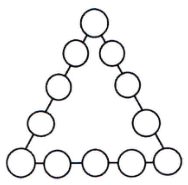
Place the numbers 1 through 12 in the diagram, one in each circle, so that the sums along the three sides of the triangle are equal. What is the largest possible sum along one side?
Use every number exactly once. Each side includes its two corner circles. Enter one whole number.
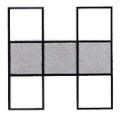
Place the whole numbers 1 through 7 in the figure, one per square. The sum in the left column, the sum in the right column, and the sum on each diagonal must all be equal. What is the largest possible product of the numbers across the grey row?
Use each of the seven numbers exactly once. Choose one option.
Find the sum of the numbers in the 101st group: $(1,4,6),(2,6,10),(3,8,14),\ldots$. Continue the pattern in which the first, second and third entries increase by 1, 2 and 4 respectively.
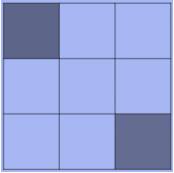
The source asks how many ways we can go from the dark square at the top to the dark square at the bottom, moving only right or down, with no backtracking and no repeated section. It also says “only along the grid lines”.
**Movement clarification for this edition:** start in the top-left dark cell and finish in the bottom-right dark cell. Each move goes to the neighboring cell immediately right or down, across a shared side. Count cell-to-cell routes, rather than routes between grid vertices. The original wording mixes these two descriptions.
Which of the following numbers has an odd number of even prime factors? Count prime factors with repetition: for example, 12 = 2 × 2 × 3 has two even prime factors. This edition allows more than one correct option.
The largest four-digit number $A$ is formed using all the digits 4, 5, 0 and 3. The smallest four-digit number $B$ is formed using all those digits. Find $A-B$. Use each digit exactly once in each number.
A solid brick is formed by gluing together eighty $1\times1\times1$ cubes. The brick has as little surface area as possible. The two faces with the least area are painted blue. What is the number of square units in the area of one blue face?
Here “brick” means a completely filled rectangular prism with whole-number side lengths.
Enter only the whole-number answer, without units.
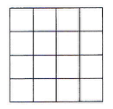
Sixteen $1\text{ cm}\times1\text{ cm}$ tiles form a square in 4 rows and 4 columns, as shown. Its perimeter is 16 cm. If it is cut into exactly two pieces along tile edges, what is the greatest total perimeter of the two pieces, in centimetres?
Each piece must remain connected through shared tile edges. Choose one option.