Orville has L-tiles, each made up of three $1\times1$ squares as shown. What is the greatest number of these L-tiles that can fit into a $14\times10$ rectangle without overlap? The tiles can be rotated to fit, but cannot be cut.
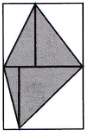
Four shaded right-angled triangles with leg lengths 1 cm × 4 cm, 2 cm × 4 cm, 3 cm × 4 cm and 4 cm × 4 cm fit together to form a quadrilateral. It fits inside a 5 cm × 8 cm rectangle as shown. Find the area of the quadrilateral, in square centimetres. The legs are the two sides beside the right angle.
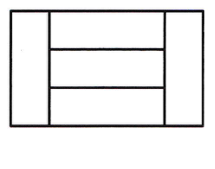
The figure below is made of five identical rectangles. Its total area is $60\text{ cm}^2$. What is the perimeter, in centimetres, of one small rectangle?
Tom can paint a classroom in 12 hours. Jerry can paint the same classroom in 4 hours. If they work together, each at their own constant rate, how many hours will they take to paint this classroom?
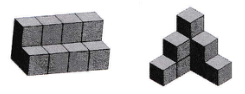
The two figures below are made from cubes with side length 3 cm. What is their total volume?
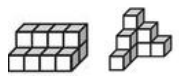
The standalone source redraws the same shapes as follows:
Assume each figure is packed with equal cubes, including hidden supporting cubes, and fits flush into the corner between perpendicular walls. Choose one option.
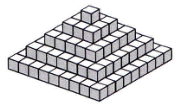
There are 165 unit cubes arranged in 5 square layers with no space between the cubes as shown. The layers are 1 by 1, 3 by 3, 5 by 5, 7 by 7, and 9 by 9. If a sixth layer is placed on the bottom of the arrangement following the pattern, how many unit cubes are completely surrounded by six other unit cubes?
Follow the centred, aligned square-layer arrangement shown; “surrounded” means sharing each of the six faces with a neighbouring cube.
Gina has 1350 dollars and receives 11 dollars every week. James has 1650 dollars and spends 19 dollars per week. After how many weeks will they have the same amount of money?
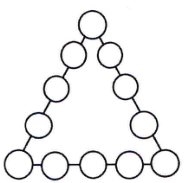
The numbers 1 through 12 are placed in the diagram, one in each circle, so that the sum along each side of the triangle is the same. What is the smallest possible sum per side?