Skip to content / Đến nội dung
ThichHocToan.com

SASMO 2027 · Grades 4-5 · SET 002 · Self-study

Question 1

Editorial self-study SET for 2027; not an official SASMO 2027 examination. Known source years remain in individual attributions. Time: 90 minutes. Platform scoring starts at 0: Q1–15 are worth 2 points each; Q16–25 are worth 4 points each; wrong and blank answers score 0; maximum 70. Official SASMO scoring instead starts at 15, deducts 1 for an incorrect Section A answer and has a maximum of 85. Verified means editorially checked; assumptions, source errors and mathematical uncertainty are disclosed where relevant.

A building has 20 doors numbered 1 to 20. Alex opens all the doors. Bin closes every door whose number is divisible by 2. Cindy closes every door whose number is divisible by 3. Denny closes every door whose number is divisible by 5. Yelly then closes all open doors and opens all closed doors. How many doors are closed at the end?
Question illustration

Enter the numerical answer only.
Question 2

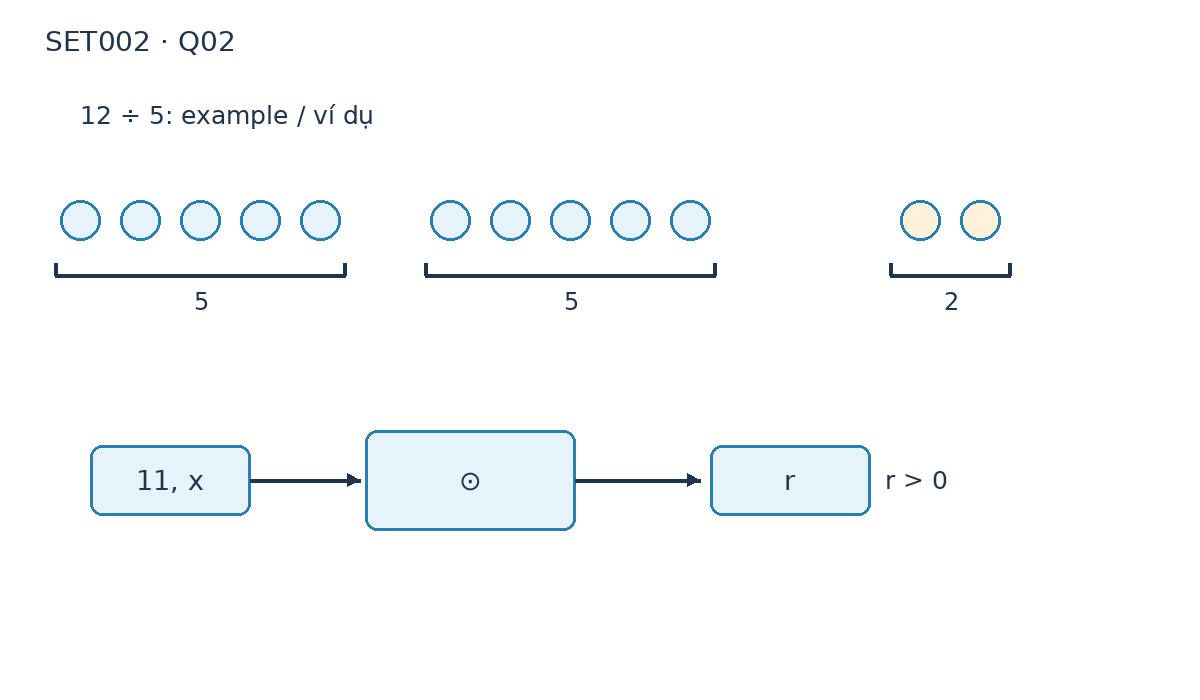
For positive integers $a,b$, define $a\odot b$ as the remainder when the larger number is divided by the smaller. For example, $5\odot12=12\odot5=2$. Given $(11\odot x)\odot11=2$, find the minimum positive integer $x$. The intermediate operation must be defined, so its divisor cannot be zero.

Question illustration

Enter the numerical answer only.

Question 3

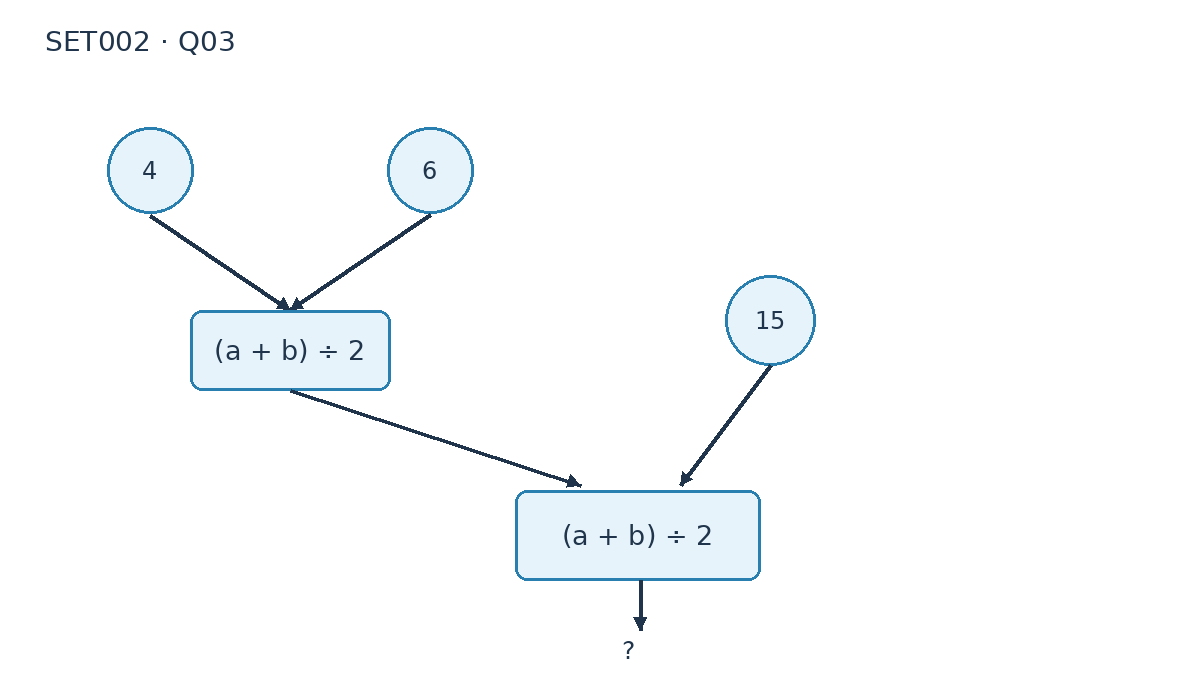
If $a!b=(a+b)\div2$, calculate $15!(4!6)$. Here ! denotes this new binary operation, not a factorial.

Question illustration

Enter the numerical answer only.
Question 4

A building has 20 doors numbered 1 to 20. Alex opens all the doors. Bin closes every door whose number is divisible by 2. Cindy closes every door whose number is divisible by 3. Denny closes every door whose number is divisible by 5. How many doors are closed?

Question illustration

Enter the numerical answer only.
Question 5

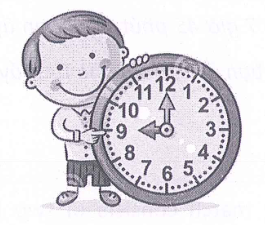
Starting from 9 o’clock in the morning, what time will it be after the minute hand completes 2019 full cycles? Enter the time in 24-hour form HH:MM.

Question illustration

Question 6

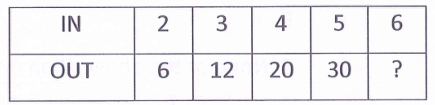
Using the simple multiplication pattern between IN and OUT, find the missing number. IN: 2, 3, 4, 5, 6. OUT: 6, 12, 20, 30, ?.

Question illustration
  1. 30
  2. 42
  3. 48
  4. 54
  5. None of the above

Question 7

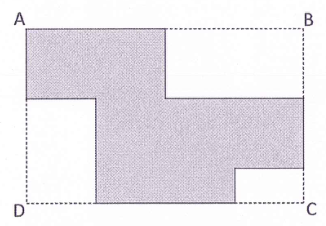
Rectangle ABCD has perimeter 30 cm. Lisa cuts off three rectangles at the corners as shown. The sum of the perimeters of the three removed rectangles is 15 cm. What is the perimeter, in cm, of the remaining shaded figure?

Question illustration

Enter the numerical answer only.

Question 8

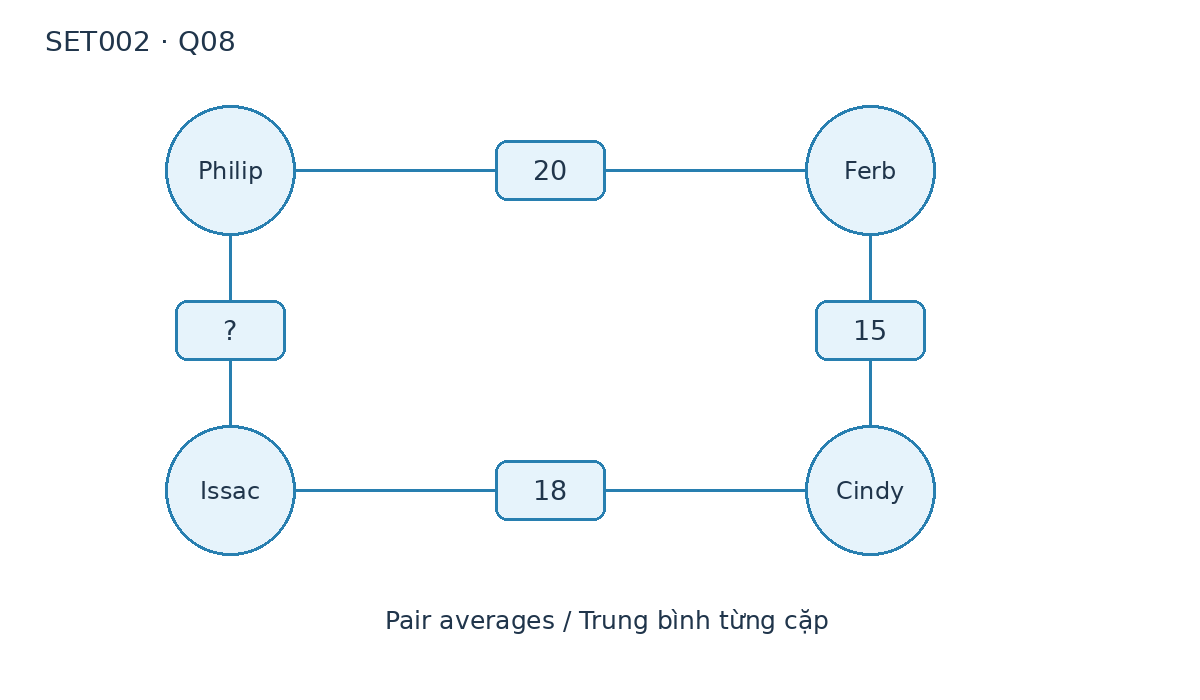
(SASMO 2018) The average number of candies of Philip and Ferb is 20. The average for Ferb and Cindy is 15. The average for Cindy and Issac is 18. Find the average number of candies of Issac and Philip.

Question illustration

Enter the numerical answer only.
Question 9

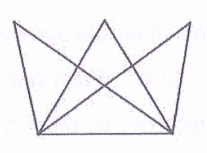
How many triangles are there in the diagram below? Count triangles of all sizes whose three sides follow drawn straight segments.

Question illustration

Enter the numerical answer only.
Question 10

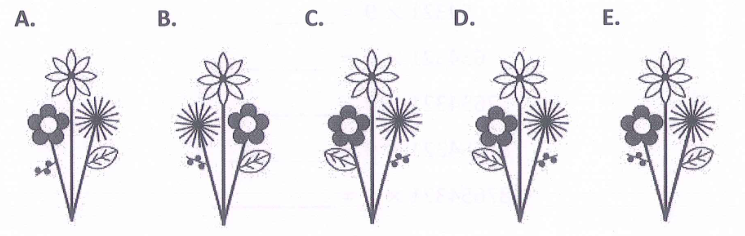
Mr. Brown has painted flowers on a store window, as shown. Which of A–E shows the flowers seen from the other side of the window? Keep the top at the top. The five choices are shown below the original.

Question illustration

Question illustration
  1. A
  2. B
  3. C
  4. D
  5. E

Question 11

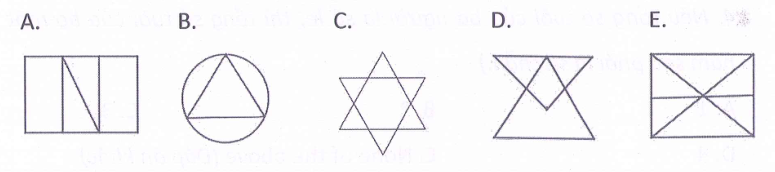
Drawing a shape in “one stroke” means drawing it without lifting the pen and without tracing any line twice. Which of the five shapes CANNOT be drawn in one stroke? Crossings are joining points where the pen may change direction.

Question illustration
  1. A
  2. B
  3. C
  4. D
  5. E

Question 12

(SASMO 2017) Amy and her four friends each own one cat. The cats are Max, Oliver, Charlie, Kitty and Smokey. Each cat is either black or white, but not both.
1. Three cats are black and two are white.
2. Oliver and Smokey have the same colour.
3. Charlie and Kitty have different colours.
4. Three cats are male and two are female.
5. Max and Charlie have the same gender.
6. Kitty and Smokey have different genders.

Amy’s cat is female and white. What is its name? Enter the cat’s name.

Question illustration

Question 13

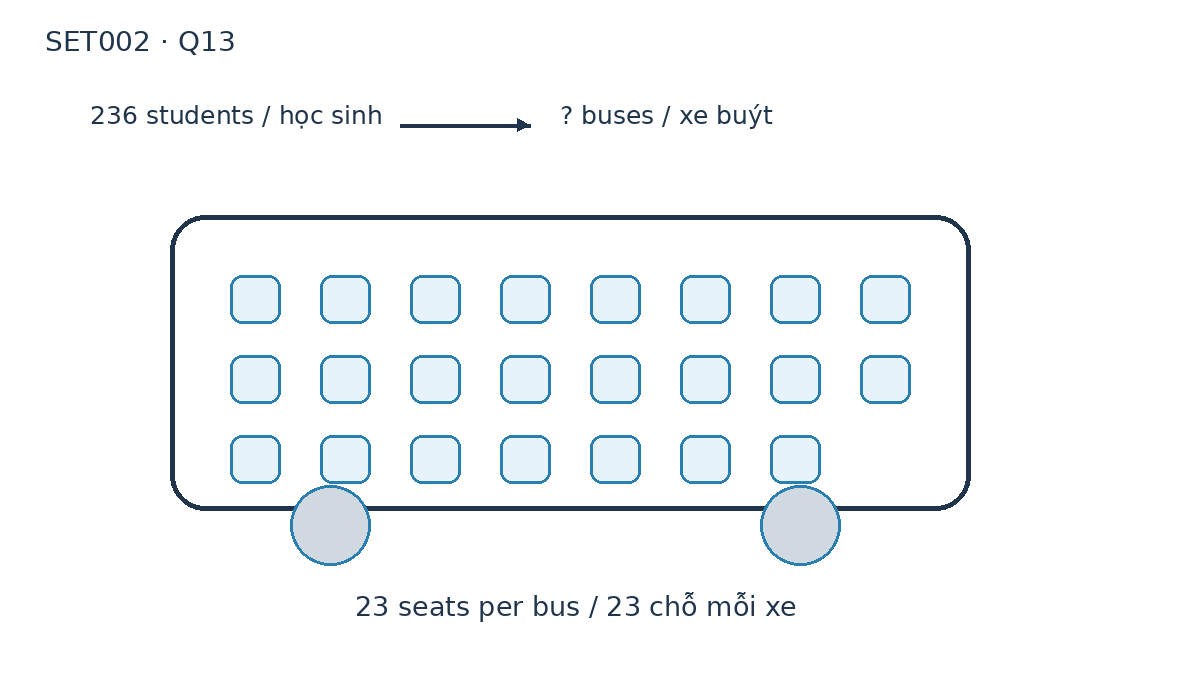
A bus can carry 23 students. How many buses are needed to take all 236 students to the school swimming carnival?

Question illustration
  1. 10
  2. 11
  3. 12
  4. 13
  5. None of the above

Question 14

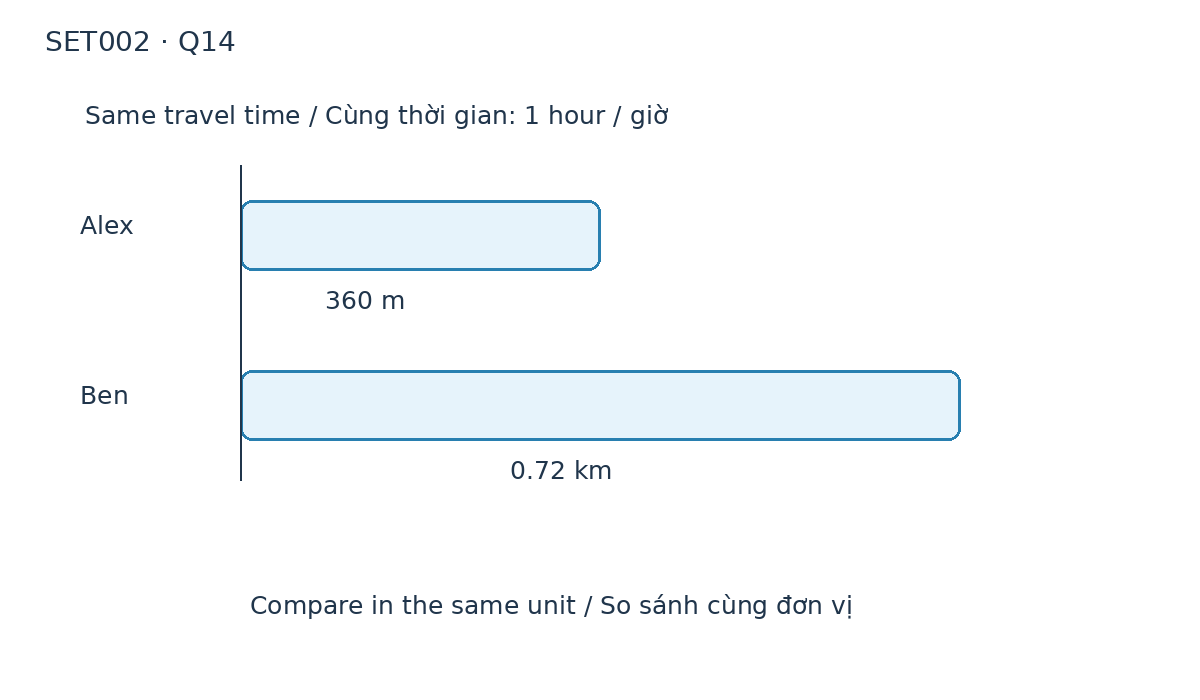
Alex’s toy car travels 360 metres in one hour. Ben’s toy car travels 0.72 kilometres in one hour. What is the ratio of Alex’s speed to Ben’s speed?

Question illustration
  1. 360 : 0.72
  2. 36 : 7.2
  3. 2 : 1
  4. 1 : 2
  5. None of the above

Question 15

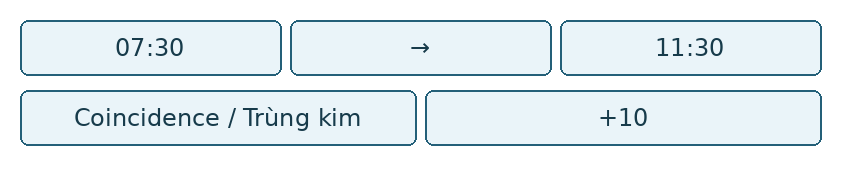
Whenever a clock’s hour and minute hands coincide, the number of germs in a dish increases by 10. Between 7:30 a.m. and 11:30 a.m. on the same day, by how many does the number of germs increase?

Question illustration

Enter the numerical answer only.
Question illustration

Question 16

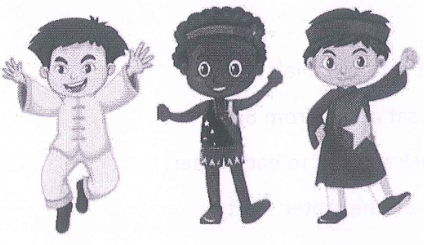
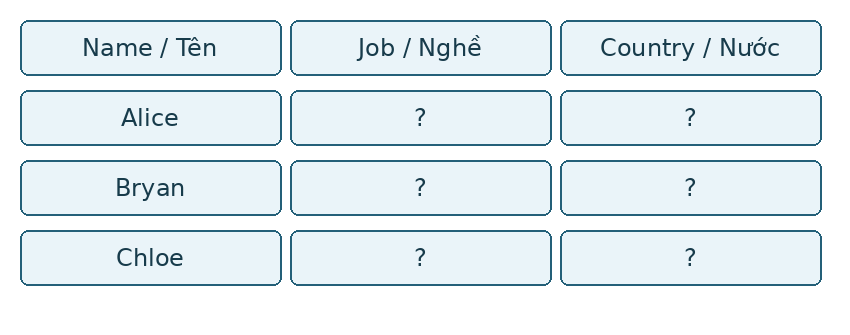
Alice, Bryan and Chloe were born in Korea, Vietnam and Indonesia, in some order, one person in each country. Their occupations are accountant, lawyer and doctor, one of each.
1. Bryan is not the accountant.
2. Chloe is not the lawyer.
3. The accountant was not born in Indonesia.
4. The lawyer was born in Korea.
5. Chloe was not born in Vietnam.

What is Bryan’s occupation, and in which country was he born? Enter occupation; country, in English or Vietnamese.

Question illustration

Question illustration

Question 17

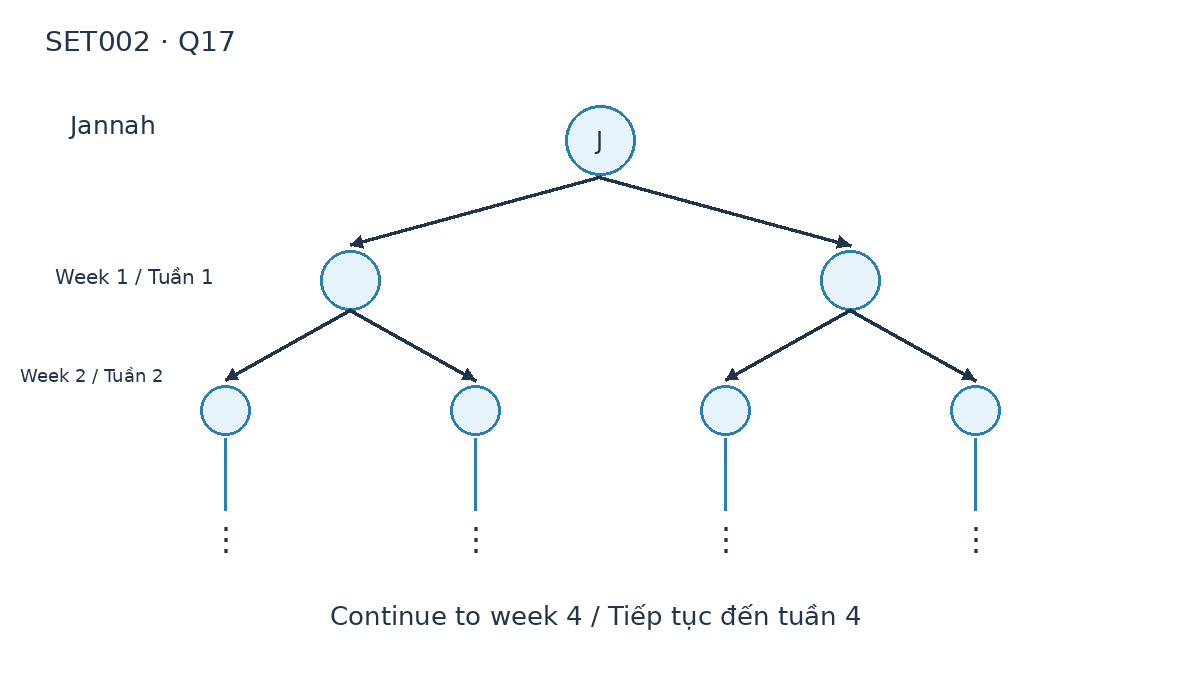
Jannah starts a movie club at school. In the first week she recruits two members. From the second week onward, each new member recruited in the previous week recruits two new members. How many club members are there after four weeks, including Jannah?

Question illustration
  1. 16
  2. 30
  3. 31
  4. 32
  5. None of the above

Question 18

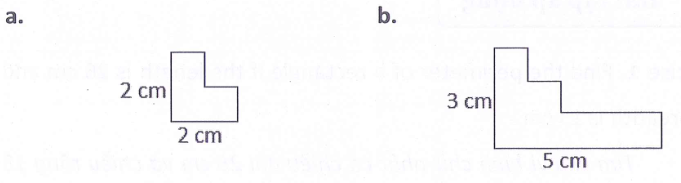
Find the perimeter of each of the two figures (a) and (b). All corners shown are right angles. Enter the two perimeters in cm, in the order a; b, separated by a semicolon.

Question illustration

Question 19

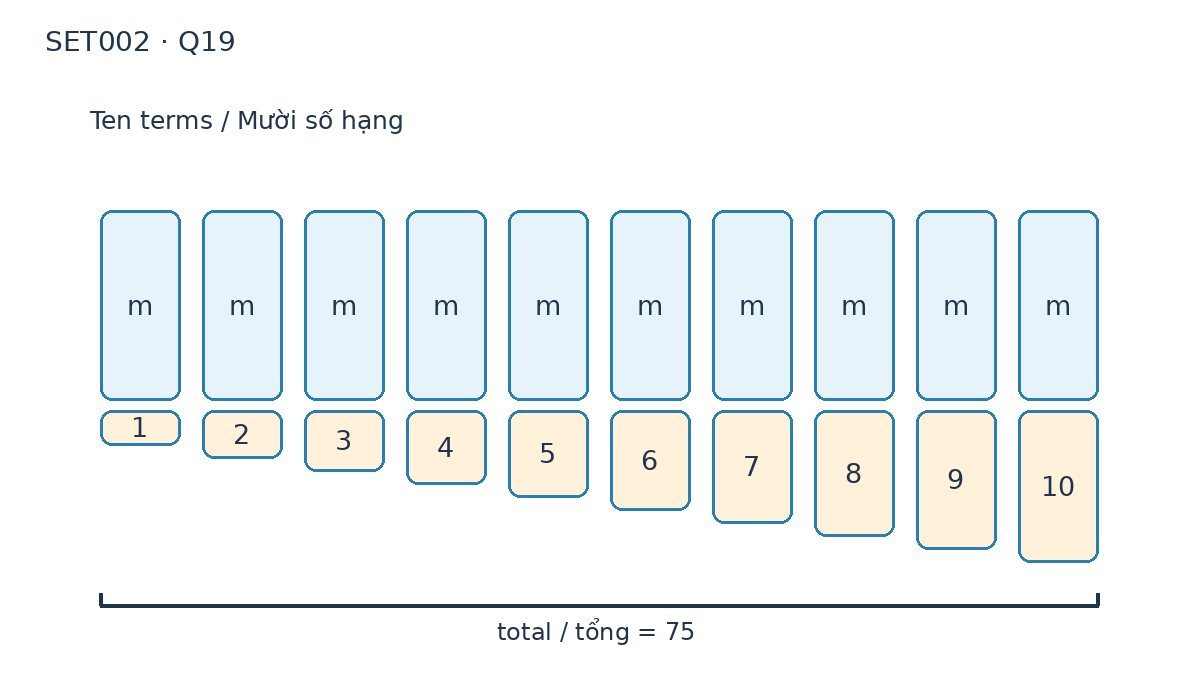
The operation $*$ is defined by $a*b=(a+1)+(a+2)+\cdots+(a+b)$. Find $m$ if $m*10=75$.

Question illustration

Enter the numerical answer only.
Question 20

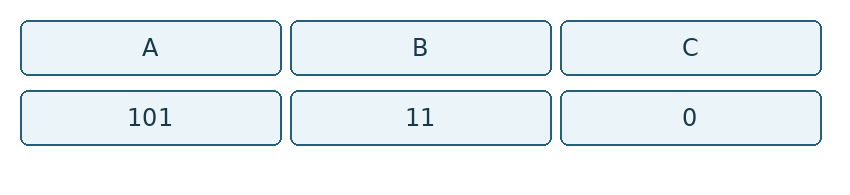
Leon encodes a string consisting only of A, B and C by replacing A with 101, B with 11, and C with 0. The resulting digit string is 110101101110101. How many letters were in the original string?

Question illustration

Enter the numerical answer only.