Editorial self-study SET for 2027; not an official SASMO 2027 examination. Known source years remain in individual attributions. Time: 90 minutes. Platform scoring starts at 0: Q1–15 are worth 2 points each; Q16–25 are worth 4 points each; wrong and blank answers score 0; maximum 70. Official SASMO scoring instead starts at 15, deducts 1 for an incorrect Section A answer and has a maximum of 85. Verified means editorially checked; assumptions, source errors and mathematical uncertainty are disclosed where relevant.
Whenever the hour and minute hands of a clock coincide, the number of germs in a dish increases by 10. Between 7:30 a.m. and 11:30 a.m. on the same day, by how much does the number increase? Use an ordinary clock whose hands move continuously.
The two source keys disagree. Use the stated interval and actual clock-hand meetings; the disagreement is explained after answering.
Andy starts with 3 pieces of paper. He tears each into 5 smaller pieces, then takes some smaller pieces and tears each of those into 3 pieces. He continues tearing chosen pieces into 3. Can he finish with exactly 50 pieces? Enter Yes or No.
Jason, Adam and Tom are siblings. Their ages, in some order, are 6, 9 and 10. Tom’s age is a multiple of 3. Jason is younger than Tom. How old is Adam?
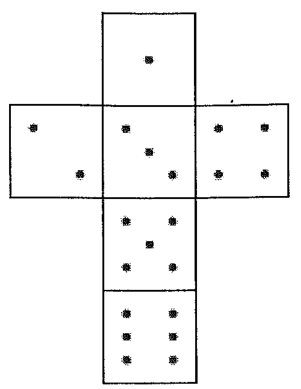
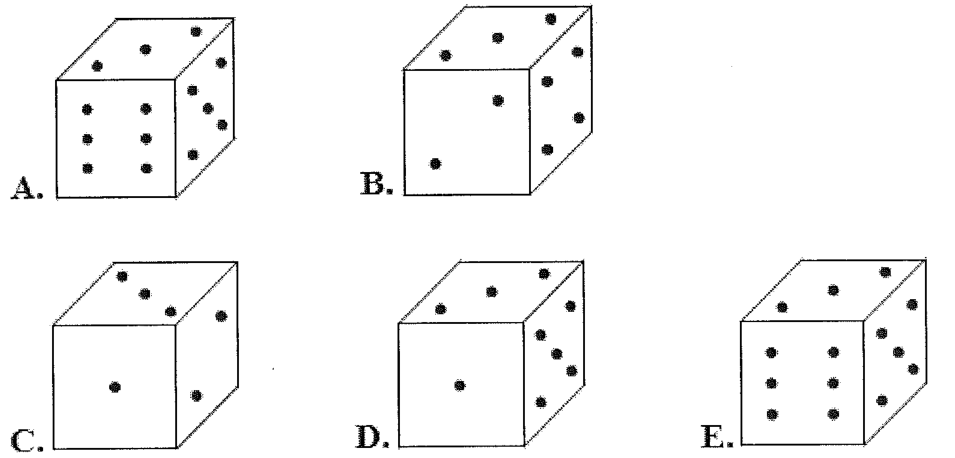
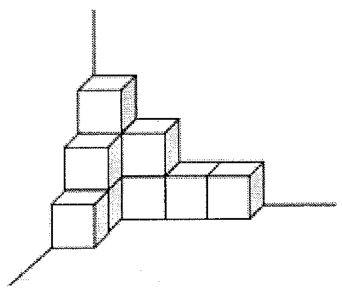
The diagram shows equal-sized cubes stacked at a room corner. How many cubes are there altogether? The floor is horizontal and both walls are vertical. There are no gaps or holes behind the visible cubes. The lesson asks for the number; the paper versions provide choices A–E.
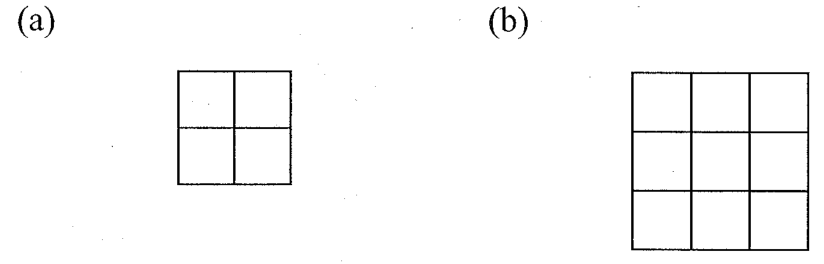
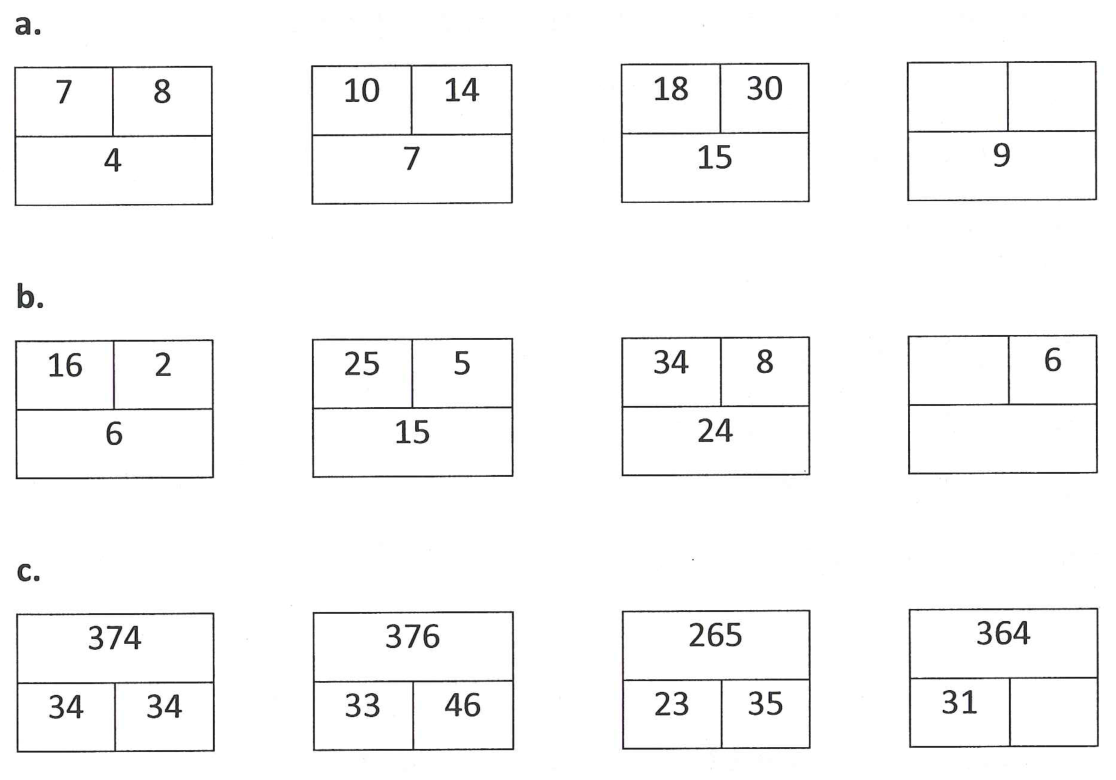
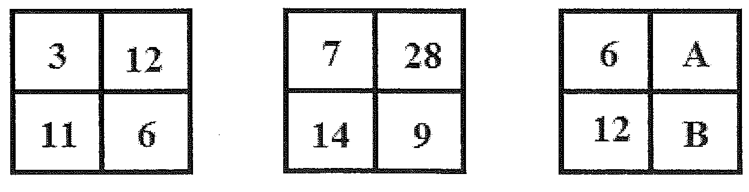
Fill every blank in patterns (a), (b), (c). Follow the simple intended relationship within each group. Enter the five missing numbers in this order: (a) upper left, upper right; (b) upper left, bottom; (c) bottom right, separated by semicolons.
Find the sum of the three numbers in the 50th group of the pattern: (1, 1, 2), (2, 4, 12), (3, 9, 36), … Use the simple intended rule for the three positions.
Paul is taller than Joe. William is shorter than Paul. Eddie is taller than William but shorter than Joe. Rank all four children from tallest to shortest. Enter names separated by semicolons.
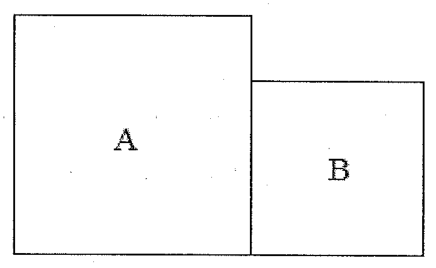
The sum of the areas of squares A and B is 202 square centimetres. They are placed side by side with bottoms aligned, as shown. Find the perimeter of the combined figure, in centimetres.
For this self-study version, assume both square side lengths are positive whole numbers of centimetres and A is larger than B. The source does not explicitly state this assumption.
Bob wants to buy two balls of different colours. The shop has orange, yellow, white and red balls. How many different two-colour combinations can he choose? The order of the two balls does not matter.